



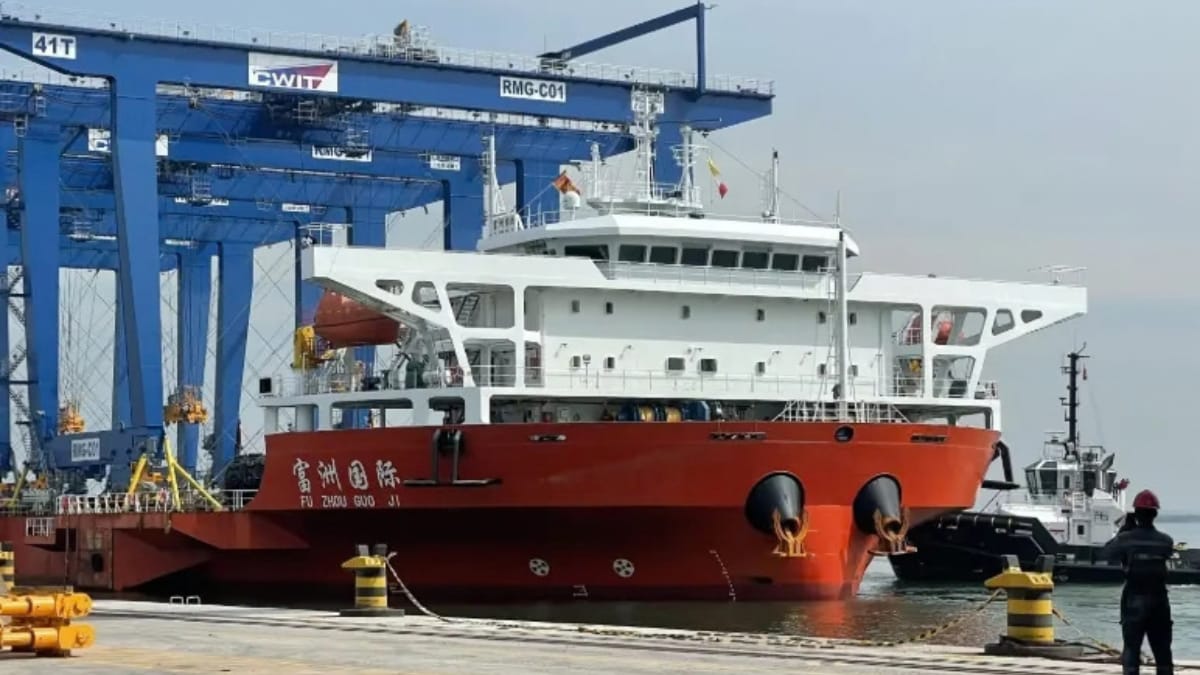
The Colombo West International Terminal (CWIT), a key Adani Ports-backed container terminal within the Colombo Port in Sri Lanka, has just replicated an important milestone that the Vizhinjam Port achieved earlier this year.
Building on its earlier record as the fastest terminal to handle 1 million TEUs within its inaugural year in 2024, the CWIT went on to achieve a cargo throughput of 2 million TEUs within its first 18 months in operation.
Adani Ports and Special Economic Zone (APSEZ), which is the majority stakeholder in the consortium that manages Sri Lanka's first fully automated deep-water container terminal, announced the news on Wednesday.
What makes this a major development is that same 18-month milestone that took the whole of Vizhinjam Port was single-handedly achieved by the CWIT.
Yet, the terminal and the port are as much siblings as they are competitors, as the Vizhinjam Port is also managed by Adani Ports via its subsidiary, Adani Vizhinjam Port Private Limited (AVPPL).
APSEZ also announced on Wednesday that Sri Lankan PM Dr Harini Amarasuriya inaugurated the $750 million phase two expansion of the terminal, in a bid to have the CWIT handle about 25 per cent of the Colombo Port's throughput target of 13 million TEUs by 2028.
"Reaching 2 million TEUs in record time and commencing Phase II today is not just a milestone for the Port of Colombo, but a milestone for our nation's economic future," the Sri Lankan PM said in a statement.
The Vizhinjam Port in Thiruvananthapuram is no small beast either, as it is still the fastest Indian port to cross the 2-million-TEU milestone in the 18 months since it began operations in 2024.
The port had already handled over 950 vessels—including 67 ultra-large container vessels (ULCVs)—by May 2026, when APSEZ announced the 18-month milestone.
Just weeks later, and well within the two-year mark, the Vizhinjam Port had also berthed its 1,000th ship, the massive mothership MSC Luciana.
A few more months later, the port officially began export-import (EXIM) operations, adding to APSEZ's plans for a ₹10,000-crore phase two expansion of the port, under which its berth will be expanded from 800m to 1,200m by 2027, and then to 2,000m by 2028.
