



As India accelerates its push for green shipping, global leaders in towage have made a marked turn towards the country's shipyards.
In an exclusive interview with THE WEEK, Danish towage giant Svitzer's Chief Operating Officer (Global) Kasper Karlsen and Managing Director (AMEA) Deniz Kirdar True discussed their expanding footprint in India, the growing competency of the shipyards here, and the future of green shipping in the country. Excerpts:

Q/ What makes a TRAnsverse tug more adaptable to Indian harbours than, say, a regular azimuth-powered tug?
Kasper: The combination of hull lines and the placement of the thrusters, one aft (near the back), one in the front, makes it very manoeuvrable, so it can exert higher forces on the vessel than a normal ASD tug, so that we can, with a smaller vessel, apply greater forces on the vessel that we are assisting.
This, in turn, means that we can manoeuvre in constrained waters and also apply forces at multiple positions around the vessel, making the whole operation more efficient.
Q/ Why did you choose CSL—a public-sector enterprise—for electric tugs and private player Swan Defence for biofuel/heavy tugs?
Kasper: At Svitzer, we are currently building from six different yards globally, and the ambition is to build 20 tugs a year from now on, which also means that we need to diversify our choice of yards.
When we go out based on vessel demand, we listen to our market—our customers’ needs—and then translate that into the specifications of the tugs, after which we go to the market in the tender phase and qualified yards like SDHI and CSL place bids. There is then a procurement and technical follow-up phase afterwards, leading up to the choice of yards.
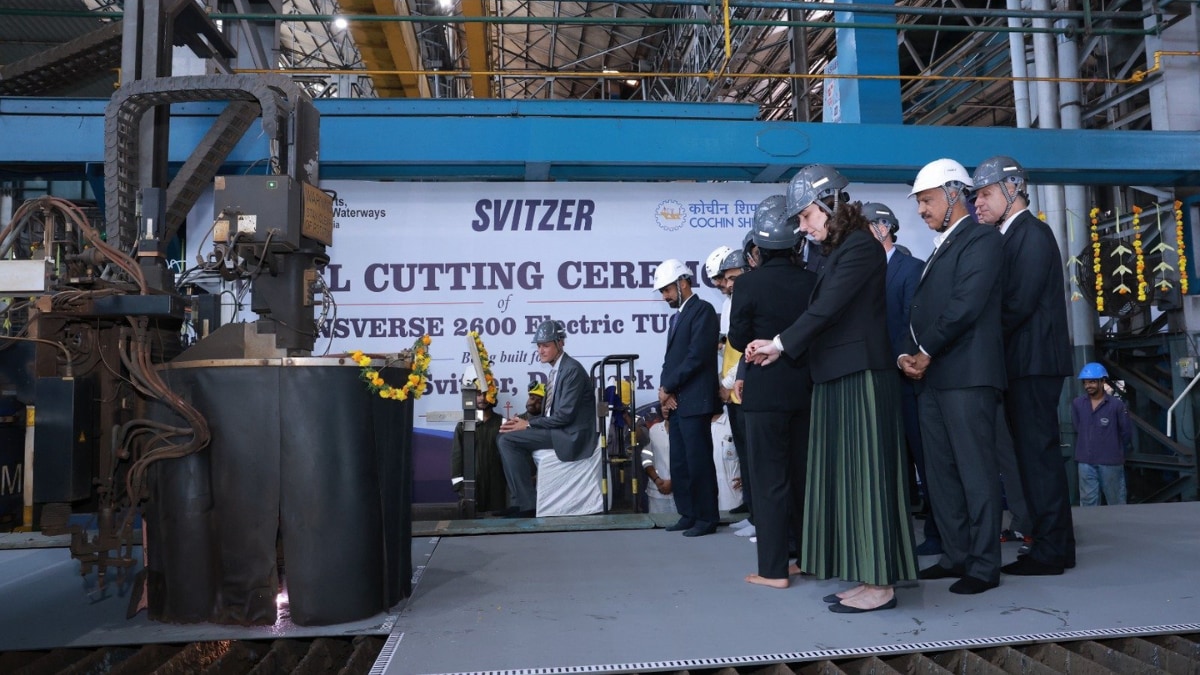
For the electric tugs, we chose CSL because of their experience with fuels of the future and the construction of complex vessels. You see, the combination of the TRAnsverse design and battery electricity is still a new concept, based on proven building blocks, but at the same time an advanced project, and we believe that Cochin Shipyard was best placed to take it up. We look forward to future collaborations with them as well.
Q/ Is India just an operational market for Svitzer, or are you using it as a global base for manufacturing green tugs?
Deniz: So far, Gujarat's Pipavav—India's first private sector port—is the (sole) operation we have in India, that also comes with some challenging weather, tide, and draft conditions. So, it's really important for us to deliver reliable and safe services there. We also have plans to support that port's growth.
Kasper: The shipbuilding industry in India is at a really good level, and when we then look at future fuels and electrification, there is definitely a scope for future partnerships as well.
Deniz: Svitzer's decarbonisation goals also match really nicely with India's Maritime Amrit Kaal Vision 2047 and the Green Tug Transition Programme (GTTP). It is from this sweet spot that we can do something meaningful to bring about progress in both of our agendas.
Q/ Are Indian ports ready though, infrastructure-wise, in terms of shore power, green tariffs, and policy backing for these green tugs?
Deniz: I think the ambition is there—definitely the desire.
There is a lot of openness to try new things, and with a strong shipbuilding policy in place, there are incentives for operators and yards to do something on this front, though I feel policies on shore power could perhaps catch up and work hand-in-hand with that, because tugs are typically only as good as the shore infrastructure allows.
Still, there is a lot of interest and a lot of forward thinking that I've seen across India.
Kasper: It is also important to note that we're building fully-electric tugs here, meaning that they can do the full operation on batteries.
These vessels still have combustion engines—which utilise diesel or renewable fuels such as biodiesel—just in case. In a nutshell, you're not dependent on infrastructure, but of course, in order to go fully green, then shore-based infrastructure is a requirement.
Q/ Policies like the Green Tug Transition Programme, Make in India, and Maritime India Vision 2030 are planning to induct 50 green tugs by 2030. How have they helped shape your strategy? Did you have to rework the strategy at any point during the process?
Deniz: I don't think we have had to rework the strategy: it's been amazing to watch the progress in India, and how the building blocks of the sector are falling into place.
Of course, they could stand to be tailored to more specialised, smaller assets than just big vessels, but there's still quite a bit of incentive for us to come here and build.
Kasper: The reason we didn't have to rework our decarbonisation strategy from 5-6 years ago is the strategic match between us as a company and India as a country in terms of the energy transition and larger maritime goals.
Q/ Looking past this initial wave of green tugs, what is Svitzer's next target for maritime decarbonisation in India?
Deniz: As far as India is concerned, our vision for the future is centred on the entirety of the GTTP and its two phases. It's not just a question of obtaining 50, or 100 tugs over various phases, but also the adoption of these in the country's major ports, and then the non-major ports and related maritime facilities as well.
Our plans are to become part of the wider process as well.
Kasper: On the electrification front, we have also gained experience with biofuels, and eventually plan to deploy vessels powered by hydrogen and methanol once we have sufficient R&D for those tug types.
Our work on the R&D front and deployment is also a question of timing, because India’s progress in other aspects of green shipping, such as green hydrogen and green methanol bunkering, is also expected to create demands that we hope we can contribute to. But, at the moment, it's all a work in progress.
