



Seafood is a delicacy to some and daily sustenance to many. In the last 70 years, global seafood consumption has increased from approximately 10kg of aquatic food per capita in 1961 to 21kg in 2023.
Our taste for seafood has also resulted in global trade generating an estimated $186 billion in revenue in 2024, moving through nearly 230 economic territories. 600 million livelihoods depend on it. However, when we eat our fish and shrimp, we rarely think of this interconnected web that touches so many parts of the global food system.
For most of human history, fish came from wild ocean stock. But ocean stocks are depleting. Wild capture fisheries have more or less stagnated since the 1990s.
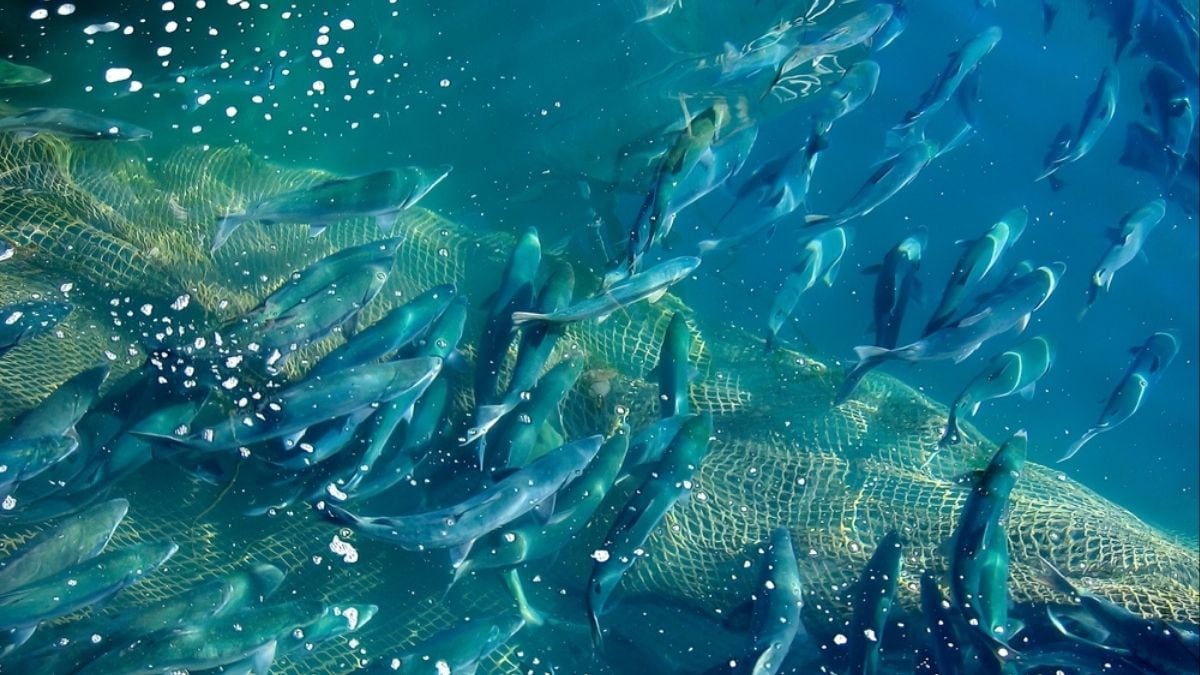
Meeting the global demand has been routed to farmed fish, a promising alternative to overfishing the oceans. In 2024, aquaculture accounted for 60 per cent of global production vs 40 per cent through wild capture fisheries.
With the world's population projected to grow to nearly 10 billion by 2050, aquaculture becomes a key to unlocking food security for millions.
But whether the promise of aquaculture holds depends on one pertinent question: what are we feeding the fish we farm?
For a sector that is supposed to be decoupling seafood supply from the ocean, aquaculture still depends heavily on the ocean. Over 90 per cent of global fishmeal and roughly 64 per cent of fish oil are produced from small pelagic fish from the ocean that goes directly into aquafeed.
Peru alone supplies roughly a fifth of the world's fishmeal. This single input anchors a fragile supply chain.
In 2023, El Niño crashed supply, spiking prices and creating volatility. This year, the latest El Niño forced Peru to suspend the fishing season three times since May, pulling down fishmeal production by an estimated 30-40 per cent with wholesale prices nearly doubling.
We cannot keep treating supply shock as a recurring baseline assumption rather than a tail risk because the consequences surpass aquaculture. Fishmeal and fish oil are key ingredients in animal feed and pet food.
A shock in supply eventually disrupts feed costs and protein prices across sectors.
The encouraging part is that commercial-scale alternatives already exist; they just haven't become mainstream yet. Insect protein is the clearest example.
The global insect-feed market is projected to hit $13 billion by 2036, and aquafeed is already its largest and fastest-growing application.
Insects offer a direct nutritional substitute for fishmeal with high protein concentrations, well-balanced essential amino acids and nutritional parity that comes at a fraction of the ecological cost.
Edible insect farming can use significantly less land and emit much less carbon compared to conventional livestock systems, and with significantly shorter farming cycles, giving it a cost and supply-reliability edge reduction that fisheries can't match.
There’s also a marked role for the Global South to play in this transition with its deep-rooted insect traditions, favourable climate and the ability to build capacity locally.
Promising developments in regulation and policy are also accelerating global adoption. Norway's salmon industry has set a target for a sustainable feed supply chain. Regulators across the world have authorised insect protein in aqua and animal nutrition.
None of this points toward eliminating fishmeal outright. What we are looking at is blended feed formulations combining fishmeal with insect proteins and other alternatives, optimised ingredient by ingredient using data and nutritional science rather than a single dominant input.
What accelerates the transition from here is less about science and more about practical levers: clearer regulatory approval pathways for novel feed ingredients and targeted incentives for sustainable feed innovation. Aquaculture will definitely grow; that’s not in question. The question is whether it grows by continuing to let fragility become a part of the system or by building resilience into the system starting now.
The writer is CEO and co-founder of Loopworm.
The opinions expressed in this article are those of the author and do not purport to reflect the opinions or views of THE WEEK.
