



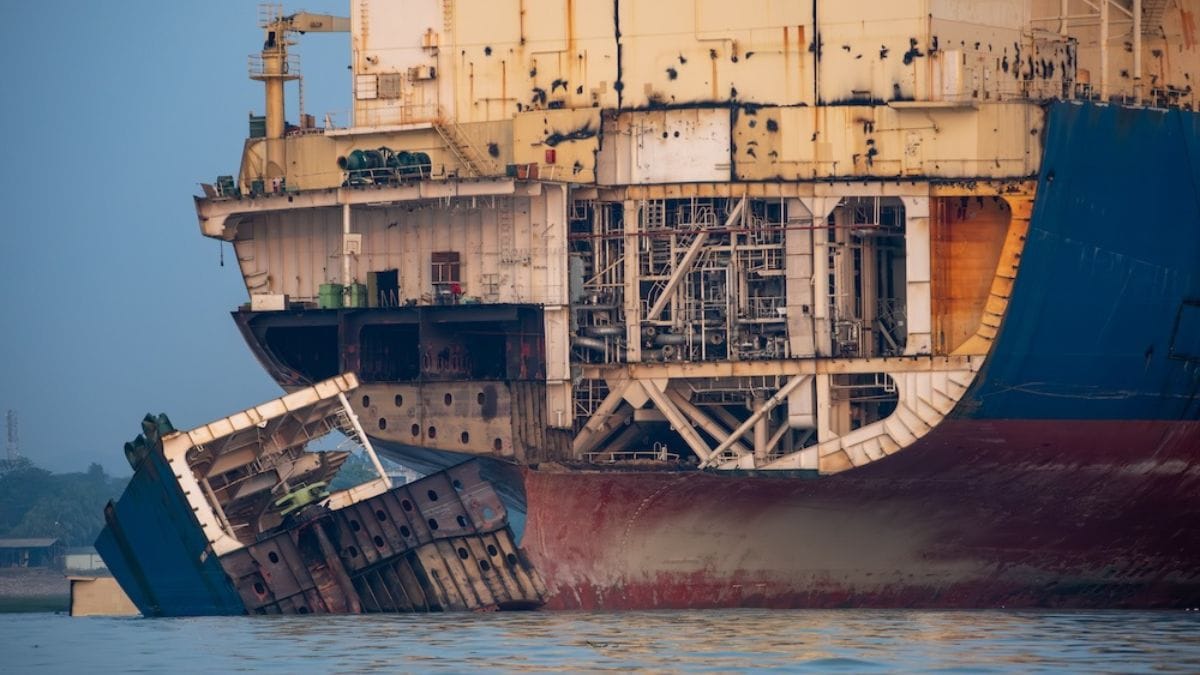
The European Commission's (EC) proposal to include two Indian ship recycling yards on its European List of Ship Recycling Facilities is being met with fresh pushback from a ship recycling NGO.
It had proposed that two Indian yards—the Shree Ram Vessel Scrap Pvt Ltd/Shree Ram Shipping Industries Pvt Ltd (Plot no 78/81) and YSI Recyclers LLP (Plot No 59)—be a part of the 16th edition of the European List of Ship Recycling Facilities under the European Union Ship Recycling Regulation (EUSRR) framework.
This would finally allow ships carrying flags from the EU nations to be recycled at these yards—a historic first for India's maritime sector.
However, the NGO Shipbreaking Platform, which has long been a vocal critic of a number of such facilities in South Asia, has said that including these yards in the list "sets a chilling double standard and seriously undermines the EU’s own ship recycling sector", as per a Maritime Executive report.
This has renewed the debate around the beaching method of dismantling ships on mudflats, which the NGO has said poses a serious risk to coastal ecosystems, workers, and supporting communities.
Interestingly, this beaching method is not explicitly prohibited in the EUSRR per se, but is not typically allowed by the EU.
Citing a recent heavy fuel spill in June 2026 at one Indian yard, the NGO also declared that the Indian yards were unable to contain pollutants when breaking ships beached on mudflats.
“The standards of the EUSRR cannot change based on the location. Every yard on the EU List should be subject to the same rules and procedures. If not, compliant yards in the EU will continue to face unfair competition,” explained Ingvild Jenssen, the founder of the NGO.
Jenssen also pointed out that the EU and its member states are signatories to the Basel Convention, which imposes strict controls on the transboundary movements of hazardous waste, a category that includes end-of-life ships.
What comes next?
Pushback from the NGO Shipbreaking Platform comes as the EC seeks public comments on its proposed 16th update of the approved list of ship recycling facilities.
Despite the backlash, the proposed move has also received support from the European Shipowners Association (ECSA), which called it a "welcome step".
Beyond the practical significance, it claims that the inclusion would be a strong incentive for non-OECD yards to meet the EU standards and get on the list.
The Baltic and International Maritime Council (BIMCO) also backed it, noting that the Alang yards had invested heavily in infrastructure, undergone repeated audits, and received an official Document for the Authorisation of ship Recycling (DASR).
A final decision on including the yards in the EUSRR list will be taken after a discussion with EU member states in autumn, as per Jessika Roswall, the European Commissioner for Environment, Water Resilience and a Competitive Circular Economy.
The proposed move would be a big push for the country's maritime sector, and comes weeks after the latest data from the United Nations Conference on Trade and Development (UNCTAD) showed that India had emerged as the world's top ship recycling nation in 2025—five years ahead of its planned target of 2030, in line with the Maritime India Vision 2030.
The UNCTAD data also showed that India's share in global ship recycling had grown from 30.1 per cent in 2024 to 35.4 per cent in 2025—a jump from 1.86 million gross tonnes (GT) to 2.99 million GT over the same period.
Lauding the robust environmental infrastructure and worker welfare measures at Indian yards, Union Minister for Ports, Shipping and Waterways (MoPSW), Sarbananda Sonowal, has said that developments at these yards were part of the goal to recycle about 16,000 ships over the next decade under its comprehensive maritime package of ₹69,725 crore for shipbuilding and ship recycling, approved by the Centre in September 2025.
Specifically, it is the ₹4,001 crore Shipbreaking Credit Note—under this package—that gives those scrapping their vessels at Indian yards a credit equivalent to 40 per cent of the scrap value.
All eyes are now on how the proposed inclusion will play out at the autumn session with EU member states, given that both sides are looking to build on ties with the free trade agreement that is expected to be signed by the end of the year.
