



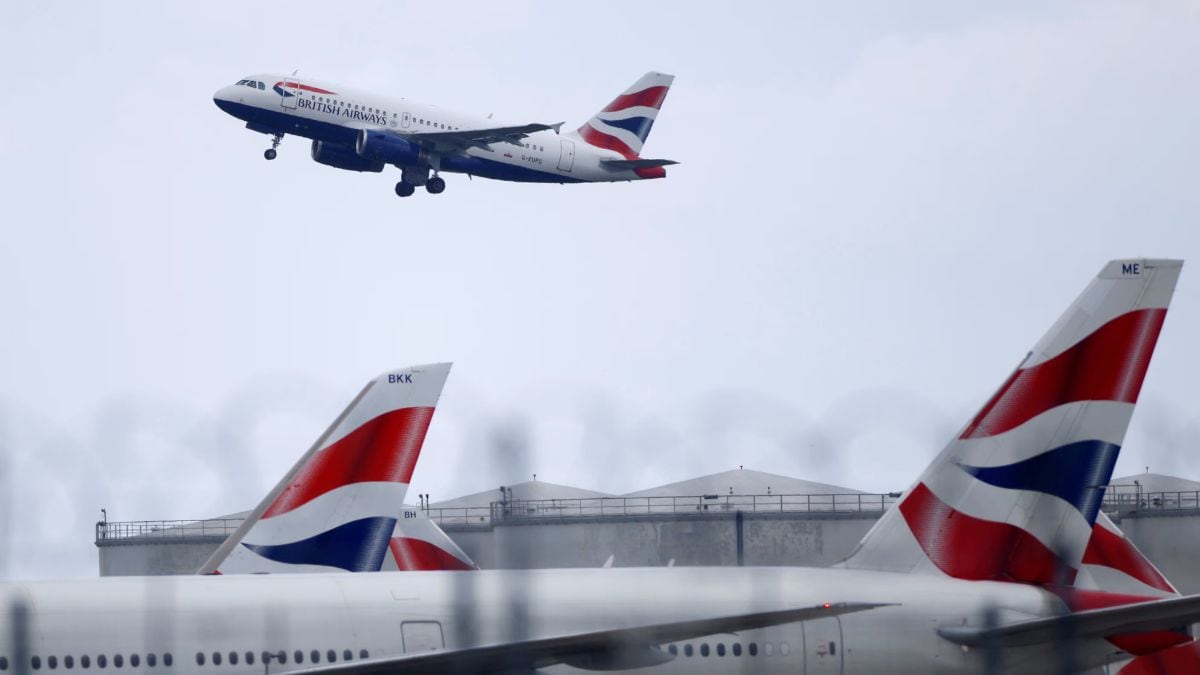
A British Airways flight from London to Chicago on Monday declared an emergency over Ireland airspace as it lost around 28,000 feet of altitude before abandoning the trip and returning to London, shows flight-tracking data.
The flight, BA295, which took off from Heathrow's Terminal 5 in London at 11.50 am GMT, was heading to O'Hare airport in Chicago.
Official flight tracking service Flightradar24 confirmed the incident on X, posting, "#BA295 from London to Chicago squawking 7700 and descended down to 9000 feet above Ireland."
Flight tracking data showed the plane gaining around 37,000 feet altitude before dropping rapidly to nearly 9,000 feet over Ireland. It reportedly sent emergency transponder code 7700 while flying over the Irish airspace.
Reports suggest that the trip to Chicago was cancelled and the Boeing 777 was diverted back to Heathrow airport in London. British media outlets reported that the flight started facing "an unexpected operational issue".
Before landing in Heathrow, the plane was seen flying in circles as it reduced its fuel load before returning to London. However, further details about the emergency was not immediately available.
AIRLIVE reported that as the airport headed to London, the authorities have deployed emergency response teams at potential diversion airports on standby as a precautionary measure.
This comes a week after a flydubai flight from Dubai to Tel Aviv lost around 17,000 feet rapidly while over Jordanian airspace. Later, it turned out that the Omani co-pilot of the flight tried to kill the captain and crash the flight. However, the Indian captain, identified as Smit Machchhar, was able to keep the cockpit door unlocked, allowing cabin crew and passengers to subdue the attacker and stabilise the plane.
On September 30, another British Airways flight from Cyprus to London was forced to make an emergency landing due to a medical incident. The flight, BA711, issued a 7700 squawk code for general emergency. It landed at Luxembourg Airport around four hours into the flight before resuming its route to Heathrow less than two hours later.
