



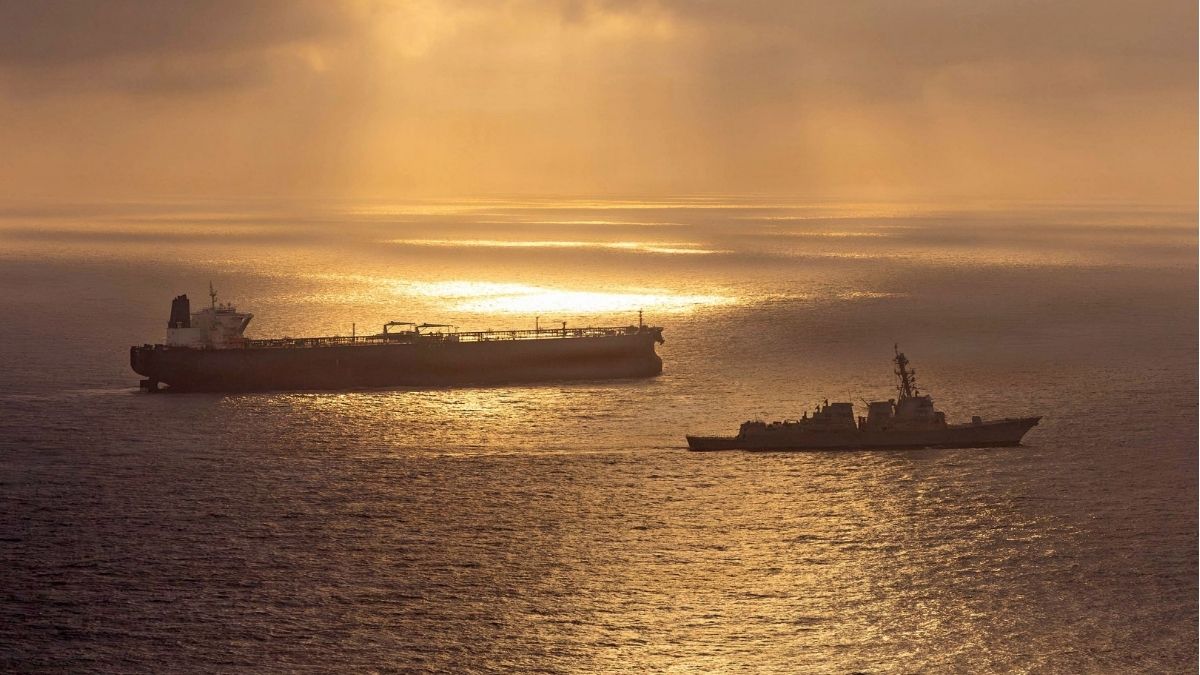
For long in the ongoing US-Iran conflict that began on February 28, it was all about the rain of missiles and screeching drones and their swarms. But with the Strait of Hormuz Strait and its control becoming the central point of tussle between the US and Iran, the prime focus now is on the asymmetric naval war that Iran is waging against the much qualitatively and quantitatively superior US.
And if the truth be told, the threat of lurking Iranian fast-attack crafts and midget submarines all along the Hormuz has proved to be a formidable challenge to the US might. Punching much above its weight, the Iranian navy, also called the Islamic Revolutionary Guard Corps Navy (IRGC Navy), has suddenly assumed a much amplified military dimension.
And in that Iranians are using the terrain to the maximum. The Strait of Hormuz is a complicated bit of geography. It is about 167km long, with the width ranging from 97km at its widest to 39km at its narrowest. But the navigable band is only about 3km wide for inbound and outbound traffic, separated by a buffer.
But it is through that narrow band of water that 20 per cent of global oil and LNG exports pass, with 80 to 130 ships crossing the Strait every day. More than 30,000 tankers cross the Strait every year, with each tanker carrying about one million barrels of oil. It is therefore least surprising that the blockade of the Strait has the world economy in turmoil.
The Iranian coast is a rugged terrain comprising extensively of cliffs, a large number of coves and small islands where small crafts can be hidden, as well as gun batteries can be conveniently placed with a dominating overview of what sails in the Strait. Iran is also reported to have constructed many sea cave tunnels close to its coast. In short, an ideal terrain for Iran to conduct naval wars on the Strait.
What the IRGC Navy has done is to extensively mine the Strait, which may have been planted strategically so as to force maritime traffic towards the Iranian coast in order to exert greater control over the movement of ships.
Iran’s stockpile of mines varies from 2,000 to 6,000, most of them domestically manufactured. Notably, the military utility of a naval mine lies more in its capability to create a fear psychosis. It is a commonly understood fact that while laying a mine is easy, detecting and clearing it is a far more complex and time-consuming job.
Mainly, the two main types of mines have been laid—the 300kg Maham 3 and the 220kg Maham 7—which do not need physical contact with a naval vessel but can detonate their warheads by using magnetic and acoustic sensors to detect when a ship is close by.
Keeping the geography of the Strait in mind, Iran is believed to be operating between 3,000-5,000 fast crafts with the aim of creating a ‘mosquito-fleet’ that can swarm around the big-sized US naval platforms. Unveiled in 2025, the Haidar fast attack craft is capable of reaching incredible speeds of 110knots or 214km per hour. The other fast attack crafts include the Zolfaghar-class (70knots), Peykaap-class (52knots), and the Taregh-class (46knots).
Before the conflict began, the Iranian navy deployed about 20-odd Ghadir-class midget submarines, which are easier to manoeuvre in the Strait and can operate in shallow waters. Reports indicate that while a few midget submarines were destroyed in the joint US-Israel attacks, some remain safely hidden to be used in more opportune circumstances.
The 170m-long Ohio-class and 140m-long Virginia-class nuclear US subs would find it much more difficult to operate in the shallow Strait as they need a draft of at least 11m, while the Iranian Ghadir-class midgets are just 29m long and need a draft of just 2.5m.
The average depth of the Hormuz Strait ranges from 30 to 60 metres, making it difficult for the US submarines to dive deep or to undertake maneuvers, but perfect for the IRGC Navy’s midget subs while on the surface fast-attack crafts undertake hit-and-run guerrilla-style naval attacks.
