



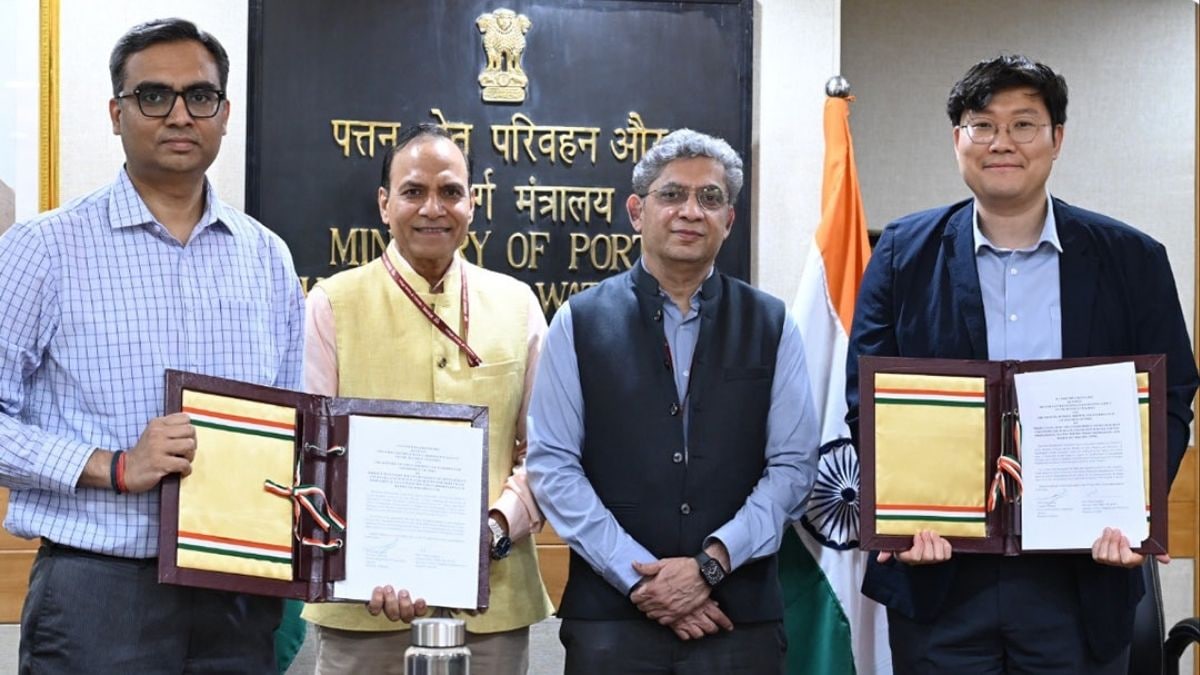
In a move that links India’s long coastline to Korea’s world‑class shipyards, the Union Ministry of Ports, Shipping and Waterways (MoPSW) signed a Plan of Implementation (PoI) with the Korea International Cooperation Agency (KOICA) to strengthen skill development in India’s shipbuilding sector under the Maritime Amrit Kaal Vision 2047.
Announcing the pact on X, the ministry called it “a major step towards strengthening India’s shipbuilding ecosystem”, saying the collaboration will drive workforce planning, advanced training, and create a dedicated Shipbuilding Workforce Development & Technology Cooperation Centre to boost growth and global competitiveness.
According to industry reports, the proposed centre will act as a hub for advanced training, research and technology collaboration, bringing in global best practices from South Korea, home to some of the world’s largest and most efficient shipyards.
The focus areas are expected to include hull design, modular construction, marine engineering, automation and digital shipbuilding technologies, all of which are critical to building large, complex vessels at scale.
The agreement fits into a broader India–South Korea shipbuilding push. Last year, Cochin Shipyard Limited signed a long‑term MoU with HD Korea Shipbuilding & Offshore Engineering to co‑build large tankers, containers and bulk carriers, while Tamil Nadu has unveiled a Shipbuilding Policy 2026 aimed at attracting mega shipyards and creating a specialised maritime workforce.
Under Maritime Amrit Kaal Vision 2047, India wants to move from its current 16th rank in global shipbuilding into the top 10 by 2030 and among the top 5 by 2047, backed by massive investments in fleet expansion and shipyard capacity.
The tie‑up is also expected to bring about more jobs and skills. Shipbuilding is a labour‑intensive industry that can create thousands of direct positions for welders, fitters, designers and engineers, and many more indirect jobs in steel, electronics, logistics and port services. Studies show that countries which combine technology transfer with systematic skills upgrading are the ones that succeed in moving up the shipbuilding value chain, rather than being stuck with low‑value, repair‑only work.
If implemented well, the India–KOICA plan could help ensure that as ship orders rise under Maritime Amrit Kaal, Indian yards are not constrained by a shortage of trained people.
