



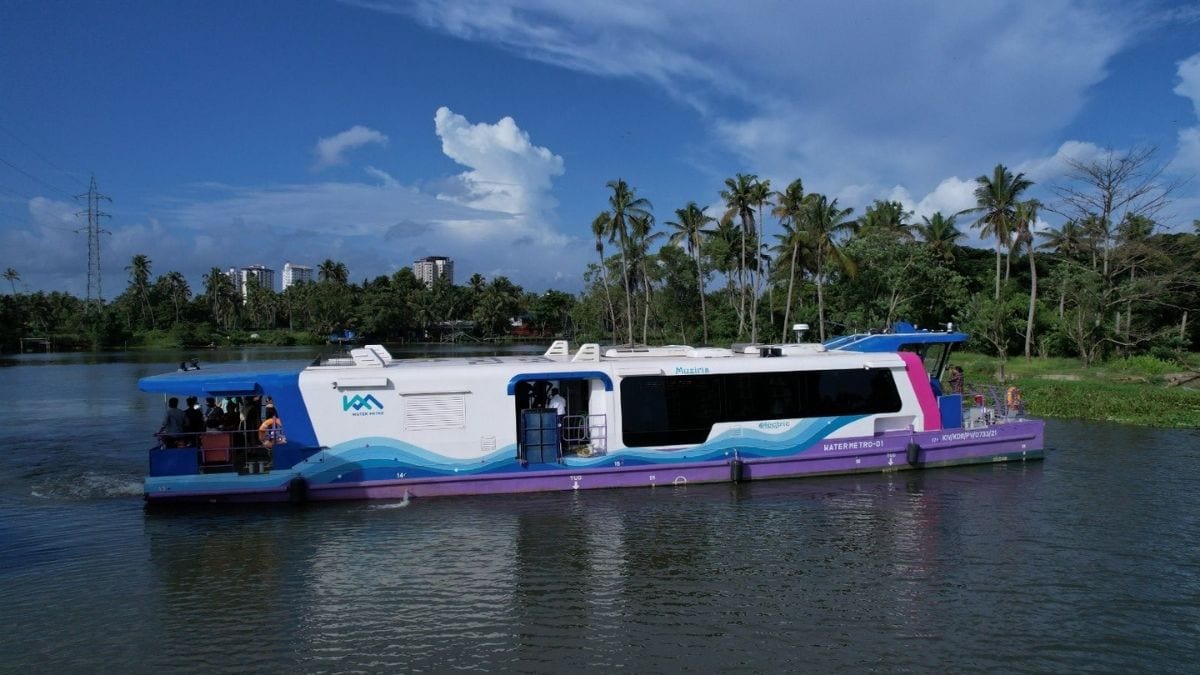
The Ministry of Ports, Shipping and Waterways (MoPSW) on Monday released the draft National Water Metro Policy, as part of the Centre's plan to bring water metro services to 18 cities.
Union Minister (MoPSW), Sarbananda Sonowal, also chaired a review meeting ahead of the release of the draft policy, which will now be discussed by (and between) various ministries involved in implementing water metro services in the cities.
So far, Srinagar, Patna, Guwahati, Varanasi, Prayagraj, and Ayodhya have been chosen to receive water metro services under Phase I of the project, while the second phase will cover Tezpur and Dibrugarh.
The point of the draft policy is to use the success of the Kochi Water Metro as the blueprint for a national framework for urban water transport across cities with navigable inland waterways.
In that regard, the draft policy also shows that it was the Kochi Metro Rail Limited (KMRL)—which had conducted the feasibility study for the Kochi model—that the Inland Waterways Authority of India (IWAI) had roped in to conduct feasibility studies for the 18 cities last year.
So far, Lakshadweep is the only place where feasibility studies have not been completed. Of the 17 cities, Srinagar, Patna, Guwahati, Varanasi, and Ayodhya have also already approved the feasibility reports as well.
“The proposed Water Metro systems are significantly less capital intensive as they utilise existing waterways with minimal civil infrastructure," Sonowal said at the meeting.
He pointed out that the criteria for choosing water metro cities included regions with suitable geographic conditions (including continuous/semi-continuous waterways), populations exceeding one million, and a demonstrated transport demand, particularly in tourist corridors.
"With faster construction timelines, lower land requirements, and reduced operational costs particularly through the adoption of electric and hybrid ferries the system offers a viable and eco-friendly alternative to conventional urban transport," he added.
Indeed, apart from standardising things like vessel designs, capacity benchmarks, and safety protocols, the shipping ministry is also incorporating green technology—hybrid and electric propulsion systems—and periodic upgrades within the policy framework.
Other aspects of the water metro projects that will be standardised nationwide include floating pontoons, modern jetties, terminal architecture, and charging infrastructure.
Multiple funding models are being considered, keeping in mind each state's unique challenges. This includes joint Centre-State funding, fully State-funded projects, Public-Private Partnerships (PPP), and fully Centre-funded initiatives.
The draft policy also sets the ball rolling for discussions on cost optimisation strategies through efficient planning, fleet rationalisation and operational management to ensure long-term viability.
Calling the initiative a “golden opportunity", Sonowal added that the water metro projects should enhance the beauty, reputation, and legacy of cities while delivering world-class and sustainable mobility solutions.
