


 Add as a preferred source on Google

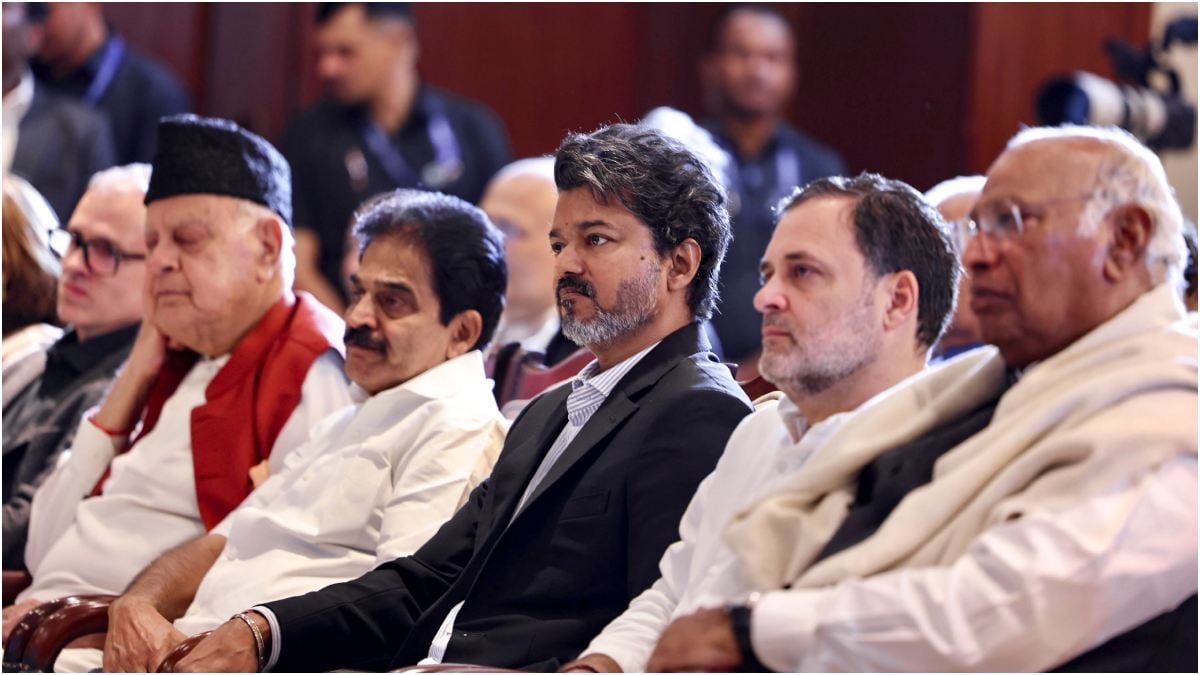
Tamil Nadu Chief Minister C. Joseph Vijay's visit to New Delhi for the launch of Sonia Gandhi's memoir, ‘Belonging: A Journey of Love’, was more than a courtesy call. His presence alongside Congress leader Rahul Gandhi, at a time when the Congress has shifted its political allegiance from the DMK to the TVK, offered a glimpse into the changing equations in Tamil Nadu politics. The conspicuous absence of DMK president M.K. Stalin and the subsequent controversy over an alleged phone call from Rahul Gandhi only added another layer to the changing political equations in Tamil Nadu.
Vijay, who attended the November 16 event following an invitation from Sonia Gandhi and a personal call from Rahul Gandhi, was seated beside the Congress leader. The optics were significant. A party that had shared political space with the DMK for years was now publicly embracing a new political partner in Tamil Nadu.
The controversy began with reports that Rahul Gandhi's office had attempted to contact Stalin to invite him to the event, but the DMK leader did not respond. Stalin said there had been no formal invitation and that the organisers had contacted his personal assistant over the phone. He had conveyed his wishes and sent a letter to Sonia Gandhi, he clarified.
The distinction is politically important. While Stalin has avoided making his absence appear to be a personal snub to Sonia Gandhi, he has made little effort to conceal his displeasure with the Congress leadership. Incidentally, the Congress had lost one of its strongest allies from the South. In fact, sources in both the Congress and the DMK say that, in a closed-door meeting, Congress’s top leadership had expressed regret over the decision with regard to the post-electoral alliance in Tamil Nadu. This meeting with a senior DMK functionary and a leader happened a few months before in Delhi. However, the DMK categorically rejected any attempt to get back into a working relationship with the Congress, let alone an alliance.
The rupture has its origins in the 2026 Assembly election. The Congress, which contested alongside the DMK, had pushed for a larger share of seats and a greater political role. The negotiations strained the relationship between the two parties. After the election, the Congress extended support to Vijay's TVK, which emerged as the single largest party with 108 seats in the 234-member Assembly. The Congress's five MLAs helped Vijay secure the numbers to form the government, subsequently securing two ministerial berths. For Stalin, the Congress's decision was a political betrayal. For the Congress, it was an opportunity to regain relevance in a state where it had long remained a junior alliance partner.
Meanwhile, Vijay’s Delhi visit also came amid another complication for the Congress—the Mekedatu project. Vijay's government has opposed Karnataka's proposed dam across the Cauvery, while Karnataka Congress leaders, including Chief Minister D.K. Shivakumar, have defended the project. This places the Congress in an uncomfortable position, having to balance its partnership with Vijay against its government's stand in Karnataka.
The DMK has sought to use this contradiction to question the usefulness of Vijay's new political proximity to the Congress high command. Being photographed alongside Rahul Gandhi, it argues, does not necessarily translate into political gains for Tamil Nadu.
For the DMK, the episode is also an opportunity to establish itself as a credible opposition force after losing power. It wants to remind voters that the Congress abandoned a long-standing alliance when a more immediate political opportunity emerged. The larger question is whether Rahul Gandhi can maintain working relationships with both Stalin and Vijay. The book launch may have celebrated Sonia Gandhi's memoir, but its political subtext was unmistakable - Tamil Nadu's old alliance equations are being rewritten, and the Congress is at the centre of that realignment.
