



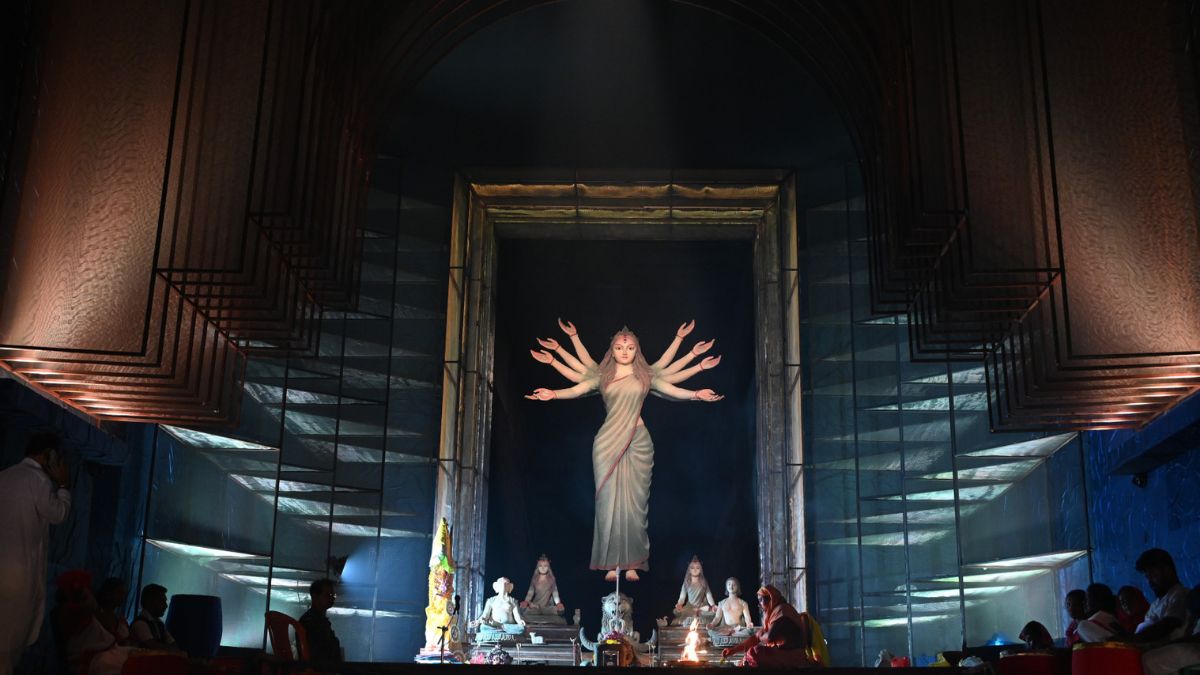
The vermilion was bright, the embraces lingering, but the sadness was hard to conceal. On Vijaya Dashami, married women gathered before Goddess Durga with their baran dala, a ceremonial tray carrying sweets, betel leaves and sindoor.
They offered these to the goddess before smearing vermilion on her face and each other in sindoor khela, the ritual farewell that blends celebration with the sorrow of parting. The deep, resonant beats of the dhak, a traditional Bengali drum, filled the air as women danced in circles, laughter mingling with tears.

In West Bengal, Goddess Durga is Uma, the daughter who leaves her home in mythical Mount Kailash each year to visit her parents and loved ones. On Vijaya Dashami, she returns to her divine abode, leaving behind the ache of a daughter’s departure. As the idols begin their journey towards immersion, Bengalis bid her goodbye with a familiar promise: Asche bochor abar hobe (she will return next year).
This year, however, the farewell carries a heavier heart. The stampede at Kolkata’s Chorbagan Sarbojanin Durga Puja on October 17, which killed 19 people and injured 25, cast a long shadow over the celebrations. The tragedy raised painful questions about crowd management and public safety at a festival that draws enormous numbers of people onto Kolkata’s streets.
The unease extended beyond the loss of lives. Allegations that Left parties’-affiliated book stalls had been vandalised at several locations brought politics into a festival whose neighbourhood celebrations have traditionally drawn people across ideological lines. Disputes over the influence of organisations in community pujas added to the sense that the festivities had become entangled in contests over control and visibility.
The political responses exposed differences within the ruling Bharatiya Janata Party (BJP). West Bengal Chief Minister Suvendu Adhikari questioned why Left parties that did not participate in religious rituals should set up stalls outside puja pandals, suggesting they sell books from their party offices instead. State Finance Minister Swapan Dasgupta condemned the alleged vandalism, arguing that ideological differences could not justify destroying books or book stalls. BJP state president Samik Bhattacharya also distanced the party from the attacks.
Intellectuals and cultural figures, too, took to social media to express their disquiet. For many, the issue went beyond party rivalry.
West Bengal has a long tradition of political argument, literary engagement and public debate. Book stalls at puja pandals have been part of that culture, bringing ideas and literature into the heart of community celebrations.
The para puja, or neighbourhood celebration, rests on a simple premise: people come together to raise funds, build pandals and share the festivities, whatever their political affiliations. When that shared space becomes a site of confrontation, something of the festival’s spirit is lost.
Yet, on Vijaya Dashami, the rituals continued. Sindoor-streaked faces, tearful embraces and the final beats of the dhak accompanied the goddess on her way to immersion. The sadness was real, but so was the hope that has sustained this annual farewell for generations.
Asche bochor abar hobe. The words carry West Bengal’s promise to welcome Uma home again, but this year they also hold a wish that the next Puja will be safer, more harmonious and free from the disputes that clouded the celebrations.
As the goddess departs for Mount Kailash, West Bengal lets her go with a prayer that, when she returns, the streets will be brighter, the festivities more joyful and the spirit of togetherness stronger.
