



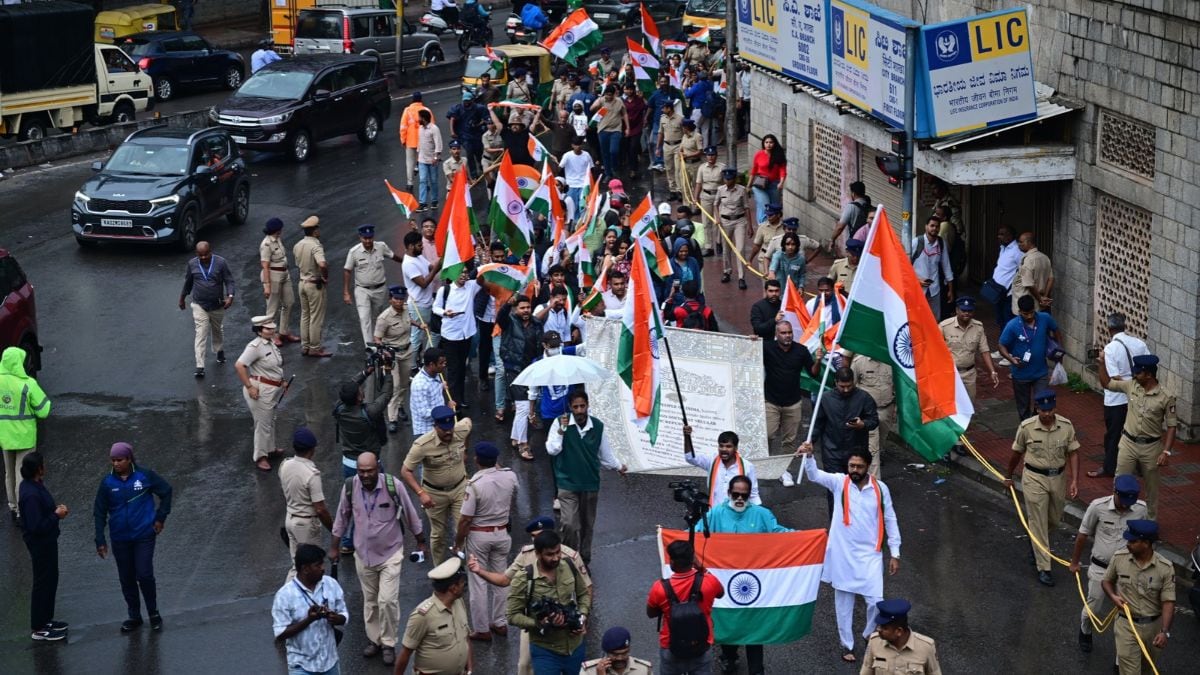
More than a hundred Cockroach Janata Party (CJP) supporters marched in Bengaluru on Friday, carrying the national flag from Town Hall to the Quit India Memorial, in a rally organised in support of CJP national leaders who are detained by Delhi police after they tried to enter Jantar Mantar and unfurl the national flag.
But beneath the sea of tricolours, the march presented the city police with a dilemma: no protests are allowed on Bengaluru roads other than the designated protest area. The restrictions on public protests in non-designated areas are enforced after a Karnataka High Court order on demonstrations.
Meanwhile, CJP founder Abhijit Dipke is detained in Delhi while going to Central Park in Connaught Place. The Tiranga March in Bengaluru took place amid intermittent spells of rain that have been lashing Bengaluru since Thursday. The showers, however, did little to deter the participants, who continued their march carrying the national flag and walking between police ropes to allow Bengaluru traffic to move. Four deputy commissioners of police, five assistant commissioners of police and 300 police personnel were deployed for double the number of protesters.
The police initially hesitated to allow the procession, apprehending that what had been planned as a peaceful march could turn into a demonstration against the Union government and the Special Intensive Revision (SIR) of electoral rolls. Against the High Court’s directions, public protests in Bengaluru can take place only at Freedom Park.
After negotiations, and possibly following directions from the Karnataka government, the police eventually permitted the procession on the understanding that it would remain a framework of a peaceful march, with participants carrying the national flag. The agreement, however, was tested when some participants began raising slogans against the Union government and the Election Commission of India.
Police personnel intervened and attempted to curb the slogans, seeking to ensure that the procession remained within the agreed framework. The organisers were also instructed not to display placards, posters or banners, or raise slogans that could disturb public order. Slogans against any political party, organisation, community or individual were prohibited. The police further directed the organisers to ensure that the gathering and procession did not obstruct the movement of pedestrians or vehicles.
The march comes four days after the October 12 anti-SIR protest near the Election Commission office in Bengaluru, where police action against protesters, including arrests, drew widespread criticism of the Karnataka government. The handling of that demonstration had raised questions about the state’s response to anti-SIR protests, even as the Congress is fighting against the same exercise.
Participants proceeded from Town Hall towards the Quit India Memorial carrying the national flag. Yet the police response showed that the distinction between a march and a protest remained a sensitive issue for the authorities.
For the police, the challenge on Friday was to balance the restrictions imposed on public demonstrations while still not denying permission to the CJP supporters. As rain swept through the city and darkness covered the streets, the tricolours stood out above the protesters’ heads.
