


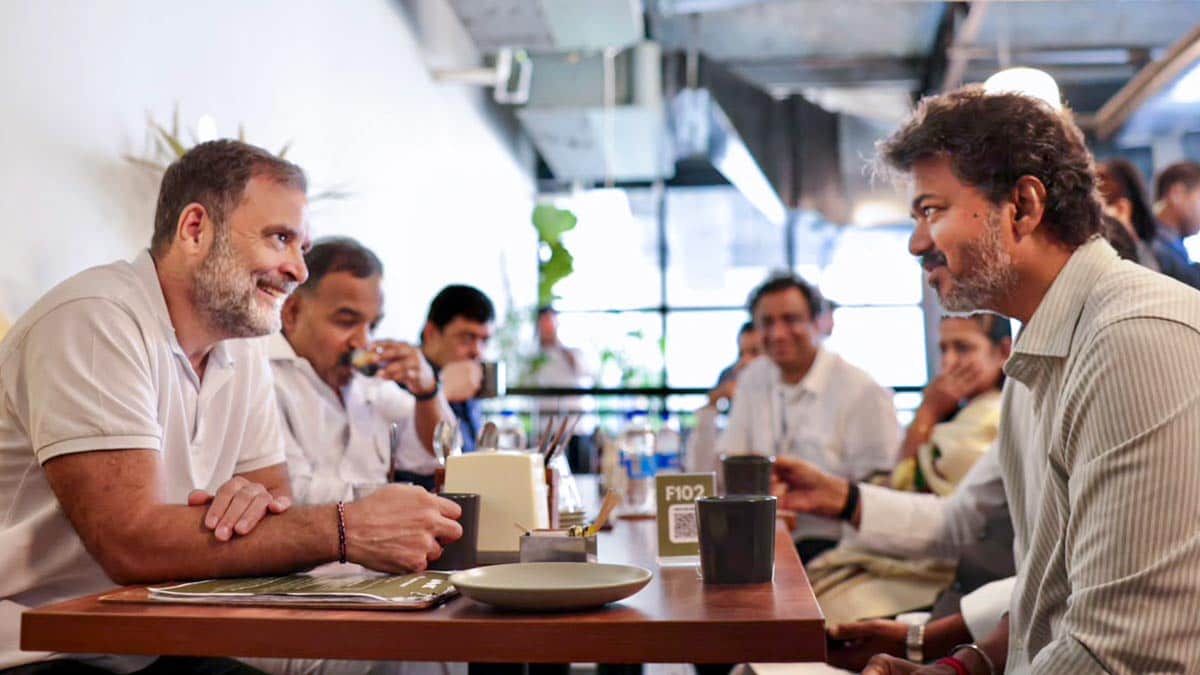
Tamil Nadu Chief Minister C. Joseph Vijay seems to have discovered a new formula for coalition politics: lunch with Rahul Gandhi on Saturday and a metro ride with Narendra Modi on Sunday. If politics is the art of balancing contradictions, Vijay has turned an entire weekend into a masterclass in political tightrope walking.
Saturday was about cappuccino, tiramisu and camaraderie with the Congress MP. Sunday is about sharing a metro coach with the BJP's tallest leader. In less than 24 hours, the actor-turned-politician has travelled between two political poles without publicly clarifying where he stands. If this is political balancing, Vijay has taken it to a new level. If it is political pragmatism, it comes with a generous dose of ambiguity. And if it is a carefully choreographed exercise in keeping everyone guessing, the cameras have certainly delivered enough material for a slew of Instagram reels from a politically eventful weekend.
Vijay’s political vehicle appears to have multiple platforms, but its final destination remains undisclosed. There is nothing inherently wrong with an opposition ruled state chief minister meeting the prime minister as governance requires it. And a lunch with Rahul Gandhi, of course, cannot be treated as evidence of a secret political pact. But the sequence raises a legitimate question as to how political pragmatism turned into the art of political convenience.
The problem is not the meetings themselves, but the absence of an open explanation of what Vijay wants to achieve through them and what the TVK stands to gain. For an actor-politician like Vijay, who built his political appeal largely on his cinematic cult and, more subtly, on the promise of an alternative, these two meetings within a day’s gap raise an uncomfortable contradiction. Apparently, in the new age of politics, Vijay may find it difficult to sell himself as a political disruptor while practising one of the oldest tricks in the political playbook. It seems his strategy is to keep every channel open and remain friendly with everyone, especially since his government does not have a majority.
If Saturday’s coffee can be interpreted as a signal of solidarity with Rahul Gandhi and the INDIA bloc, TVK supporters have presented Sunday’s metro ride as a demonstration of cordial relations with the Union government. The BJP and the RSS, too, feel that the Vijay-led TVK government is less confrontational and not in an agitative mode like the previous DMK government. This could be described as “double diplomacy”. But the trouble with such carefully balanced optics is that they risk making Vijay look less like a statesman and more like an actor-politician perpetually auditioning for every available role. In cinema, ambiguity keeps audiences hooked until the climax. In politics, however, it only leaves people wondering whether they have bought a ticket to a drama without a script.
The contrast becomes sharper as the Congress raises concerns over the Special Intensive Revision (SIR) of electoral rolls and demands accountability from the Election Commission. Apart from a few social media posts criticising the SIR, Vijay has not come up with a strong position on the issue. Nor has he raised his voice against the Modi government's crackdown on young protesters in Delhi. This raises several questions: Where does Vijay stand on the substance of these controversies? What does his party propose on electoral transparency and federalism, and how does it view the relationship between the state and the Union government? A conversation with Rahul Gandhi over a cappuccino may do little to answer these questions, just as a metro ride alongside Modi cannot make them disappear.
Vijay’s supporters may call this smart politics. A new chief minister needs working relationships across party lines, and refusing to engage with national leaders would be neither practical nor desirable. But pragmatism should clarify a leader’s priorities, not obscure them. If every meeting is justified in the name of governance and every political association is defended as strategy, ideology risks becoming little more than a decorative accessory.
There is also a troubling imbalance between image and substance. Vijay’s celebrity status gives him instant visibility. Yet, the more politics revolves around a leader’s movements, the more those movements risk being mistaken for meaningful political messaging. Who had lunch with whom, who shared a metro coach with whom, and who smiled for which camera can overshadow harder questions about public welfare and Tamil Nadu’s demands to the Centre.
Of course, a superstar like Vijay, with a long and successful film career, knows how to command a frame. But people expect a chief minister to demonstrate that he can also articulate a clear political position and explain his path forward, particularly in a state like Tamil Nadu, where anti-BJP sentiment runs deep. Vijay may believe he can have coffee with the Opposition, ride the metro with the prime minister and remain answerable only to his own political calculations. In doing so, he appears equally comfortable in both camps. His political calendar seems to have embraced the principle of inclusivity, even as his ideological itinerary remains a work in progress. But an itinerary can never explain an ideology. In Tamil Nadu politics, the journey matters, but the 1.75 crore voters who voted for Vijay—whether fans, followers or fence-sitters—deserve to know the destination before the next photo-op, not after the credits roll.
Specials
×
Search results for
Coffee with Rahul and a metro ride with Modi: Vijay’s politics of convenience
One weekend, two political poles, and a thousand questions about TVK’s political stance

Disclaimer: Comments posted here are the sole responsibility of the user and do not reflect the views of THE WEEK. Obscene or offensive remarks against any person, religion, community or nation are punishable under IT rules and may invite legal action.
