



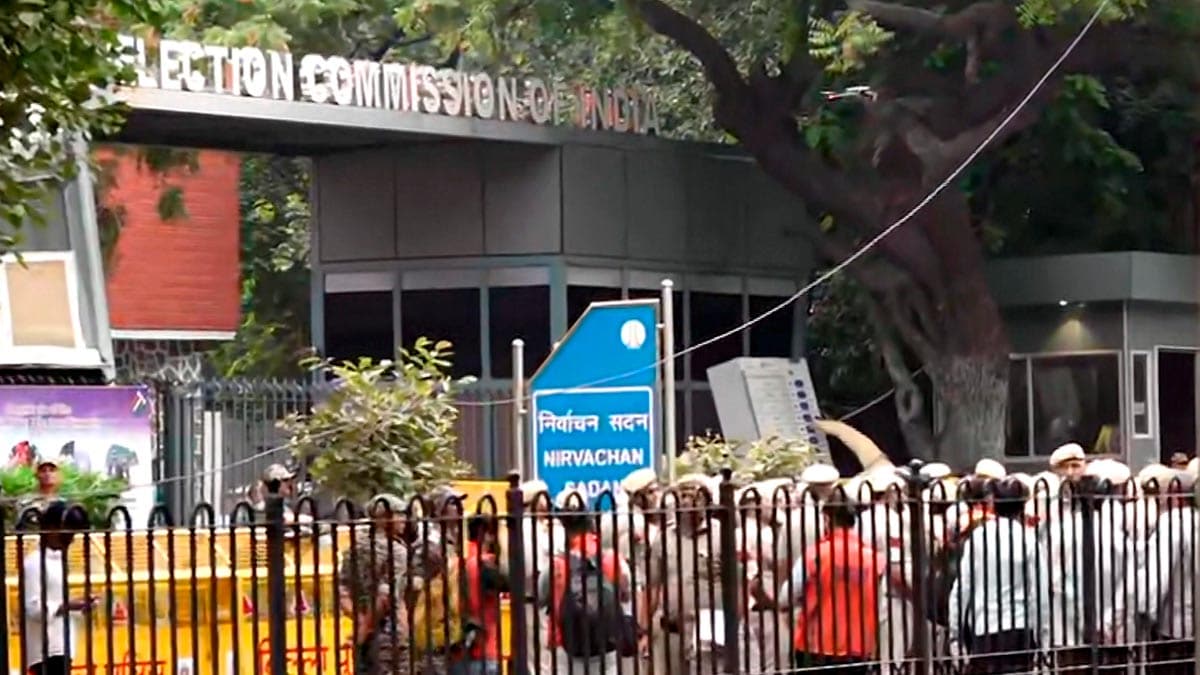
The faces of the policemen say it all. Central Delhi is a fortress. Nearly 23,000 police and paramilitary personnel have been deployed in the national capital, and many of them guard every entry leading to and exiting from Jantar Mantar — the 18th-century observatory built by Raja Sawai Jai Singh that has long doubled as the capital's protest nerve centre.
Jantar Mantar has seen many agitations. This one is different. The target is not a ministry or a policy, but one of the most venerated constitutional bodies — the Election Commission of India (ECI), mandated to ensure free and fair polls in the world's largest democracy.
The broad target is the ECI. The bullseye is the Special Intensive Revision (SIR) of electoral rolls, and Chief Election Commissioner Gyanesh Kumar.
Kumar, a 1988-batch Kerala cadre IAS officer, forms the three-member Commission with Sukhbir Singh Sandhu (1988-batch, Uttarakhand cadre) and Vivek Joshi (1989-batch, Haryana cadre).
For years there have been murmurs about the Commission's functioning — questions about its impartiality and a gradual erosion of public faith. The latest upsurge has been triggered by reports that many decisions of the three-member body were not consensual, with allegations that Kumar bulldozed his way through.
What is striking is the vociferousness. A simple explanation is the reported opacity. There is no visible redressal mechanism, no safety valve to absorb grievances. When institutional channels clog, the street becomes the vent. That is what Delhi is witnessing.
While protests against the ECI have simmered for a month, the October 10 mobilisation is distinct in three ways.
One, from the courtroom to the street. The SIR debate has moved beyond petitions and Election Commission hearings. It now has a face — the CEC. The strategy on the street is clear: push for Kumar's resignation first, then demand a rollback of SIR. The sequence matters.
Two, a leaderless crowd with too many leaders. The protest brings together an unlikely mix — students, unemployed youth, Leader of the Opposition Rahul Gandhi and Priyanka Gandhi Vadra, YouTuber Dhruv Rathee, and citizen activist Abhijeet Dipke, among others. The government is unsure who to talk to. That is both the strength and the weakness of the agitation. Strength, because it cannot be dismissed as party-sponsored. Weakness, because it has no negotiating counterpart.
Three, a new institutional question. When a voter's name is deleted, who bears the burden of proof? The Commission or the voter? The government calls SIR a clean-up of dead, duplicate and illegal voters. Protesters ask: why are those who voted in 2024 getting deletion notices in 2026? The question reframes SIR from an administrative exercise to a citizenship anxiety.
So far the government's response has been largely through the prism of law and order — barricades, detentions, Section 163 of BNSS. That misreads the malaise. This is not a law and order problem. It is a trust problem.
A first step to defuse would be political, not policing: invite the Opposition, agree on a transparent, time-bound verification protocol, and jointly place it before the citizen tribunal. Without that, the protest will travel — from Bengaluru's Freedom Park on October 8 to Delhi on October 10, and likely to Mumbai and Patna next.
The government would do well to remember: how SIR is handled on the streets of Delhi in October 2026 will shape how India votes in 2029.
