



How does getting detained feel? All my life, I have seen people getting detained, arrested and beaten while being carried away in police jeeps and vans in Kashmir. I have never come close to an angry policeman, nor has any policeman charged at me to take me to a police station. But that is the story of my life in Kashmir, where the possibility of getting detained is much higher than anywhere else in India. And I was among the luckiest. When I came to Delhi unscathed, I felt I am chosen.
A few years later, at the age of 32, I was detained for the first time, and that too in the capital of India. Ironically, I was detained for something I didn't do — protest. And then comes the mother of all ironies: I was detained in the capital of largest democracy in the world. Despite my photographer colleague, Kritajna blocking the police's way, they took me anyway because I wasn't carrying my press card. But this also shows the degree to which strict police orders were being enforced, in contrast with the last CJP protest, when the police let people come together and mostly took punitive action. That time, they let people gather and did not confront them much. This time they are too preventive.
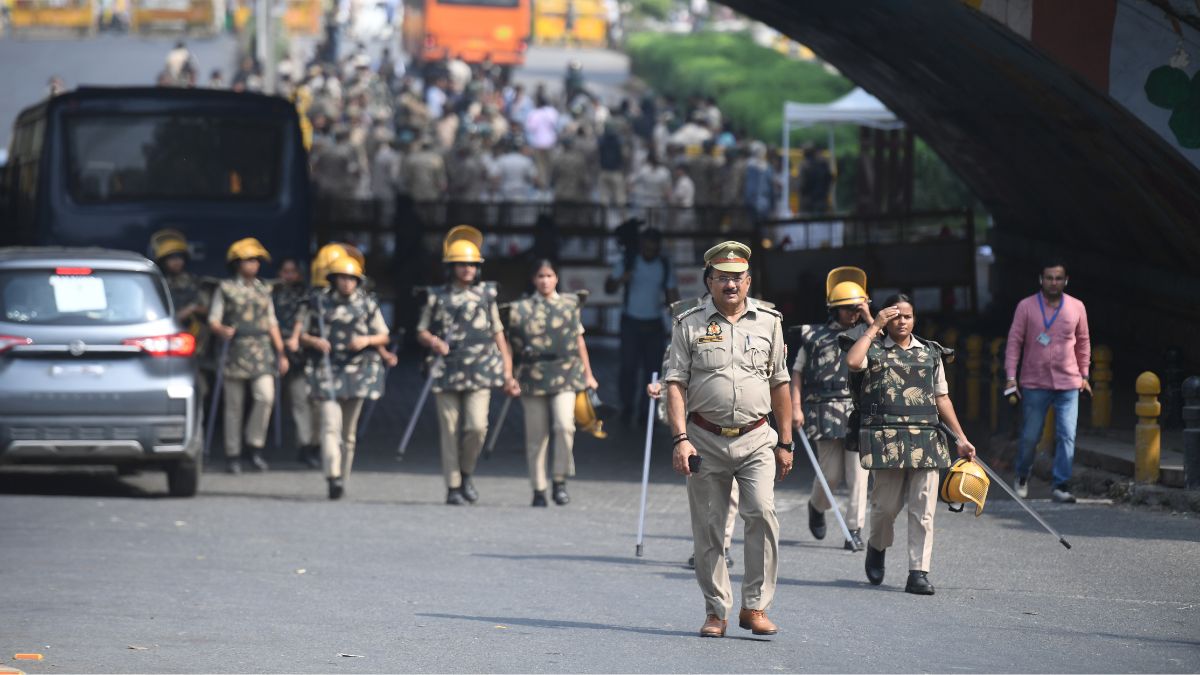
There are more law enforcers on the ground this time. It is a mix of police, CAPF personnel and more. In short, they are the ones who know how to pick people up by their limbs and carry them to buses or other vehicles.
Two policemen will hold your arms, while two others lift your legs by the calf muscles. They do it so smoothly that it looks like they have mastered the technique from the past few months after the Sansad Chalo March in Delhi on July 20. Most of them are peaceful and want to do their job. But a handful were aggressive, deliberately trying to brawl, quarrel and instigate people so that they would respond too.
One policeman came to me and asked me to come into the bus. I said I was a journalist. But another policeman responded, "So what? Where is your ID? Move him into the bus."
Security personnel in Kashmir ask fewer questions and take action more quickly. I have seen the police in Kashmir; they are battle-hardened and make use of their batons. Most Delhi policemen follow orders strictly and refrain from using force. Plus, the media is always there, so they are cautious too. They are aware of the rights of protesting people. The police in Kashmir are less aware of all these things.
Throughout the journey, the police told the detainees that they would be dropped somewhere and not taken to a police station. When they didn't do so, they later said that they were taking us to a police station and that we were under detention.
At one point, a few protesters employed guerrilla tactics and came in front of the bus to rescue us. But the driver was so artful in knocking them off, slowly and forcefully. Let me describe it in detail.
One man, along with a dozen others, came right in front of our bus. The driver had to instantly press the clutch and hit the brakes. As firmly as the man stood in front of the bus, the driver was equally unafraid of confronting him. For a second, he accelerated, and the next second, he stopped the bus. He created such a thrust repeatedly, knocking off young men as if they were zombies. And rapidly picked up speed.
The bus I was in was the last of the few buses in which protesters were detained at the Minto Road flyover. There were 10 of us. Some 100-odd people had somehow gathered at Minto Road. A feat in itself, considering that barricades and checkpoints had been installed almost every 500 metres. Most of the detainees were members or volunteers of left-wing parties.
There was another interesting part. They were detaining men first and taking them away in separate vehicles. Then, when the women police personnel arrived, they took the women too. I was safe until one policeman decided that I should also be in the bus. At one policeman's discretion, I was taken in and became the second man in the group. The first was a shy one. All the others were women.
Next, every woman in the bus was clamouring, "Gyanu, your time is over," along with some extempore slogans against the BJP. A woman police officer asked me, "Are you not with them?" I said no. She went back into her police mood.
One woman spilled water on a seat, and another wiped it. So much camaraderie, and so many comrades. Protesting people show a different level of coherence. There is no "mine" and "thine". There is just "us" versus "them". They work for each other and fight for each other. They all say they will defeat the BJP, and only that will calm them down.
After we had travelled around 10 kilometres, a packed bus carrying protesters just overtook us. As it drove parallel to ours, some men dropped placards through our windows, and detainees on both sides greeted each other from the moving buses. To come out onto the streets requires anger and serious thought. They were genuine protesters, fully anti-BJP, and had no qualms about it. And now they were in buses, I don't think they disliked the journey.
When we reached the Maurya Enclave police station in northwest Delhi, the women police personnel were considerate. The men too. They said, "Don't worry, we will take you where the other detainees are."
I said, "Even if you take me somewhere separately, I can't do anything." It occurred to me that I was not in Kashmir. So I worried less.
That is how it is. Now I am at the police station, waiting for them to release me. They aren't talking much to us, though they are talking to each other.
The "tea seller" inside the police station is nice. He didn't want me to show him the proof of the online payment I had made. He says he trusts me. "Where will you go with my few rupees?" I liked him too.
My experience with the Kashmir police has largely been through my friends, family, local media and relatives who were public officials until recently. But my experience with the Delhi police is hands-on. I remember the visuals around me throughout the journey. Yet, I couldn't observe much because it felt like a regular, casual journey. It was not shocking at all. Otherwise, I would have noticed more details in a magnified way. I cannot do that, apologies for that.
Spending a few hours at the police station felt like home, because my home never treated me like this, even though I had expected it to, forever.
Everyone from my office has been calling me. They are worried, and rightly so. They are nice people. But how can I tell them that the police here are nice too?
"If Delhi police is so nice, then who is oppressing people?" one Muslim woman said.
Another young man is still suspicious. "This is just optics," he says.
Another woman sitting beside me, broke a cracker of a joke. When someone from police came offering a cup of tea, I refused and told him I had it. She intervened and said, "Have, its our own money, we pay taxes for this." That I think was funnier.
