



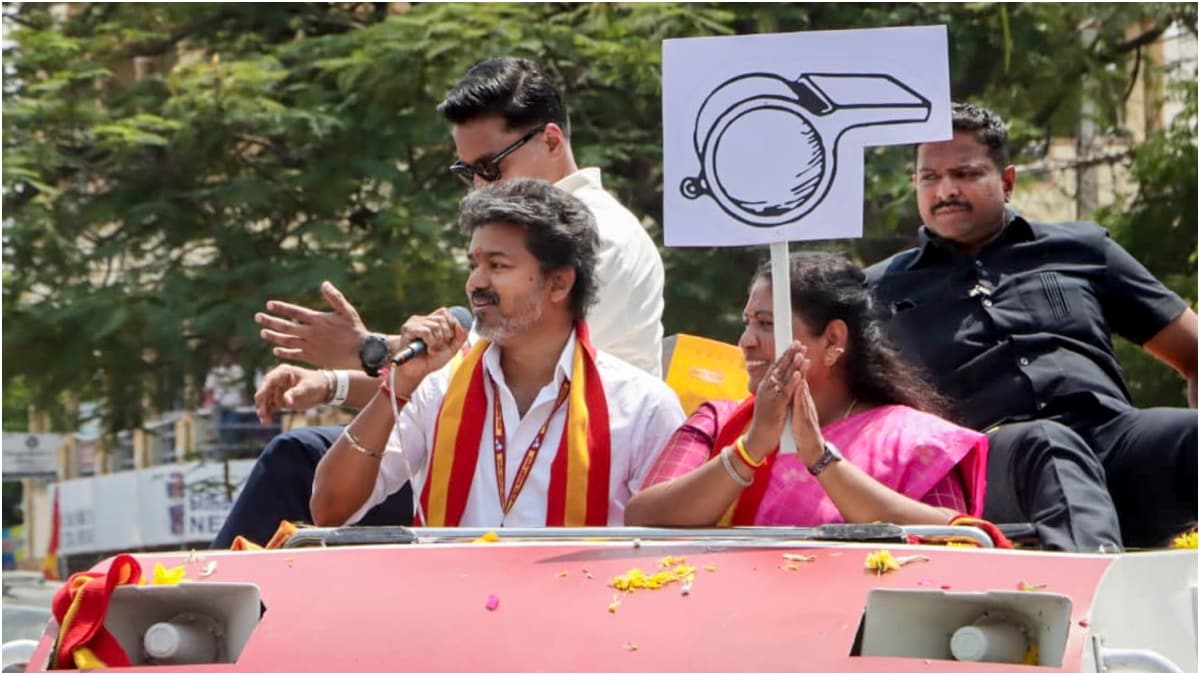
The political irony is hard to miss. Chief Minister C. Joseph Vijay’s Tamilaga Vettri Kazhagam (TVK) has now entered the INDIA bloc in Tamil Nadu, but it is still keeping the national arrangement at arm’s length. The distinction may look technical, but it captures the central dilemma of Vijay’s young party—and the increasingly uneasy position of the Congress in Tamil Nadu.
On October 3, a meeting of the INDIA bloc in Tamil Nadu was organised at Sathyamoorthy Bhavan, the Tamil Nadu Congress Committee (TNCC) headquarters, in Chennai. The ruling TVK formally participated in the first state-level INDIA bloc meeting called by TNCC president B. Manickam Tagore. He called it a “historic day” in Tamil Nadu politics. Ministers Aadhav Arjuna and Marie Wilson represented the TVK, while Vijay was absent.
After an hour-long discussion, it was decided to hold protests demanding the removal of Chief Election Commissioner Gyanesh Kumar over the Special Intensive Revision (SIR) of electoral rolls. The protests will be held in Chennai, where the TVK will also participate.
Yet Vijay is not rushing into the national INDIA bloc. And that is deliberate. The TVK wants the benefits of opposition unity in Tamil Nadu without surrendering its political identity to a national opposition platform dominated by the Congress. Vijay needs the Congress in the state to call his alliance “secular”, while in Delhi he does not necessarily need to become the Congress’s junior partner.
This distinction—taking a stand in the state while choosing to stay silent in Delhi—is important in the context of the SIR. At the all-India level, the Congress party has turned its campaign against Gyanesh Kumar into a national battle over electoral integrity. Its president Mallikarjun Kharge has been insisting that the elections held after the SIR should be called off. The Congress has turned the issue into a broader confrontation with the Election Commission and the BJP-led Union government. It is demanding Kumar’s removal and intensified protests against the revision exercise. In fact, in Kerala, the Congress government had even gone to the extent of registering a vigilance case against Kumar.
For Vijay, however, this political calculation is more complicated. The TVK wants to oppose the SIR without necessarily embracing the Congress’s demand to remove Gyanesh Kumar. In fact, minister B. Rajmohan also said openly that the TVK is against the SIR and that removing Kumar will not solve the issue. This stance by Vijay and his TVK indicates that the fledgling party will oppose the SIR process, but will decide its own course of politics.
This is precisely where the Congress’s discomfort begins. The Congress needs the TVK’s numbers, organisational reach, and Vijay’s enormous political appeal in Tamil Nadu. But it also needs its new ally to march along with the national opposition campaign, even when it doesn’t have MPs. In fact, some of the TVKians say that Vijay did not enter politics to become another component of the Congress-led opposition. Yes, he might have entered promising to create an alternative political centre, but the SIR controversy is the Congress’s central plank now. The SIR controversy has, therefore, exposed the limits of the new Congress-TVK relationship.
There is another irony. The Congress once had the DMK as its principal political partner in Tamil Nadu. After the 2026 Assembly election, it abandoned that arrangement and supported Vijay’s TVK government only to get two cabinet berths and a Rajya Sabha MP from the TVK. The DMK subsequently moved away from the INDIA bloc’s Tamil Nadu arrangement. Now the Congress finds itself sharing an alliance space with Vijay while its former ally, the DMK, sits outside it. “We lost a true ally in Tamil Nadu and also nationally. The 22 MPs from the DMK are crucial at this time. The DMK is opposing the SIR and seeking the removal of Kumar. But by being in an alliance with the TVK and in the government, we lost our political space in Tamil Nadu,” a senior Congress leader told The Week on condition of anonymity.
That has made the Congress’s Tamil Nadu politics unusually complicated. On the SIR, the DMK and the Congress may agree on the broad concern. But politically, they are no longer on the same side of the state’s power equation. The TVK, meanwhile, is simultaneously in power and a member of the opposition alliance structure.
Apparently, this contradiction cannot remain invisible for long. The October 15 Chennai protest demanding Gyanesh Kumar’s removal will be an important test for both the TVK and the Congress. The Tamil Nadu INDIA constituents have announced district-level protests on October 13 and 14, followed by a Chennai demonstration. The TVK’s participation will show whether its entry into the bloc translates into genuine political coordination or remains a carefully calibrated state-level arrangement.
For Vijay, the challenge of opposing the SIR and removing Kumar means approving the Congress’s call regarding mass deletions and mass manipulations in the electoral roll. Congress leaders in Delhi have been demanding that the SIR be scrapped, which means Vijay’s victory too could be nullified. More than that, Vijay faces yet another challenge: preventing the Congress alliance from swallowing the TVK's identity.
For the Congress, the challenge in Tamil Nadu is even harder—building a powerful anti-BJP campaign when its most important Tamil Nadu ally refuses to automatically inherit every battle of the national Congress. The SIR controversy has thus become more than a dispute over electoral rolls. It is a test of who controls the political narrative in post-DMK Tamil Nadu. Vijay appears to want the alliance—but not the baggage. The Congress wants its ally to be in power in the state—but also aligned at the national level.
