



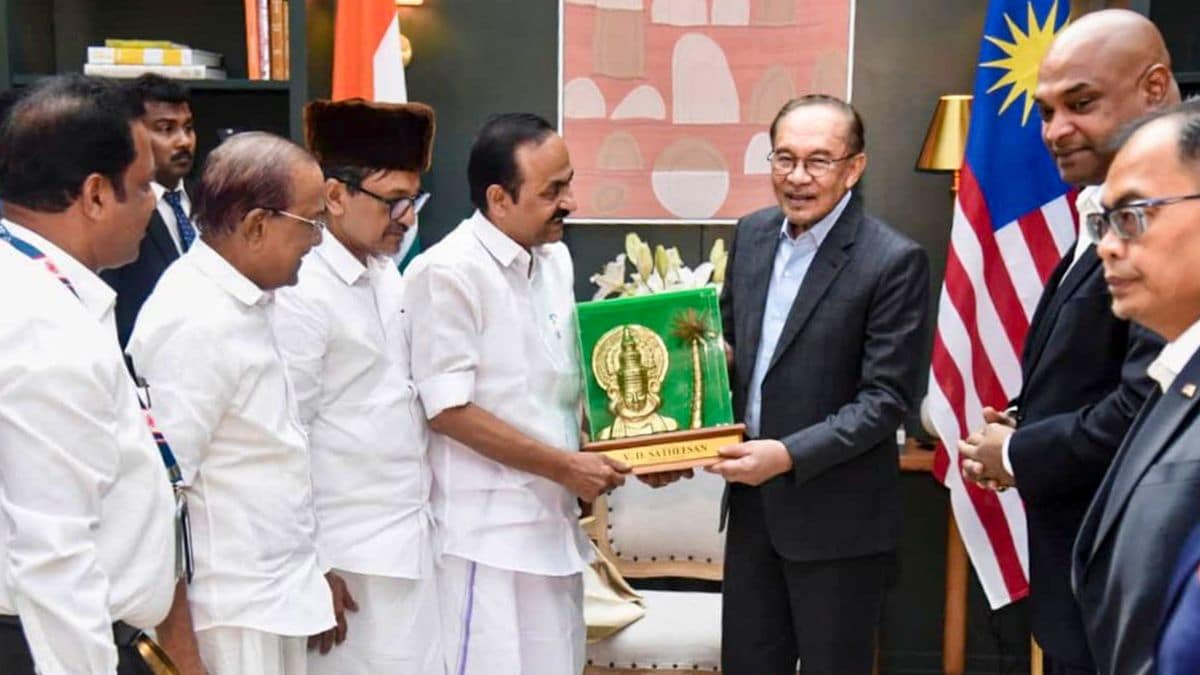
When Malaysian Prime Minister Anwar Ibrahim rose to speak at Markaz in Kozhikode, he began in the language expected of the occasion, with Arabic verses and salutations. Then, almost casually, came two words in Malayalam: “Entha varthanam?”
Roughly, what’s up?
The crowd understood immediately. I had spent the previous few days following Anwar at the BRICS summit in New Delhi, where the vocabulary was rather different: multipolarity, strategic partnerships, supply chains, the Global South. Yet it was those two ordinary Malayalam words that stayed with me after the trip.
Perhaps that was because I had arrived in India expecting BRICS to be the story. Delhi certainly looked the part. There were giant conference halls, security cordons, motorcades and enough accreditation tags to sustain a small stationery business. Indian television, meanwhile, was already debating whether these gatherings were worth the money. On one channel, Arnab Goswami wondered aloud whether critics expected Vladimir Putin to be accommodated in a budget hotel in Paharganj. It was a wonderfully Indian way of turning geopolitics into an argument about hotel rooms.
The debate also gave me a useful new expression: “naraz fufa”, the disgruntled uncle at a family gathering who is never entirely satisfied. BJP figures had used it while responding to Congress leader P. Chidambaram, who had asked what tangible benefits India was getting from BRICS.
Malaysians know the character even if we lack such an economical name for him. Ours tends to surface in family WhatsApp groups, usually with several question marks and information forwarded from somebody’s cousin.
But every summit probably needs a naraz fufa. The grumpy uncle can still ask a fair question.
Malaysians asked similar questions when Kuala Lumpur hosted major Asean meetings last year: what does the taxpayer actually get from all the security, limousines, hotel rooms and official dinners? Malaysia’s government was itself pressed in Parliament on whether the expenditure would produce economic returns.
Anwar and Narendra Modi discussed trade, semiconductors, investment, tourism and education in Delhi, but meetings and declarations are the easy part. What matters is whether anything happens after the flags are packed away.
Yet some of the most memorable diplomacy in Delhi was not contained in any declaration. Anwar picked up a microphone at the gala dinner hosted by PM Modi and sang Kishore Kumar’s 1965 classic, Khwaab Ho Tum Ya Koi Haqeeqat. The performance travelled across Indian television and social media, reaching people who were unlikely ever to read a BRICS communique. His social media team later leaned into the same cultural familiarity, pairing official posts from India with Bollywood tracks.
Malaysians perhaps understand this instinct better than most. India is not culturally distant from us. Indian food, cinema, religion and languages are part of everyday Malaysian life, and generations of Indians have lived, studied, worked and done business in Malaysia. Much of that familiarity, for historical reasons, has been shaped by Tamil culture. It can leave Malaysians with the dangerous confidence that we know India quite well.
Then you fly from Delhi to Kerala.
For a third-generation Malaysian Malayali like myself (whose grandparents made the journey across the Bay of Bengal decades ago) the shift was visceral. The language changes, the food changes, the politics changes and the pace changes. Somewhere between official engagements in Kozhikode I encountered a Malabar porotta with a faint coconut-oil finish that was so good it felt like coming home; a convincing argument for bilateral relations all by itself.
Kerala nevertheless felt strangely familiar, and Anwar appeared to feel it too. He recalled the Malayali lawyers who stood by him during the difficult years of his political career (a nod to the deep-rooted diaspora that has shaped Malaysian professional life for generations) joking that their one weakness was knowing when to stop talking. It was a brave complaint from a politician who happened to be holding a microphone at the time.
After the crowds that greeted him, he even joked about contesting an election in Kerala.
At another engagement, Anwar noticed that a programme described as a “hi-tea” seemed, for the moment at least, to consist mainly of water. For a few seconds, refreshments threatened to become an issue in Malaysia-Kerala relations.
The humour revealed something that formal statements did not: he was comfortable there. At Markaz, Anwar explained that he had told Modi he wanted to visit Sheikh Abu Bakar Ahmad while he was in India. He also spoke about the old links between the Malabar Coast and the Malay world, stretching across what is now Malaysia, Singapore, Brunei, Indonesia and the southern Philippines.
Those connections long predate BRICS, Asean or even the modern states of India and Malaysia. Traders, scholars, migrants and religious teachers crossed the Indian Ocean for centuries, carrying beliefs, language, food and ideas with them. Modern diplomacy is, in some ways, building on routes that ordinary people established long before foreign ministries existed.
Even the setting for some of Anwar’s Kerala engagements hinted at the newer relationship taking shape. At Tulah Clinical Wellness in Chelembra, where he met Kerala leaders, discussion turned to trade, tourism, education, healthcare and investment. There was an interesting contrast here: Kerala was selling not merely heritage and Ayurveda, but expertise, medical capability and modern services. Malaysia, meanwhile, was looking for precisely those kinds of higher-value partnerships.
This is exactly the kind of practical, nuts-and-bolts diplomacy our naraz fufa demands to see. I had heard a similar business case back in Delhi from Arun Rajendran of Segula Technologies, a French engineering company with major operations in India. His point was strikingly practical. Experienced engineering talent in India had become more expensive, while Malaysia already possessed much of the manufacturing infrastructure needed to undertake more sophisticated engineering work. With the right skills, some work now carried out in India could eventually be done by Malaysians.
For a parent, that is easier to understand than multipolarity. It means the possibility of a son or daughter graduating as an engineer and finding higher-value work at home.
None of this means every meeting will produce an investment. Announcements are not jobs, and a handshake, however enthusiastic, cannot be deposited in a bank. Six months or a year from now, it is reasonable to ask whether the engineering centre materialised, whether businesses invested, whether more Malaysians and Indians travelled in both directions and whether companies found new customers.
Following Anwar from Delhi to Kerala made me think that India-Malaysia relations are sometimes described too narrowly by both sides. In Delhi, we spoke about semiconductors, investment and the emerging world order. In Kerala, the same relationship was visible in old friendships, maritime history, religion, migration, food and the ease with which a Malaysian politician could say “entha varthanam?” and have a hall full of people instantly respond.
I came to India to cover BRICS. Some of the important stories were certainly at Bharat Mandapam.
What stayed with me, however, was Kishore Kumar in Delhi, Malayalam in Kozhikode, an absent cup of tea, an excellent porotta and an Indian-based engineer explaining why Malaysians might one day do work now done in India.
Foreign ministries call this people-to-people relations. The naraz fufa might just demand to see the receipts. But either way, along after the motorcades leave and the communiques are filed away, it is the shared songs, the diaspora ties, and the ease of an unexpected “entha varthanam?” that actually keep the door open.
The author is Northern Bureau Chief at Free Malaysia Today, a news online portal based in Selangor, Malaysia.
