



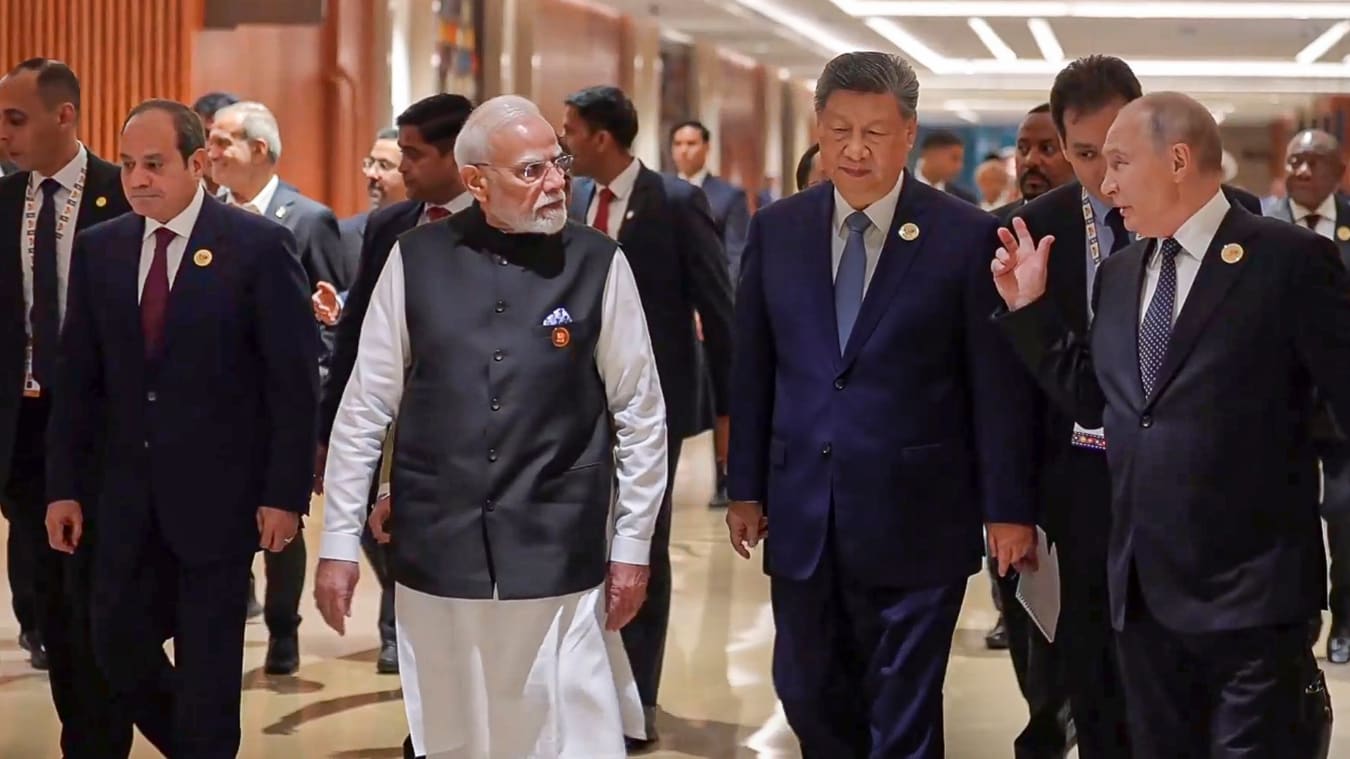
When the leaders of the expanded BRICS grouping meet in New Delhi on September 12-13, much of the attention will inevitably focus on geopolitics: the future of the international order, the tensions between major powers, the reform of global institutions and the expanding influence of the Global South. But there is another question that deserves more attention: What does India's growing claim to Global South leadership actually mean for Africa?
The answer matters because Africa is no longer a peripheral presence in BRICS. South Africa, Egypt and Ethiopia are full members, while Nigeria and Uganda are partner countries. Africa is now one of the most represented regions in the grouping. That gives India an opportunity, but it also gives it a test.
India has made a credible case for itself as a voice of the developing world. During its G20 presidency, New Delhi helped secure permanent membership for the African Union and has consistently supported greater African representation in global institutions. It also worked with other BRICS members to bring Egypt and Ethiopia into the grouping. Yet leadership of the Global South cannot ultimately be measured by the number of summits convened, declarations signed or diplomatic positions shared. It must be judged by whether developing countries are able to come together and change the economic structures that have kept them subordinate in global production. That is where Africa becomes the test.
India and Africa already have a substantial economic relationship. Bilateral trade reached $81.99 billion in 2024–25, making India Africa’s fourth-largest trading partner. Indian exports include pharmaceuticals, automobiles, engineering goods, chemicals, textiles and food products. India has also extended 196 concessional lines of credit worth about $12.2 billion to 42 African countries, supporting projects in power, railways, agriculture, industry, technology and other sectors. Thus, this is not a story about India discovering Africa. It is a story about what comes next.
The larger African trade picture remains stubbornly familiar. According to UN Trade and Development, 76.7 per cent of Africa’s merchandise exports were primary goods in 2025, with fuels accounting for 29.5 per cent of that primary-goods basket. In much of Asia, by contrast, manufactured goods dominate exports. Despite decades of integration into the global economy, Africa still exports overwhelmingly what it extracts, pumps or grows from the soil rather than what it manufactures.
This should force us to question our perspective on India-Africa trade. The question should not simply be: How do we increase trade? It should be: What kind of trade do we want to increase?
If the next doubling of India-Africa trade simply means more African oil, critical minerals and agricultural commodities moving one way and more manufactured products moving the other, then South-South trade risks reproducing an old pattern under a new geopolitical label. The truth is that South-South trade is not automatically developmental because it happens between countries of the Global South.
India has an opportunity to do something more ambitious. It should not seek to become Africa’s latest development “partner” in the conventional sense. It should instead aim to become a partner in production.
There are already glimpses of what that could mean. India’s concessional financing has supported technology parks and solar-related projects in Africa alongside more conventional infrastructure. In Mozambique, Indian-backed concessional finance has supported not only roads and power but also an information technology park and an assembly plant for solar cells. In Tanzania, Indian firms are involved in manufacturing, agro-processing, telecommunications, steel, power transmission and other industries. Hester Biosciences has established a veterinary vaccine manufacturing facility there. Indian investment in Tanzania reached approximately $4.74 billion in 2025.
And then there is a striking private-sector example from Nigeria. Raj Gupta, an Indian businessman who built African Industries Group into one of Nigeria’s largest industrial groups, has secured 500 hectares in Niger State for a proposed integrated project combining a steel complex, a utility-scale solar plant and an industrial park. The group currently operates around 31 manufacturing plants in Nigeria and employs about 10,000 people. The importance of this example lies in the model it represents: Indian entrepreneurship combined with African resources, labour, markets, and industrial opportunities to create production on African soil.
I believe this is the direction towards which India-Africa relations should move: from India selling to Africa to India and Africa producing together.
The opportunity is particularly clear in pharmaceuticals. The African Development Bank estimates that meeting Africa’s pharmaceutical and enabling-infrastructure requirements through 2030 would require an overall investment envelope of roughly $111 billion, of which about $11 billion would be for the pharmaceutical industry itself and the majority for infrastructure and logistics. The Bank is explicitly promoting technology transfer, local manufacturing and stronger supply chains, and sees Indian pharmaceutical capabilities as relevant to that effort. The obvious opportunity, then, is not simply for India to export more medicines to Africa. It is for Indian and African firms to manufacture more medicines in Africa, for Africa and eventually for export beyond Africa.
The same logic applies to digital public infrastructure. India’s experience with Aadhaar, UPI and other elements of India Stack has attracted growing African interest. In 2026, the African Development Bank launched an India–Africa partnership intended to help several African countries develop scalable and interoperable digital public infrastructure. This may ultimately prove more consequential than just another conventional infrastructure project. Digital infrastructure is not merely something a country consumes. Properly designed, it becomes part of the institutional infrastructure through which businesses, workers and governments participate in a modern economy.
India, therefore, has something valuable to offer Africa that goes beyond finance: experience in building capabilities at scale. But that does not make India a template for Africa. The continent is far too diverse for that. The relevant lesson is that two large parts of the Global South possess capabilities that could be combined more effectively.
India has technology, manufacturing experience, pharmaceutical capabilities, digital systems, capital and a huge domestic market. Africa has natural resources, rapidly expanding markets, entrepreneurial potential and, increasingly, continental scale.
That last point is crucial. The African Continental Free Trade Area is designed to create a continental market of roughly 1.3 billion people and $3.4 trillion in combined GDP, with industrialisation and greater value addition among its objectives. From an Indian business perspective, that should change the value proposition. The question should no longer be simply about investing in Nigeria, Kenya, Ghana or Tanzania. It should increasingly be: Can we produce in Africa for Africa?
For African governments, however, there is an equally important question: What will that investment leave behind? Too often, investment is celebrated according to how much capital arrives. I believe a much better measure is what productive capability remains thereafter. Does it create local suppliers? Does it transfer technology? Does it train workers? Does it build domestic firms? Does it create products that can be exported? Does it connect African producers to regional and global value chains? These are the outcomes African governments should negotiate for. India, for its part, should be willing to measure its Africa strategy by them.
This is where BRICS can demonstrate whether its Global South rhetoric has economic substance. BRICS is not a coherent alternative world order waiting to replace the existing one. Its members have very different political systems, economic structures and geopolitical interests. Grand claims about a completely new global economic order risk obscuring what the grouping can realistically accomplish. But BRICS can do something important: it can give developing countries a stronger platform from which to negotiate questions of finance, trade, technology and global economic governance.
Africa’s infrastructure challenge provides a useful test. The African Development Bank estimates that the continent needs between $130 billion and $170 billion in infrastructure investment every year, leaving an annual financing gap of roughly $68 billion to $108 billion. A serious BRICS conversation about Africa should therefore be less interested in declarations and more interested in what gets financed: power systems that enable factories, transport corridors that connect producers to markets, digital infrastructure that allows firms to transact, agricultural processing that turns crops into higher-value exports, pharmaceutical manufacturing that reduces import dependence, and industrial ecosystems that allow African and Indian companies to participate in the same value chains.
That would be a more meaningful expression of South-South cooperation than another communiqué promising solidarity.
The responsibility is not India’s alone, however. African governments must also change how they approach foreign investment. They cannot demand economic transformation from foreign partners while competing primarily through tax holidays, cheap labour and access to natural resources. Africa needs to become better at bargaining for technology, skills, local value addition and export capacity.
The bargain needs to change on both sides. India should bring technology, capital, manufacturing experience and entrepreneurial capability. Africa should bring resources, markets, talent and continental scale. The objective should be to combine these assets rather than simply trade them.
That is where India’s Global South ambition and Africa’s economic transformation agenda intersect. India wants a greater voice in shaping the institutions and rules of the international economy. Africa wants greater control over how it produces, trades and captures value in that economy. Those ambitions can reinforce each other.
But the test of India’s Global South leadership will not be how prominently Africa features in the Delhi summit photographs. Nor will it be measured by the number of memoranda signed or the value of another round of trade. It will be measured in productive capacity.
Five years from now, can an African manufacturer point to an Indian partnership and say: this helped us produce something we could not previously produce? Can an Indian pharmaceutical company be manufacturing in Africa rather than simply exporting medicines there? Can African agricultural products be processed on the continent before they leave it? Can Indian investment help create African suppliers, technologies, skills and firms capable of entering regional and global value chains? Can BRICS financing help close the gap between Africa’s enormous economic potential and its infrastructure constraints?
That is the standard by which India-Africa relations should increasingly be judged.
If India wants to lead the Global South, Africa is not merely an important constituency. It is the test.
And if India and Africa can move from diplomatic solidarity to trade, and finally to shared production, they will have demonstrated something larger than the success of a bilateral relationship. They will have demonstrated that South-South cooperation can mean not simply developing together, but producing, innovating and becoming more globally competitive together.
The author is an Associate Professor of Economics at O.P. Jindal Global University and researches development economics, trade and India–Africa economic relations.
