



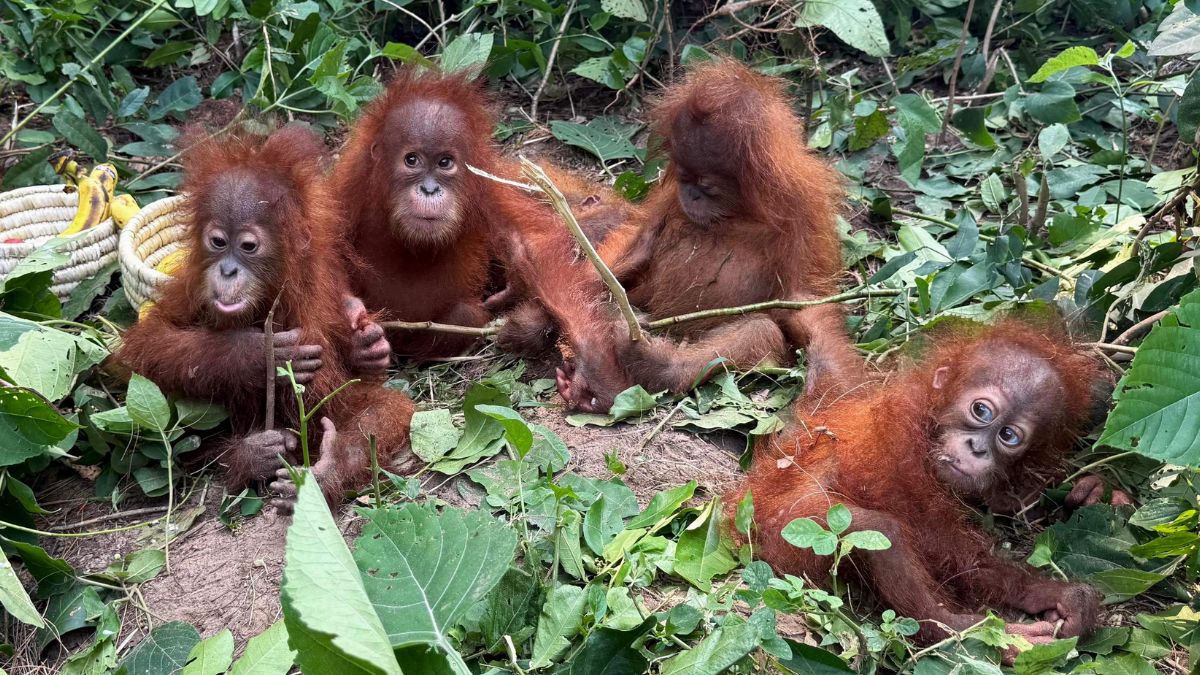
The Wildlife Crime Control Bureau and Odisha Police’s Special Task Force have launched a joint probe into the case of five Orangutans sighted in Odisha’s Balasore district. Since they are not indigenous to India, officials are speculating the possibility that the critically endangered animals were smuggled into the country.
According to media reports, locals spotted a black SUV near the forest on Monday night, before the orangutans were found in the morning. CCTV footage obtained from the area also matched the sighting. The footage shows a black Thar passing through the forest area at around 11:25pm and returning 15 minutes later, NDTV reported.
Locating the SUV and its owner is expected to make a significant breakthrough in the case. CCTV footage from airports, ports and major railway stations is also being examined.
State Forest and Environment Minister Ganesh Ram Singhkhuntia said that the Odisha forest department has also sent messages to zoos across the country seeking information on whether any orangutan was missing from their facilities.
The orangutans were spotted early on Tuesday by residents of Badapai village forest in Bhograi. They were rescued after the citizens informed the forest department. The animals were taken to the divisional forest office before being shifted to Nandankanan Zoological Park.
Orangutans can fetch ₹20 to 25 lakh in international markets, increasing the suspicion that they were smuggled from some foreign forest.
The animals are currently being monitored in Nandankanan. The zoo has a special enclosure for the animals, but it has remained empty since the death of a mother orangutan called ‘Bini’ in 2003. The state government is seeking permission from the Central Zoo Authority to keep the five orangutans at the Nandankanan Zoological Park.
Authorities at the Zoological Park said that three of the orangutans were male, while the other two were female. All of them are roughly six months to one year old.
Orangutans are native to the rainforests of Malaysia and Indonesia and have no natural range in India. All three recognised species are classified as Critically Endangered on the International Union for Conservation of Nature (IUCN) Red List.
