



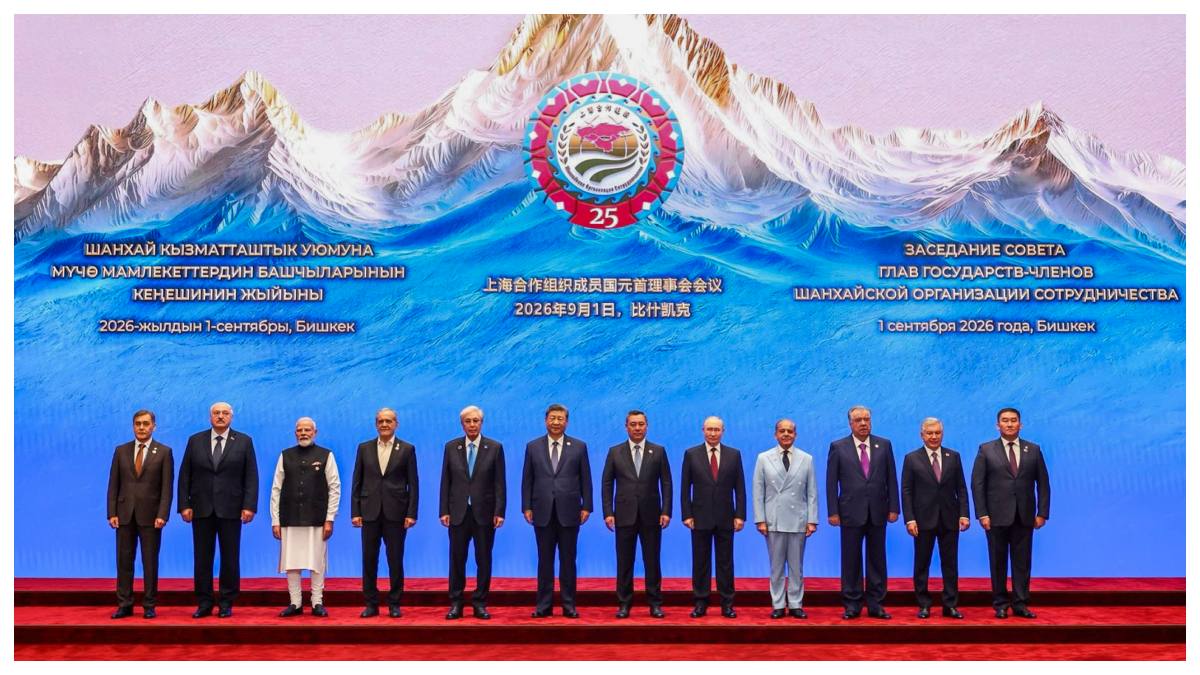
The numbers alone tell a story of a compelling voice of an increasingly vocal Global South. And in the upcoming BRICS Summit in New Delhi, the shadow of SCO will invariably fall, with India possibly falling in line with the dominant narrative of the times.
In the September 1 Bishkek Declaration, India had to ink its acquiescence categorically.
Set up in 2001, the ten-member SCO (Shanghai Cooperation Organisation) represents about 42 per cent of the global population and about 25 per cent of the global nominal GDP.
Meanwhile, BRICS, established in 2009, with Brazil, Russia, India and China as the founding members, is now a 11-full membered body who make up more than 54 per cent of the world’s population and 42.2 per cent of the global GDP (on PPP basis).
The important member countries common to both the SCO and BRICS are the ones that are assuming significant political positions in today’s world—India, China, Russia and Iran—with Russia being bogged down in the battlefields of Ukraine while Iran is standing up to the combined military might of the United States and Israel.
In that backdrop, the tone and tenor of the September 1 Bishkek Declaration assume greater significance for the outcome of the September 12-13 BRICS Summit in New Delhi.
The SCO joint statement underscored the tightening concern of the Global South on collective political and economic concerns in the face of a belligerent US and its regional ally Israel. It also underscored the increased significance of West Asia and thereby the Caucasus as the geostrategic hotspot.
The Bishkek Declaration has brought out a clear-cut position on the US-Iran conflict. It says, “Member states express deep concern over developments in the Middle East and around Iran. They reiterate the SCO’s previously stated position condemning military strikes on the territory of the Islamic Republic of Iran, which have resulted in numerous civilian casualties and significant damage to the country's economy.”
“Such actions violate the principles and norms of international law and the UN Charter and create serious risks to international peace, security and stability.”
And then, significantly, it adds, “Member States express their sincere condolences to the people and Government of the Islamic Republic of Iran on the tragic death of Supreme Leader Ayatollah Seyed Ali Khamenei, and to the families of the victims.”
This is a direct criticism of the US action on Iran.
Not stopping at that, it attacks Israel on the Palestinian question. The Declaration says, “Member States note that the only possible way to ensure peace and stability in the Middle East is a comprehensive and just settlement of the Palestinian question.”
The September 1 Bishkek Declaration in the Kyrgyzstan capital may well be a sign of what awaits the BRICS summit to be held in New Delhi after 10 more days. It also may be a harbinger of the transition of a block mandated “to promote greater economic, political, and geopolitical alignment among emerging market economies” to one that will increasingly confront geopolitical issues of the day in no more uncertain, but categorical terms.
While the Bishkek Declaration of SCO may be the harbinger of how discussions may unravel in the forthcoming BRICS session in Delhi, it also may sound the bugle of the coming together of the China-Russia-Iran axis in a far more robust form.
It may result in reconciling the huge heft of BRICS-SCO to its true potential. But it is up to India to determine how far this reconciliation will go. Whether New Delhi changes tune to adapt to the emerging new geopolitical realities or sticks to its policy of strategic autonomy to the T is something that will become much clearer after September 13.
