



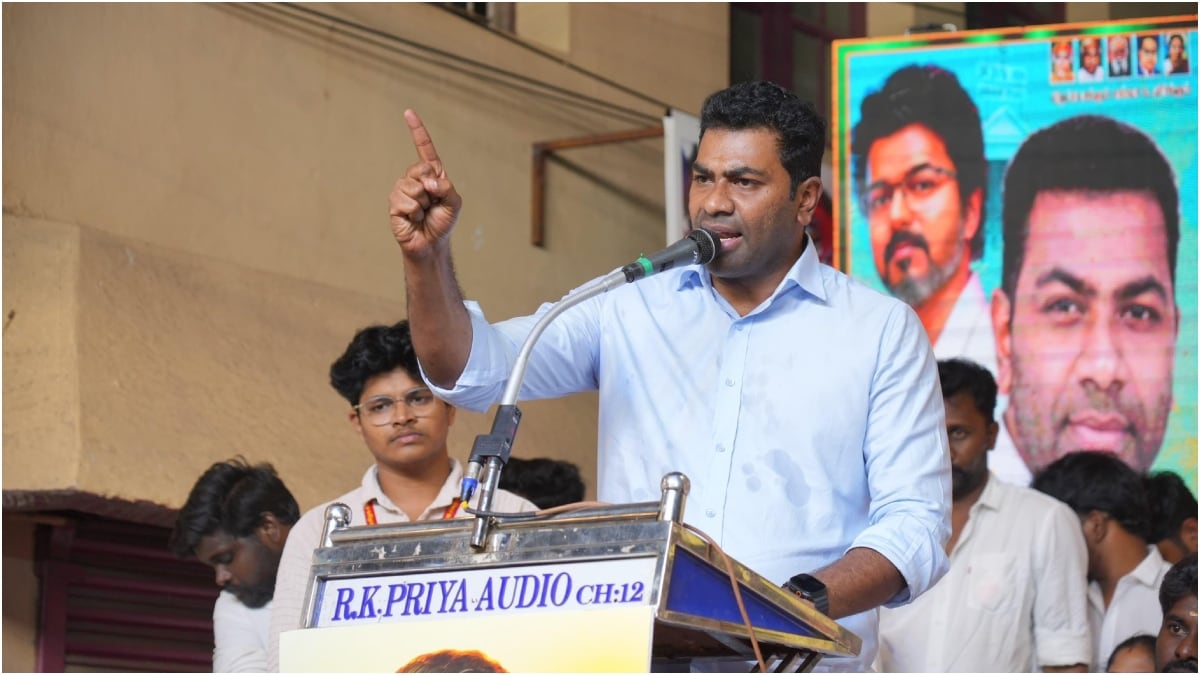
A few days ago, DMDK leader Premalatha Vijayakanth had raised an important concern in the Assembly. She had noted that the Assembly, where the welfare of the people was to be discussed, was inadvertently turning into a “fight club”. With a pun, she pointed to Public Works Department (PWD) and Sports development minister Aadhav Arjuna as the reason for it.
He was next seen in Delhi, coordinating with the Ministry of External Affairs (MEA) and TVK ministers to receive Tamils who were stranded in Nepal after the devastating flash floods.
Two days later, he was again in the Assembly, this time to take on Leader of Opposition (LoP) Udhayanidhi Stalin and to say that the government headed by CM C. Joseph Vijay was planning to come up with a world-class sports city to accommodate international games.
He was also there to offer sharp replies to the Opposition when questions on liquor trade and the TASMAC-run liquor retail shops came up. While the ministers in the front row reply to every issue raised by the Opposition benches, Aadhav’s replies influence not just the TVKians, but also the general public.
When actor Vijay entered electoral politics, the biggest question was not whether he could draw crowds—he already had that ability in abundance. The larger question was whether the Tamilaga Vettri Kazhagam (TVK) could convert the charisma of its founder into a functioning political machine.
Enter Aadhav Arjuna.
In little over a year, Arjuna has gone from an influential political strategist to one of the most visible figures in Vijay's political project. He joined the TVK in January 2025 and was appointed its general secretary for election campaign management, putting him at the centre of the party's electoral preparations.
In the 2026 assembly elections, he contested from Villivakkam, a traditional DMK stronghold, and won to become the most influential minister in Vijay's cabinet. He is second in the protocol next to water resources minister N. Anand.
This extraordinary rise has made Aadhav Arjuna one of the most-watched figures in Tamil Nadu’s new political order.
Both inside and outside the TVK, he is an important man—Vijay's most effective political strategist, the organisational architect who is converting the actor's fan base into a cadre-based party, and of course the powerful second centre of influence.
The man behind the machine
Arjuna’s importance comes partly from what he brings to a party whose principal asset has always been its leader.
If Vijay brought mass appeal through his enormous fan network and the ability to command attention, Aadhav brought in a different political vocabulary—campaign planning, electoral data, organisational restructuring, political communication and constituency-level strategy.
Before joining the TVK, Aadhav had already worked in electoral politics and political consulting. His experience with political organisations and campaign strategy gave him an understanding of the machinery required to convert popularity into votes.
That background made him particularly valuable to Vijay. A key architect of TVK’s organisational strategy, Aadhav is part of the machinery that packages, distributes and operationalises Vijay as the political product.
From strategist to electoral politician
Two years before, when Aadhav had walked away from the DMK to join Thol. Thirumavalavan and VCK, this correspondent was invited to visit his office at one of the prominent locations in the city.
He ran a separate office, which comprised a huge electoral database of how each political party performed each elections and what issues affected people.
This collection actually aided his transition from a backroom strategist to frontline politician, which was completed in 2026. Arjuna was fielded in Villivakkam, one of Chennai's politically significant constituencies and the victory altered his political standing within the party.
Aadhav Arjuna’s rise also coincided with the emergence of a second line of leadership around Vijay. While there are many leaders and influential figures in Vijay’s team, Aadhav’s place in that ecosystem is distinctive. He is not merely an administrator, but an important figure in TVK’s party organisation, the electoral machinery, and the government.
Why Vijay needs Aadhav Arjuna
As an actor-turned-politician, Vijay has always had public visibility. But as a political structure, to stay in power is crucial for Vijay. A mass movement has to be converted into booths, ward committees, constituency organisations, campaign teams, candidate selection mechanisms, voter outreach and administration.
This is where people like Arjuna become indispensable. The TVK's challenge is particularly acute, because it is trying to build a political organisation, while also running a government.
The party cannot depend indefinitely on Vijay's personal appearances. It needs people capable of doing the political work when Vijay is not present. Aadhav’s organisational background makes him particularly useful in that transition.
But influence creates its own problem. For a personality-driven party, however, the emergence of strong second line of leaders presents a delicate political dilemma. Vijay’s authority rests heavily on the idea that TVK is his political project.
The party's hierarchy is clear: Vijay is president and the ultimate political authority and Aadhav is one of the influential intermediaries. A leader who controls organisational networks, has electoral credibility, enjoys access to the government and becomes the public face of important policy positions can gradually acquire political weight independent of the party president.
While it is not apparent that Aadhav is attempting to build such a power centre, the question is increasingly relevant because his responsibilities have expanded so rapidly. In that regard, his family connections have come under criticism too.
Time and again, he has reiterated that he came from a very poor background and had nothing to do with the family of lottery baron Santiago Martin. However, for the TVK, this is potentially awkward.
The party has sought to position itself as a break from established political networks and dynastic structures. Its opponents, therefore, have an obvious line of attack whenever questions arise around the backgrounds and networks of its senior leaders.
Arjuna's response to such scrutiny is likely to remain politically important because he is no longer an anonymous strategist—he is now a minister and elected representative.
The political architect question
There is another reason why Aadhav Arjuna's role deserves attention. The TVK is still building its institutional identity. The DMK has decades of cadre networks. The AIADMK developed a powerful personality-centric organisational model under M.G. Ramachandran and Jayalalithaa.
Vijay's TVK is attempting to combine elements of both—a charismatic leader with a modern campaign machine and a growing organisational network.
Aadhav Arjuna represents that hybrid model. He belongs to a generation of political operators who deeply understood that elections are no longer fought only through speeches and rallies, but also through data, digital communication, constituency mapping, targeted outreach, and continuous political messaging.
That makes him potentially invaluable to TVK, but it also means that his influence could grow alongside the party itself.
The Vijay-Aadhav equation
To the TVKians, if Vijay provides the authority, Arjuna helps provide the architecture; if Vijay provides the mass appeal, Arjuna helps translate that appeal into political organisation. Vijay remains the undisputed centre of the TVK and Aadhav is the party’s most valuable institutional asset.
If his network, visibility and political influence begin to operate independently of Vijay's command structure, the same strength could become a source of internal tension.
However as of now, Aadhav Arjuna is only Vijay’s political strategist who has become an organisational architect—and, after his electoral victory and entry into the Cabinet, a potential power centre, whose influence will be closely watched.
