



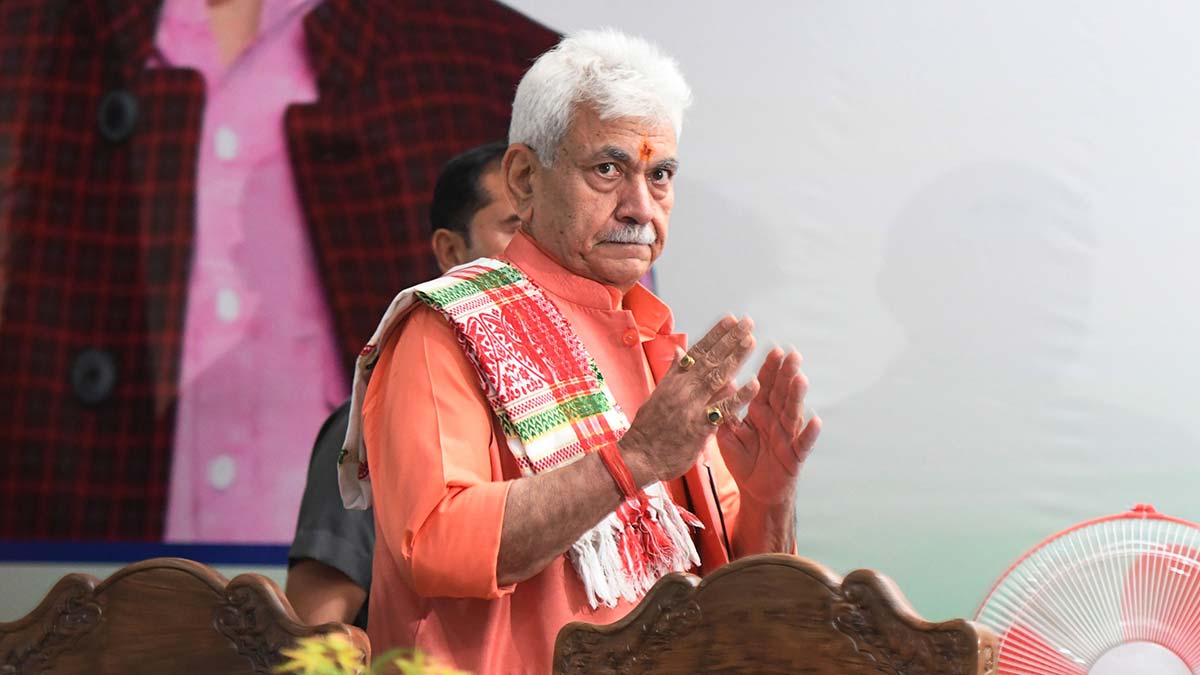
Jammu and Kashmir (J&K) completes its ambitious “100 Days for Nasha-Mukt J&K” campaign, a significant milestone in its battle against narcotics. The campaign was launched when Lieutenant Governor Manoj Sinha directed agencies to launch a structured, coordinated, time-bound drive with a 100-day timeline, with a zero-tolerance approach. It was driven by a clear message from the chair that the drug menace that had spread across Jammu and the Kashmir valley will no longer be treated merely as a law-and-order problem but as a threat to the social fabric, economic stability and security architecture of J&K. The directive from the chair evolved into a strategy and a drive was formally launched on April 11, 2026. Drug hotspots that had operated with near impunity for years have witnessed unprecedented police action and raids have been conducted across urban centres, border belts and rural pockets.
If this campaign has a single defining chapter, it is the arrest of Gulzar Ahmed (alias Lahu Gujjar), whom police described as a key figure in the narcotics network operating across J&K and can be viewed as an important development in the broader offensive action against narcotics. Security agencies allege that his drug network had extended to districts of Doda, Rajouri and Poonch, and was worth around ₹730 crore, with criminal activities spanning across northern India. Police and media reports indicate that nearly 100 FIRs were registered against him under different names nationwide, including 30 in the Jammu district, of which 23 alone were from Bishnah police station. Agencies are also investigating his cross-border links and his role in terror-financing. Following his arrest, police intensified efforts to dismantle the network and arrested his associates, including Lovepreet Singh, Amit Kumar, Sadik Hussain (alias Shonki) and Sunil Kumar (alias Kuddu). While a member, Sunny was arrested in Chandigarh, reflecting a broader strategy of pursuing traffickers across state boundaries in coordination with central and interstate agencies. Women traffickers, including Renu Devi from Rajiv Nagar, Jammu and Tai from Doda, were also arrested, highlighting women’s role in drug trafficking and its wider social penetration.
However, the campaign also raised an uncomfortable question, “Why now?” Police records indicate that Lahu was involved in criminal activities since 2006, entered into small-scale drug trade by 2016 and allegedly expanded into large-scale trafficking by 2019. His longevity raises questions about whether enforcement and intelligence mechanisms detected his expansion early enough. Reports of alleged information leaks of police raids and his ability to remain active despite numerous FIRs also warrant institutional scrutiny.
Despite these concerns, the campaign is J&K’s most sustained and coordinated anti-drug effort. Agencies, alongside arrests, took action against properties allegedly linked to drug trafficking across J&K that had been seized, attached or demolished under applicable laws. In a prominent case, a property reportedly belonging to drug traffickers Vinod Kumar (Kaddu) in Pathankot, valued at ₹2-2.5 crore, was seized in coordination with Punjab authorities. Supporters argue that targeting traffickers and peddlers assets strengthens deterrence and discourages others from entering the illegal trade. Critics, however, raised concerns about due process and the rights of family members not accused of offences where residential structures were involved. The campaign has therefore sparked a debate between public security and civil liberties. The demolitions have also provided political parties and civil society groups an entry into a broader debate. In one instance, a demonstration in Jammu led by Talib Hussain against the demolitions turned volatile after police stopped protesters, injuring several people and prompting police firing. This highlights how enforcement actions can trigger public order challenges when they intersect with political mobilisation. Equally important is the social fallout of such measures. While action against traffickers is necessary, authorities must weigh the impact on vulnerable families who lose housing and livelihoods, as resulting resentment could be exploited by criminal or extremist groups. Some accused in drug trafficking cases have reported links to international criminal networks and security agencies have already documented a drug-terror nexus in J&K. Strict enforcement must therefore be paired with efforts to prevent affected communities from feeling isolated or victimised.
Despite ongoing controversies, measurable changes are visible on the ground. Rajiv Nagar in Jammu, previously home to around 200-250 drug peddlers, has seen a marked decline in drug activities. Similarly, Balol Khad in Bari-Brahmana, Samba, once so brazen that drugs were openly sold and police faced attacks, has witnessed comparable disruption. Enforcement drives have also extended to areas, including Bishnah, Miran Sahib, Beli-Charana, Vijaypur and Marheen areas, marking genuine, even if partial, disruption of established drug hotspots.
As the campaign completes its 100-day mark, it stands both as a landmark enforcement effort and a template for the future. Credit belongs to LG for driving this focused, time-bound crackdown that goes beyond routine enforcement to embody what can be termed the “Sinha model” of anti-narcotics governance. The arrests of major traffickers, attachment of narcotics-linked properties and demolition of identified structures together demonstrate what coordinated governance can achieve. Yet the model’s long-term success will depend on complementing enforcement with gender-sensitive rehabilitation, awareness campaigns, employment generation, education and community engagement to reduce demand. Drugs survive because demand exists, supply disruption alone cannot resolve this crisis. As long as demand remains, supply will seek alternative networks, substances or routes. Globally, disrupting established heroin and opioid networks risks shifting demand toward synthetic drugs or new psychoactive substances which are often harder to detect and more dangerous.
The coming months will determine whether the momentum yields lasting change. The campaign has disrupted networks, reinforced the administration and sent a strong message that J&K has the capacity and institutional will to respond to the drug menace. Whether the “Sinha Model” ultimately succeeds in creating a truly “drug-free J&K” will depend on the consistency that can contribute to a safer and healthier future for J&K.
Shuvam Sharma is ICSSR Doctoral Fellow, Department of National Security Studies, Central University of Jammu, and Dr R. Sudhakar is Associate Professor, Department of National Security Studies, Central University of Jammu
