



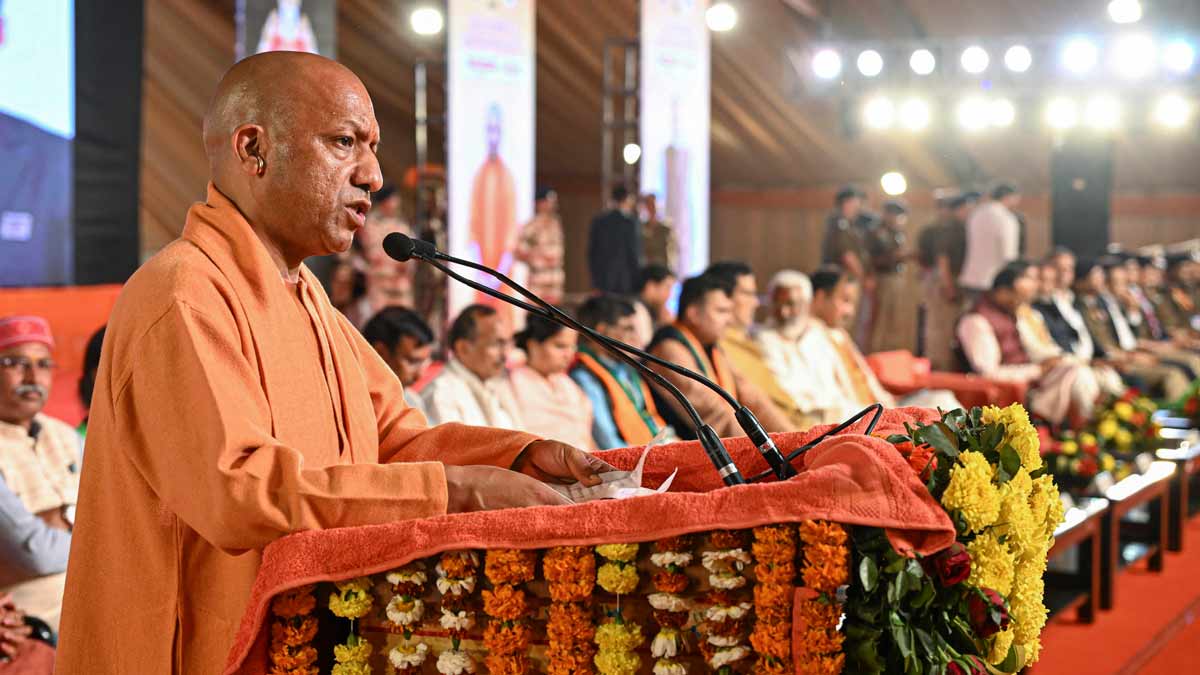
Public funds would not be used to build a museum named after an invader, said Uttar Pradesh Chief Minister Yogi Adityanath. The BJP leader slammed the Samajwadi Party (SP) for its past plan to build a museum dedicated to the Mughal emperor Aurangzeb in Agra, asserting that his government will complete the Chhatrapati Shivaji museum by the end of this year.
"In Agra, the city where Chhatrapati Shivaji displayed his valour, the SP government was building a Mughal Museum. Public funds would not be used for a museum named after an invader; instead, a museum would be constructed in the name of India's national heroes," the CM said while speaking at a function in Agra on Saturday.
"We will complete the construction of a grand museum named after Chhatrapati Shivaji by the end of this year. We have also approved the acquisition of the 'kothi' (residence) in Agra where Chhatrapati Shivaji had stayed," PTI quoted him as saying.
The Chief Minister further said, "We have already taken steps towards establishing an international airport in Agra. Agra is now developing into a new centre not only for industrial activity in the Braj region, but also for tourism. Connectivity has improved significantly."
He said the Supreme Court has given its approval for the work that was previously halted due to the Taj Trapezium Zone.
On Thursday, the Supreme Court permitted the Taj Trapezium Zone Authority to process around 400 pending applications for setting up non-polluting Micro, Small, and Medium Enterprises (MSMEs) in the ecologically sensitive area around the Taj Mahal.
The top court, however, directed that experts from the Central Empowered Committee (CEC) and the National Environmental Engineering Research Institute (NEERI) must scrutinise every proposal. If any objection arises, the application concerned "shall not be accepted without the leave of this court", it said.
A bench comprising Chief Justice of India Surya Kant and Justices Joymalya Bagchi and V Mohana heard the long-pending matter concerning industrial activity in the 10,400-square-kilometre Taj Trapezium Zone (TTZ). Since 1996, the court has imposed stringent restrictions there to protect the Taj Mahal from pollution.
