



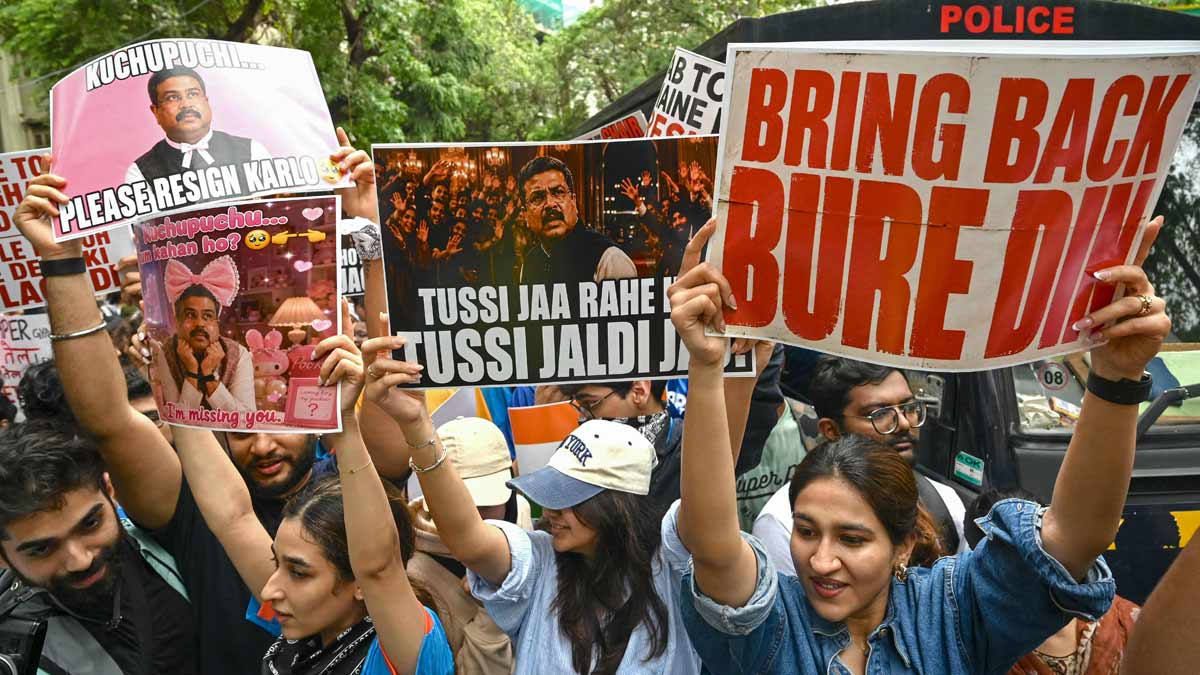
Union Education Minister Dharmendra Pradhan's resignation on Saturday marked the culmination of 48 hours that fundamentally reshaped India's education administration. His exit came amid the political fallout of the NEET-UG 2026 controversy, but it also followed a series of structural reforms that the government says are designed to ensure that examination scandals never recur.
Pradhan announced his resignation in a two-page letter addressed to the country's youth, saying he had submitted his resignation to Prime Minister Narendra Modi. While defending the government's response to the NEET crisis, he said the developments of the past several days had deeply pained him and stressed that protecting students was more important than any individual position.
His resignation, however, was only one part of a much larger overhaul.
Within days of the NEET-UG irregularities coming to light, the Centre cancelled the examination, handed the investigation to the CBI and ordered a fresh test. The government also announced that from next year, NEET would be conducted in a computer-based format, reducing the scope for paper leaks.
Simultaneously, the government initiated a sweeping restructuring of the National Testing Agency (NTA). Senior officials were reshuffled, fresh administrative oversight was introduced and the agency was asked to strengthen examination protocols, cybersecurity, logistics and question paper security. The changes were aimed at restoring confidence in an institution that conducts some of the country's largest entrance examinations.
Another major development was the appointment of a new education secretary, signalling an administrative reset within the ministry. Officials say the change is intended to accelerate implementation of examination reforms and improve coordination between the Centre, states and testing agencies.
The legal framework governing public examinations has also undergone significant changes.
The government has operationalised a stringent anti-paper leak law providing for enhanced penalties, including substantially higher fines and longer prison terms for those involved in organised examination fraud. The law targets paper leak syndicates, organised cheating networks, impersonation rackets and officials found complicit in compromising examinations.
To ensure that prosecutions do not drag on for years, the Centre has also decided to establish fast-track courts for examination-related offences. The objective is to secure speedy trials so that those accused of destroying the careers of lakhs of students are punished without prolonged delays.
These reforms come against the backdrop of growing concern over repeated examination leaks across the country.
In his resignation letter, Pradhan said he had devoted more than four decades to education and public life. He reiterated that no deserving student should ever become a victim of the exam mafia and urged young people not to allow misinformation or political conflicts to derail their future.
His resignation may bring immediate political closure to the controversy. But for the education ministry, the real challenge begins now.
A new leadership, a restructured NTA, tougher laws, fast-track courts and technology-driven examinations will all be judged by one benchmark, whether they can finally restore the faith of millions of students in India's examination system.
