



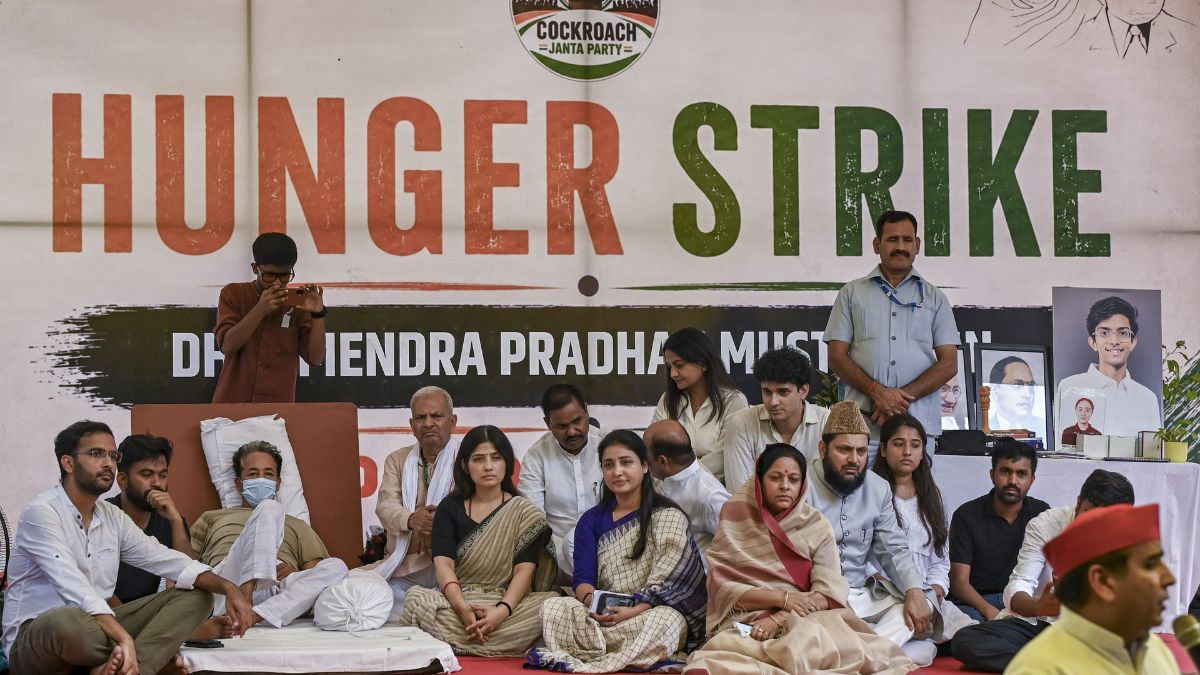
Wearing a white saree with black borders and grey stripes, Dimple Yadav, wife of Akhilesh Yadav, the national President of the Samajwadi Party and member of parliament from Uttar Pradesh, emerged on stage at Jantar Mantar on Thursday. She joined the Cockroach Janta Party's protestors and climate activist Sonam Wangchuk, who had been braving the scorching July sun for weeks, to send out a shared message-the resignation of the Union Education Minister, Dharmendra Pradhan.
Alongside Dimple stood Arvind Kejriwal, former Chief Minister of Delhi and Aam Aadmi Party MP Sanjay Singh, lending Opposition support to the CJP-led protest. The political lineup drew the attention of protestors and passersby. Their presence lent political heft to the concerns of students who have been demanding urgent attention and corrective steps by the government as they struggle with a failed examination system, where paper leaks and recruitment irregularities occur.
For many students campaigning at the site, however, the resignation of Pradhan is only one demand as they hope to set in motion changes that can have a lasting impact on the education system's credibility and transparency.
But as political heavyweights gather in Delhi for the upcoming Monsoon session beginning July 21, the demand for Pradhan's resignation will only get shriller. This poses a fresh challenge before the CJP and Sonam Wangchuk, as they cannot allow political symbolism to steal the momentum that is building up for real change.
On July 20, students and protesters at Jantar Mantar will march to Parliament on the first day of the Monsoon Session. The onus is on the Parliamentarians, on both sides of the aisle, to deliver justice to those who have suffered because of persistent failures in the examination system.
Till now, Wangchuk remains the cynosure of all eyes, resting on a bed covered in a white bedsheet.
There is a yellow tarpaulin covering the left side of the stage as Wangchuk lies under the sun. The stage is barricaded and guarded by volunteers around which tents of various student-led parties like Krantrikari Yuva Sangathan, Students’ Federation of India, All India Students' Association have cropped up.
“We do not agree with the hunger strike”, said Bhim Kumar, who associates himself with Krantrikari Yuva Sangathan. He feels the attention is getting diverted from the loopholes in the education system to the hunger strike. “We are in complete solidarity with Sonam Wangchuk, but a hunger strike cannot bring about any structural change”, said Mudita, a member of Krantrikari Yuva Sangathan. But then there are others who feel fasting with Wangchuk will draw the attention of the government. “We have called for a twenty-four-hour hunger strike in solidarity with Sonam Wangchuk”, said Sharanya, a member of the Students’ Federation of India. Their demands are the same, but not limited to the resignation of Pradhan, but a structural change in the educational system.
Neha, Manish and Aameen, who affiliate themselves with the All India Students' Association, are still fasting with Wangchuk, blending into the daily affairs at the protest site where visitors pay homage, watching them sleep. These students are weak and need around three to four supporters to help them walk to the washroom. “I have been coming here since day one, but the government has not given any ear to our pleas”, said Anjali, AISA DU Secretary, drawing attention to the miserable condition of her friends who began fasting on June 28.
“Nothing may change with the resignation of Pradhan. The structure of the education system won't change”, said Alok Vats, voicing the dissatisfaction amongst students about the shifting nature of the protests. Kapil Topo, who runs a tribal residential school, has come all the way from Jharkhand hoping to be part of a lasting change in the quality of education in the country. “Hunger strike is an outdated method”, he says. He says in a society that is more materialistic today, methods like hunger strike may not work.
Meanwhile, the constant support of political leaders to Wangchuk's hunger strike is also worrying a section of students. They argue that certain politicians are themselves part of several examination and recruitment scams, making them unfit for lending intellectual backing to the movement.
“It has become a cycle”, said Arvind Kejriwal from the stage, explaining how every year there is a paper leak, and then the legal procedure is in place to put the culprits in prison and set them free through bail.
“Dharmendra Pradhan should resign, but Sonam Wangchuk should be made the new education minister in return”, Kejriwal concluded. He went on to recall his early political journey in 2011 and connected the CJP protest with the ‘India Against Corruption Movement’.
Meanwhile, between the political speeches and the fasting students, the protest at Jantar Mantar continues to draw crowds and volunteers. Some volunteers provide food and water, others provide medical assistance, and then there are a few taking care of waste management and cleanliness. There are stalls selling books and portable libraries. The three permanent tea stalls have become spaces full of life, debates and discussions. A few of them display creative hand-painted banners and posters. The site echoes with drum beats and slogans, but beneath the noise lies a quieter plea by the students who are still waiting to be heard.
