



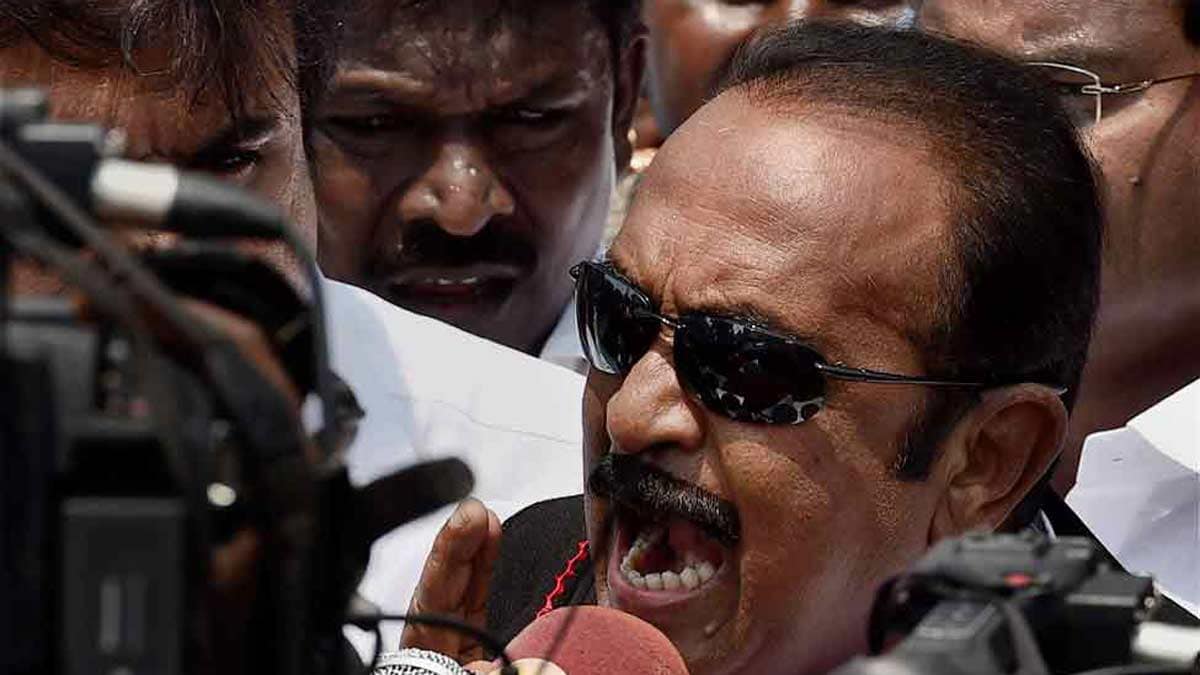
Vaiko’s Marumalarchi Dravida Munnetra Kazhagam (MDMK) on Saturday chose to walk out of the DMK-led Secular Progressive Alliance (SPA) only to move closer to chief minister C. Joseph Vijay’s Tamilaga Vettri Kazhagam (TVK). However, MDMK’s two MLAs, Rajendran and Senthil Selvan, who won in DMK’s rising sun symbol, will continue to be members of the DMK in the Tamil Nadu Assembly.
“Today's meeting is special compared to all the previous general council meetings. 1,466 members participated. Unanimously, in our general council meeting, we took the decision to leave from the DMK alliance,” Vaiko informed the media. With this the MDMK’s journey with the SPA which began in late 2017, surviving four election cycles, comes to an end. The decision to exit, taken at the party’s 32nd general council meeting in Chennai, was more than a strategic pivot, a unanimous rebellion from the rank and file against a partnership that had grown increasingly asymmetric. As the Congress, the VCK, and the Left had already abandoned the ship to enable the rise of a new government, the MDMK’s departure effectively turns out the lights on the SPA.
For a party like the MDMK—born in the 1990s from a bitter split with the DMK specifically to preserve its independent voice—the 2026 election was an existential humiliation. The party which had won from Trichy Lok Sabha seat in an independent symbol by being in the DMK alliance, wanted to contest again in an independent symbol in the 2026 election. But the DMK’s insistence that MDMK candidates contest under the rising sun symbol, according to MDMK leader Durai Vaiko, was viewed by party veterans as a policy of cannibalisation rather than cooperation. This “misfortune,” as described by Durai Vaiko, stripped the party of its dignity. In the calculus of south Indian politics, a party without its own symbol is a party without a soul and for the MDMK, regaining its independent identity became a matter of survival that outweighed the benefits of the alliance.
During the hour-long press conference on Saturday after declaring that his party has chosen to walk out of the alliance, Vaiko alleged that the DMK engaged in backroom manoeuvring to assist the AIADMK and Hindutva forces in a bid to form a government, despite the AIADMK holding only 47 seats. However, the MDMK has pivotally shifted its weight behind the TVK and Vijay. While the TVK formed the government with 108 seats, Vaiko’s support is predicated on more than just seat counts. He has specifically lauded the new administration for adopting "Anna’s way" through a twin language policy and for its apparent success in cleaning up the state’s bureaucracy. “They have eradicated commission and corruption, the two evils of democracy... In this government, there is no corruption is what I believe. There is no commission in this government is what I believe. On these two points itself, we support this TVK government,” Vaiko said.
However, Vaiko and his MDMK’a alliance with the TVK is not without its own complexities. Vaiko recently went public with a controversial request from CM Vijay that the two MDMK MLAs, T.M. Rajendran and Senthil Selvan, resign their seats and re-contest under the TVK banner. Of course, this is a transparent attempt at gaining majority to shore up the TVK’s legislative standing.
Despite this, Vaiko’s refusal to comply to Vijay’s request has sparked “horse-trading” allegations from the opposition. The situation has already fractured the MDMK’s small legislative wing. while Rajendran remains loyal to Vaiko, Senthil Selvan has effectively defected, declaring himself a DMK MLA in the Assembly.
Even as a supportive ally, Vaiko wants to position his MDMK as a moral watchdog. The party continues to demand the complete closure of TASMAC liquor shops, a hardline stance on total prohibition that remains a cornerstone of its independent platform. By maintaining this demand, Vaiko is signalling that his support for the TVK or a third force is conditional and that the MDMK cannot be absorbed by the TVK.
The formal dissolution of the SPA represents the final collapse of the old guard. By aligning with the TVK, Vaiko is attempting to hitch his party’s wagon to the clean government narrative that propelled Joseph Vijay to the chief minister’s office. However, the move raises a provocative question: Can the TVK’s promise of a corruption-free, ideological administration and survive the messy, transactional realities of managing a coalition of seasoned and demanding allies? For Tamil Nadu, the Dravidian duopoly has been written off, but the era of complex, shifting allegiances has only just begun.
