



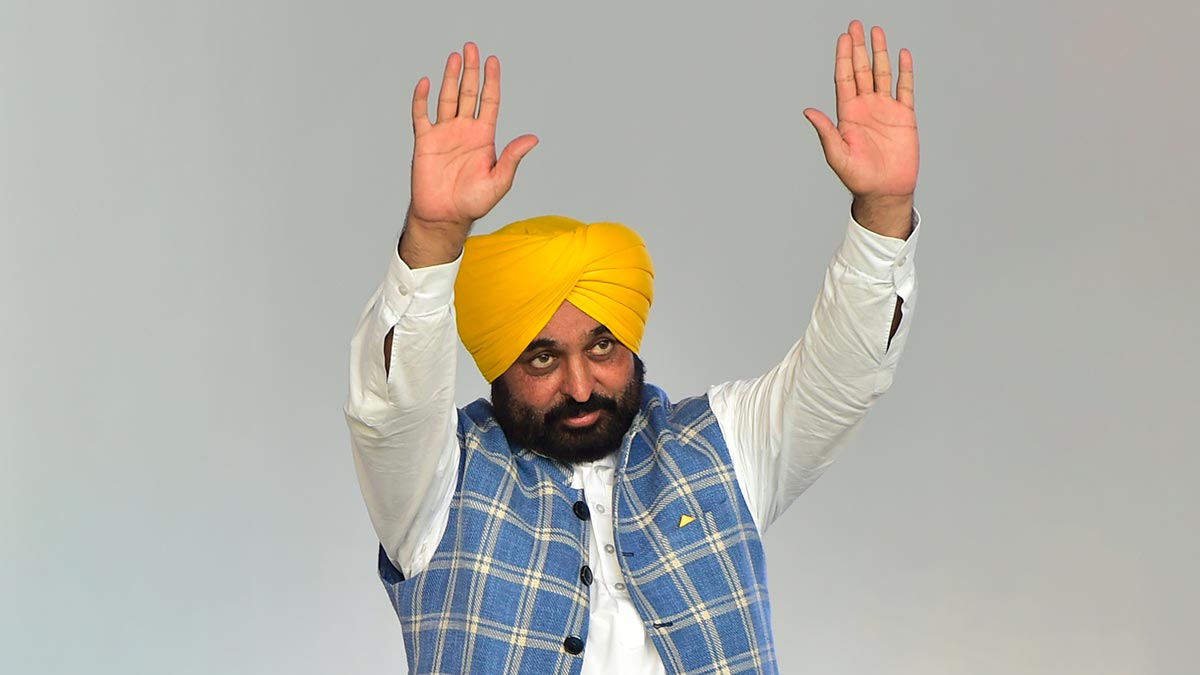
With the Punjab assembly election less than a year away, Chief Minister Bhagwant Mann finds himself facing a political storm. The controversy is no longer centred on a viral video that allegedly showed him disrespecting Sikh gurus. It is now about allegations that a forged forensic report was created to discredit that video.
The issue escalated after Gurugram Police arrested two people accused of helping prepare a fake forensic report linked to the case. The BJP has demanded Mann's resignation, while opposition parties have accused the AAP government of trying to influence public opinion through fabricated evidence.
Mann denied any wrongdoing and accused his opponents of indulging in dirty politics.
"For the past few days, fake videos of me have been circulated. When they find no other way, they try to defame me using religion," he said. Mann insisted that neither the appearance nor the mannerisms of the person in the video matched his own and maintained that forensic examinations had shown the clip to be false.
How the controversy unfolded
The dispute began after a video surfaced online claiming to show Mann sprinkling alcohol on pictures of Sikh gurus. The chief minister dismissed it as fake propaganda.
AAP cited reports from two private forensic laboratories, which it said concluded that the person seen in the footage was not Mann. On June 19, the chief minister said the man in the video was merely an actor who resembled him and directed the Punjab Police to identify those responsible for circulating the clip.
The controversy took a dramatic turn when Gurugram Police arrested two men accused of preparing a forged forensic and cyber analysis report.
The case was registered on the complaint of Jaspreet, a resident of Sirsa, who alleged that he was pressured, threatened and offered ₹10 lakh to prepare a report supporting a predetermined conclusion.
As a result, the debate has shifted. The central question is no longer whether the video is genuine. It is whether an attempt was made to manufacture evidence to shape the public narrative around it.
Why the Akal Takht's intervention matters
The controversy became much more serious after the intervention of the Akal Takht, Sikhism's highest temporal authority.
On June 15, it issued a hukamnama declaring Mann "guru dokhi" and "Khalsa Panth virodhi". The decision followed statements by Akal Takht Jathedar Giani Kuldeep Singh Gargaj that forensic examinations had found the video to be authentic.
The declaration came amid growing tensions between the Punjab government and Sikh religious authorities. Mann had earlier appeared before the Akal Takht after being summoned over remarks relating to Sikh practices.
Instead of accepting the criticism, Mann accused sections of the Sikh clergy of spreading false propaganda for political reasons, a remark widely seen as directed at the Shiromani Akali Dal and its influence within the Shiromani Gurdwara Parbandhak Committee.
Opposition parties argue that the alleged forged report was part of an effort to challenge the Akal Takht's position through alternative forensic findings rather than through institutional channels.
The sacrilege law complication
The controversy is particularly embarrassing for Mann because of a law introduced by his own government.
In April, the Punjab Assembly passed the Jaagat Jot Sri Guru Granth Sahib Satkar Act, 2026, which provides for life imprisonment in cases involving sacrilege of the Guru Granth Sahib. The law also expands the definition of sacrilege to include actions through speech, signs or electronic communication that hurt Sikh religious sentiments.
While many Sikh organisations welcomed the legislation, the Akal Takht criticised the government for not consulting Sikh institutions adequately before passing it. The law is currently facing a challenge in the Punjab and Haryana High Court.
Opposition parties argue that a government which enacted one of India's toughest anti-sacrilege laws now faces allegations that individuals attempted to fabricate evidence in a controversy involving religious sentiments and the chief minister himself.
Why it is politically damaging
The controversy affects several areas that are important to AAP's political strategy.
First, it risks undermining the party's efforts to strengthen its appeal among religious and panthic voters. Since coming to power in 2022, AAP has tried to project itself as sensitive to concerns relating to Sikh identity and sacrilege. The April legislation was seen as part of that effort.
Second, it has created an unusual degree of opposition unity. The Akali Dal, Congress and BJP disagree on most issues in Punjab politics. On this matter, however, they have largely adopted the same line of attack.
Third, the timing is difficult. With the next assembly election approaching, the controversy could shape public perceptions at a crucial stage.
Most importantly, allegations of a cover-up often prove more damaging than the original accusation. Mann can continue to argue that the person in the video is not him. The forgery investigation raises a different question: whether anyone attempted to manipulate evidence to influence how the public viewed the controversy.
What happens next
Much now depends on the Haryana Police investigation.
The key issue is whether investigators find any link between the alleged forgery effort and people connected to the Punjab government or AAP. The answer could determine both the legal and political consequences of the case.
Attention will also remain on the Akal Takht, which has already expressed strong reservations about the state's sacrilege law, and on the Punjab and Haryana High Court, where the legislation faces judicial scrutiny.
For the opposition, the strategy is straightforward. The BJP, Congress and Akali Dal are expected to keep the issue alive in the months ahead in the hope of damaging Mann's credibility before voters. That makes this one of the most politically sensitive challenges facing the chief minister since AAP's strong performance in the recent local body elections.
