



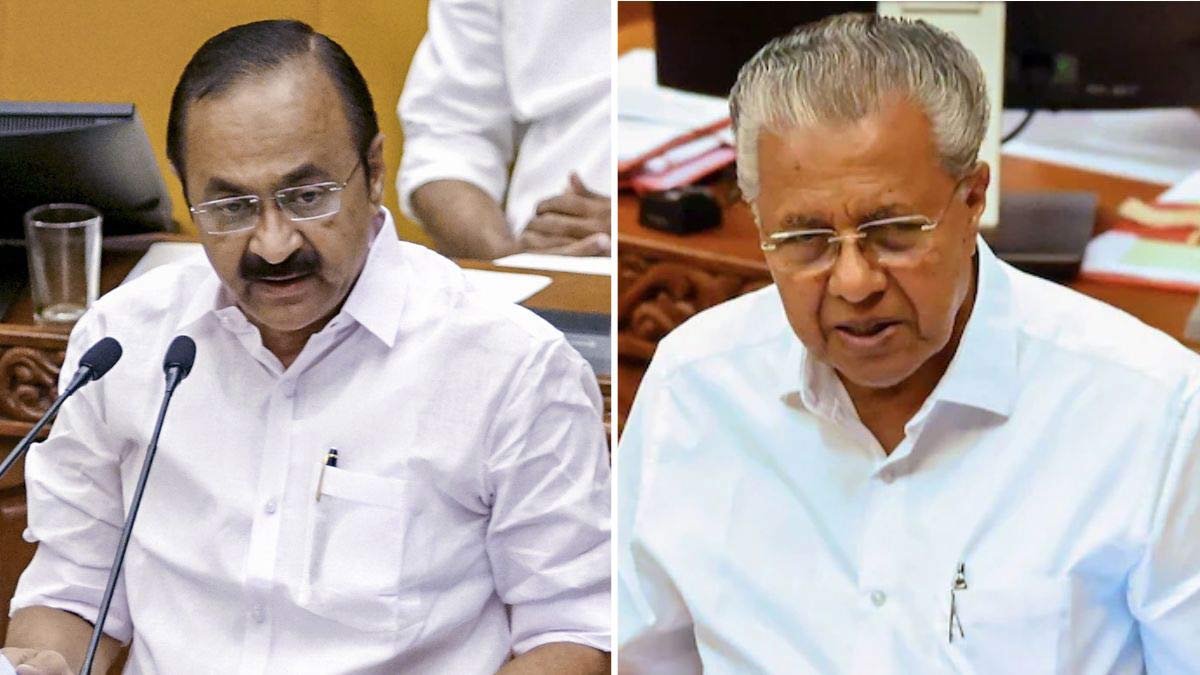
The Opposition in Kerala walked out of the assembly today after accusing Chief Minister V.D. Satheesan of pushing a tax cut for low-alcohol-content beverages to benefit a private liquor company.
Speaking on request for an adjournment motion moved by the Opposition, LoP Pinarayi Vijayan alleged that the proposal in the state budget to reduce taxes on low-alcohol-content beverages was tainted by corruption. He claimed the move was designed to generate windfall profits for a Karnataka-based liquor manufacturer.
According to Vijayan, the company had submitted an application to the state's tax department in 2023. While the previous government had not acted hastily on the request, the file moved with unusual speed after the new government assumed office. Seven officials processed the file in quick succession, he alleged, describing the pace of decision-making as highly irregular.
Seeking admission of the adjournment motion, Vijayan argued that the proposal would have far-reaching consequences for the state. Speaker Thiruvanchoor Radhakrishnan, however, rejected the request, noting that the matter fell within the ambit of the ongoing budget discussion and therefore could not be raised through an adjournment motion.
The ruling triggered noisy protests from the Opposition. Members raised slogans and eventually staged a walkout.
The controversy
Kerala's alcohol policy has traditionally sought to balance revenue generation through the state-controlled Kerala State Beverages Corporation (Bevco), social-control measures, and a gradual reduction in alcohol consumption. The state continues to have one of the highest per-capita alcohol consumption rates in the country.
The current controversy centres on budget proposal to introduce lower sales tax slabs for low-strength alcoholic beverages (0.5 per cent to 20 per cent ABV, excluding beer and wine), sharply reducing the uniform 251 per cent tax rate applied to Indian Made Foreign Liquor (IMFL) in the state.
CM Satheesan is expected to address the issue in the assembly tomorrow. His defence is likely to rest on the argument that the foundation for the policy was laid by the previous Left Democratic Front (LDF) government itself.
The government is expected to point out that the Vijayan-led LDF government amended the Abkari Act in 2023 and again in 2025 to create a separate category for beverages containing 0.5 per cent to 20 per cent alcohol. However, while the category was created, no tax structure was finalised.
Satheesan, who also holds the finance portfolio, is likely to argue that he had merely fixed the tax rates. The budget proposed a sales tax of 120 per cent for beverages with 0.5-10 per cent ABV and 175 per cent for those with more than 10 per cent and up to 20 per cent ABV. Though significantly lower than the 251 per cent rate applicable to IMFL, the government is expected to portray the move as a taxation measure aimed at formalising a category already created under law, rather than as a change in excise policy.
This defence assumes significance amid reports that Excise Minister M. Liju was unaware of the proposed tax slabs before they appeared in the budget.
After the Vijayan government introduced a proposal to permit the sale of low-alcohol beverages in Kerala and created a separate classification for such products, Bacardi approached the GST Department in 2023-24 seeking a tax concession for the sale of Breezers.
The department's initial report reportedly recommended against granting any immediate tax concession, suggesting instead that the market be observed for a year before a decision was taken. However, a subsequent report submitted six months later is understood to have proposed two options: either fix the tax rate midway between the rates applicable to beer (116 per cent) and Indian Made Foreign Liquor (IMFL) (251 per cent), or introduce differential tax rates based on alcohol content. The previous government, however, did not accept either of these recommendations.
Opposition's strategy
The LDF sees it as a multi-pronged political opportunity. A key slogan raised by the Opposition before the walkout was that the "KC group" was unaware of the development. The Opposition is seeking to portray the issue as evidence of divisions within the Cabinet, as well as within the UDF and the Congress.
AICC general secretary and Congress MP K.C. Venugopal had earlier said that the government has a responsibility to address public concerns arising from the state budget's decision to reduce taxes on low-alcohol-content beverages and its proposal on mineral sand mining, which could affect coastal regions.
Meanwhile, former KPCC president and senior Congress leader V.M. Sudheeran wrote to the chief minister urging him to reverse the decision to lower taxes on low-alcohol-content beverages.
The Opposition is expected to portray the budgetary announcement as a unilateral decision by Satheesan, taken without adequate discussion either within the party or the ruling alliance.
Community leaders, particularly from minority communities, have also expressed reservations about the proposal, arguing that it could dilute anti-substance-abuse efforts. The challenge before the CM will be not only to bring his party and alliance on board but also to frame the measure as a harm-reduction tool that could encourage consumers to shift from high-strength spirits to milder alternatives.
Satheesan is also likely to argue that such an approach is a pragmatic response at a time when Kerala is grappling with a growing drug menace.
The Opposition, however, is expected to accuse Satheesan of hypocrisy. It is likely to point out that, while in the Opposition, he had levelled allegations of corruption against the LDF government's attempt to produce low-alcohol beverages from fruits as a means of supporting farmers.
Former excise minister M.B. Rajesh has already advanced that line of attack, arguing that Satheesan has effectively taken a U-turn on the issue and is now acting in favour of the commercial interests of liquor companies.
