



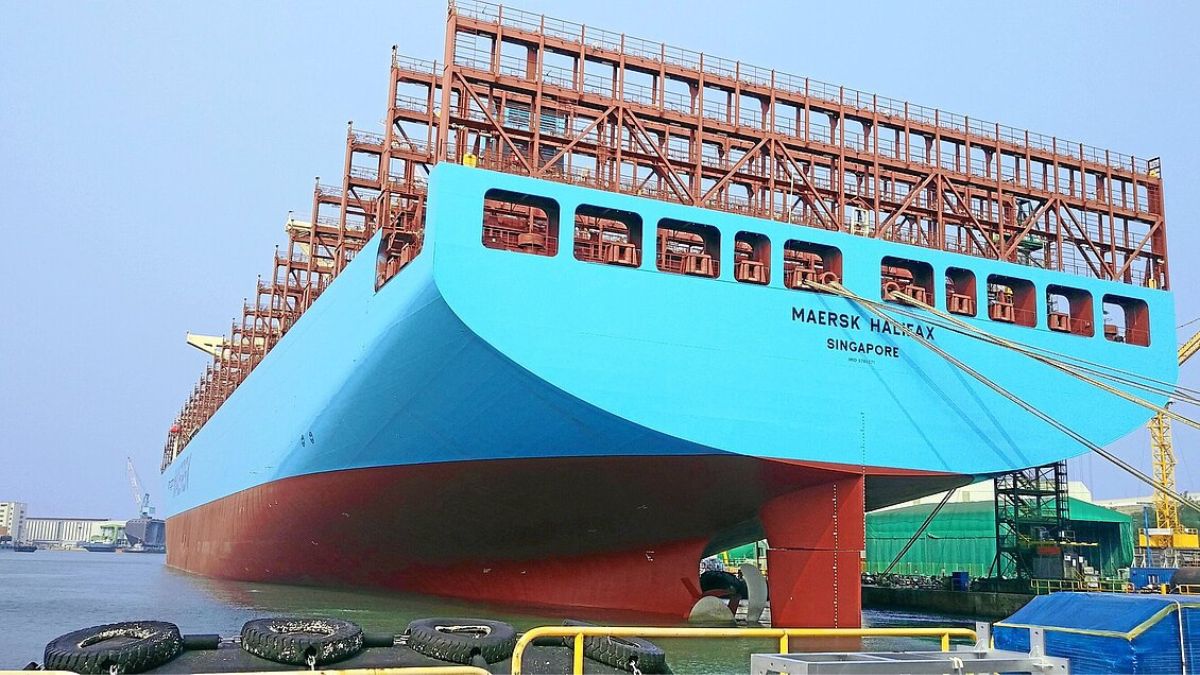
The state-run Shipping Corporation of India (SCI) has floated its biggest-ever global tender for container ships in what could shape up to become a major deal worth about $720 million (about ₹6,858 crore).
The new global tender is for the construction of six cellular ships with a capacity of 8,000 twenty-foot equivalents (TEUs) each. This includes two confirmed ships with the construction of the rest being optional, as per an ET Infra report.
A cellular ship is a type of container ship with vertical guide rails and slots to help stack standard cargo containers of 20 feet or 40 feet each in an ordered manner.
This helps stack a certain number of containers tightly, and thus cannot be used in the case of non-containerised or general cargo, which can be uneven.
The report added that a key feature of the shipbuilding contract is that it will have provisions to modify the parties involved in it, which could indicate that the six cellular ships could be owned by the Bharat Container Shipping Line (BCSL) consortium, of which SCI is a member.
Other members of the consortium behind India's aggregate shipbuilding push include the Container Corporation of India (CONCOR), Jawaharlal Nehru Port Authority (JNPA), V.O. Chidambaranar Port Authority (VOCPA), Chennai Port Authority, and the Sagarmala Finance Corporation Limited (SMFCL).
In a move to prioritise shipbuilders within the country, in line with the Make in India initiative, the lowest evaluated bidder among the qualified Indian ones will be offered the Right of First Refusal (RoFR) against the lowest evaluated foreign shipyard.
What this means is that the selected Indian shipyard will be given a chance to match the lowest evaluated bid of the foreign shipyard, and if it cannot, the next Indian shipyard in line will be given the chance to do so, and so on, in line with the tender terms.
The Indian bids can also factor in support from the Centre under the ₹24,736 crore Shipbuilding Financial Assistance Scheme (SBFAS) within the 2025 maritime package of ₹69,725 crore, which would get them 15-25 per cent financial assistance per vessel.
Indian shipyards that do not have prior experience building cellular ships are also allowed to have a technical collaboration with a reputed foreign shipyard. In this case, the latter must have delivered at least two such ships of at least 5,000 TEUs each in the last 10 years, which are in service.
The foreign shipyard must also offer basic and detailed design support to the Indian one throughout the project, and must also have experience delivering or designing dual-fuel vessels that are in service.
The tender also notes that the ships must be built in the bidder's own facility, and that sub-contracting the offer—in part or full—is not allowed. Bidders have also been asked to quote a fixed price on a 100 per cent cash-basis, payable in installments.
This comes months after the SCI floated a similar tender for the construction of six (two firm and four optional) methanol dual-fuel-ready feeder container ships.
The tender, worth about $360 million, would see it get six such vessels with a capacity of 1,700 TEUs each, in yet another major push for Indian shipbuilding.
