



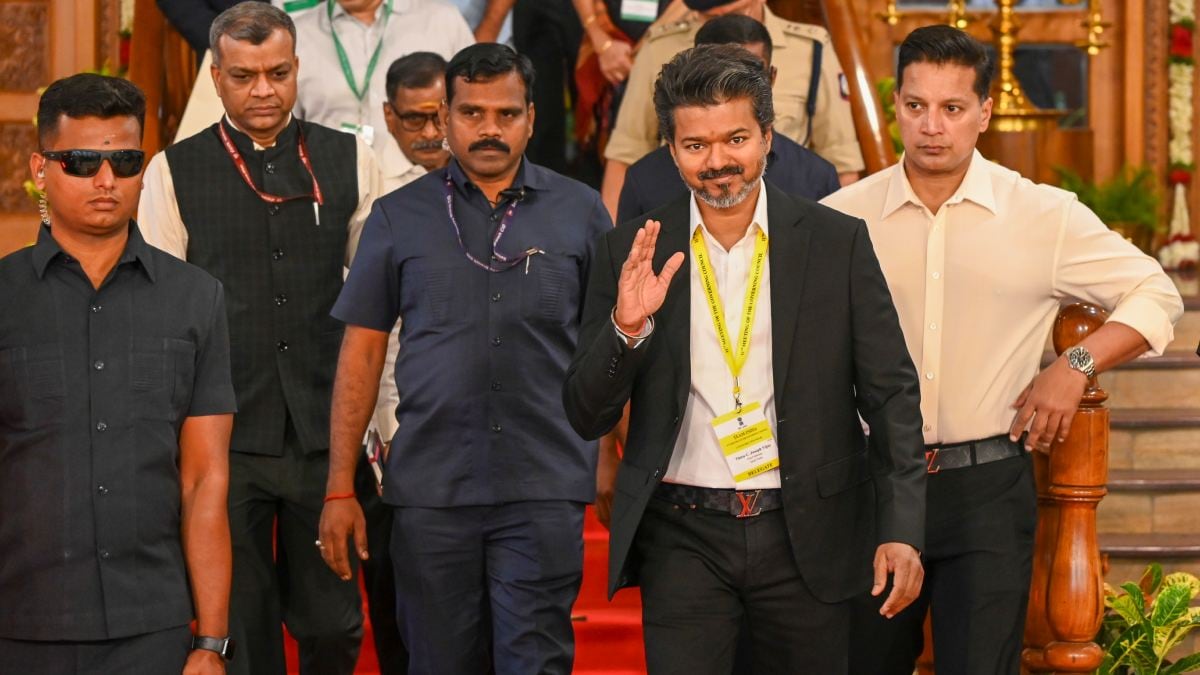
At the 11th Governing Council meeting of the NITI Aayog held in Delhi on Thursday, Tamil Nadu Chief Minister C. Joseph Vijay reiterated his opposition to the NEET exam while outlining his strategic vision and roadmap for the state's economic growth.
Speaking at the meeting, Vijay presented a high-stakes vision aimed at positioning Tamil Nadu not merely as a participant in national growth, but as its primary engine. Vijay framed the state's internal milestones as the essential prerequisites for a developed India and outlined a roadmap that transitions from a $1.5 trillion state economy by 2036 to the broader Viksit Bharat goal of 2047.
"Tamil Nadu wholeheartedly supports the nation's aspirations and firmly believes that a developed India can be built only through empowered states, cooperative federalism, and inclusive development," the CM said.
By framing its $1.5 trillion goal as a foundational anchor, Vijay appeared to argue that national strength is a derivative of state-level empowerment rather than a replacement for it.
Revealing his blueprint anchored on four structural pillars — youth, the poor, women and farmers — Vijay said in his speech that these are the fundamental drivers of Tamil Nadu's resilience and long-term productivity, and represent the "four engines" required to sustain high-velocity growth amid global economic volatility. Unlike other states that rely on single-sector booms, Tamil Nadu's engine is powered by a mix of traditional manufacturing, automotive leadership and a rapidly expanding services sector.
In his speech, Vijay indicated that his administration views the state's young population as its "greatest strength", while arguing that the demographic dividend is a time-sensitive asset that requires immediate, large-scale investment. Future-proofing the workforce is no longer an option but a survival strategy in a global market increasingly dominated by automation and frontier technologies, he noted.
"I envisage a Youth Skill and Employment Mission under which five lakh youth annually will receive stipend-supported internships and industry-linked training, and we request the Union government's support to establish emerging technology skill centres in every district and to train five lakh youth in Artificial Intelligence, deep technology, cybersecurity, cloud computing, EV technology and semiconductor-related sectors," he said.
Stating that the government is committed to protecting the rights of students, Vijay framed the abolition of NEET as a non-negotiable matter of social justice. He also sought permission to fill all seats under the state quota in MBBS, BDS and AYUSH courses based solely on Class XII marks.
By demanding admissions based solely on Class XII marks, Vijay's strategy appears to be an attempt to decouple professional opportunity from socio-economic status and assert that inclusive education is the only sustainable way to empower individuals and, by extension, the state's economic future.
Vijay's speech largely focused on harnessing the demographic dividend through youth empowerment, innovation and his opposition to NEET, while also emphasising social equity and women-led development. While insisting on cooperative federalism and the fiscal mandate, the chief minister also laid out his vision for state-led diplomacy and identity, which extends to regional security and cultural recognition.
Vijay's speech focused on Tamil Nadu's roadmap for 2047, with a definitive call for a partnership based on mutual respect rather than central mandates. His message to the NITI Aayog was clear: the vision of a prosperous India can only be achieved if the Union government supports the innovation and fiscal autonomy of its most productive states.
