



In Singapore, every large building has a green roof (vegetation) that can store rainwater that helps in urban cooling, stormwater management and improves air quality. In the Netherlands, the ‘Room-for-the-river concept is adopted, where the river (or rainwater) is allowed to flood agricultural land, playgrounds and parking lots every 10-20 years to save the downstream big cities from devastation. In Ghana, the ‘polluter must pay’ principle is a sustainable funding option where taxes collected on plastics is being used to build recycling plants.
Moving beyond engineering solutions to urban floods, a global webinar on “Managing urban floods in today’s climate-risked world”, hosted by Centre for Science and Environment discussed nature-based solutions drawing examples from Global South cities.
Flagging the chronic issues plaguing the flood control in cities, experts stated that poor urban planning and governance, outdated drainage systems, fragmented institutional responsibility, data gaps, weak early warning systems, urban planning without factoring in climate change, encroachment of wetlands, weak enforcement of land use and zoning regulations, poor solid waste management, and lack of public awareness
Rajeevan Madhavan Nair, vice chancellor of Atria University and former secretary, Union Ministry of Earth Sciences, said, “Not many people know how many rain hours their city has. It is about 400 hours in the coastal belt and up to 150 hours elsewhere for the whole season. And half of the seasonal rainfall occurs in just 25% of the total rain hours, which has the potential to cause urban floods. Globally more and more cities are under flood threat today and the settlements exposed to flood hazard increased by 122%. Most low-income countries are increasingly being exposed to urban floods.”
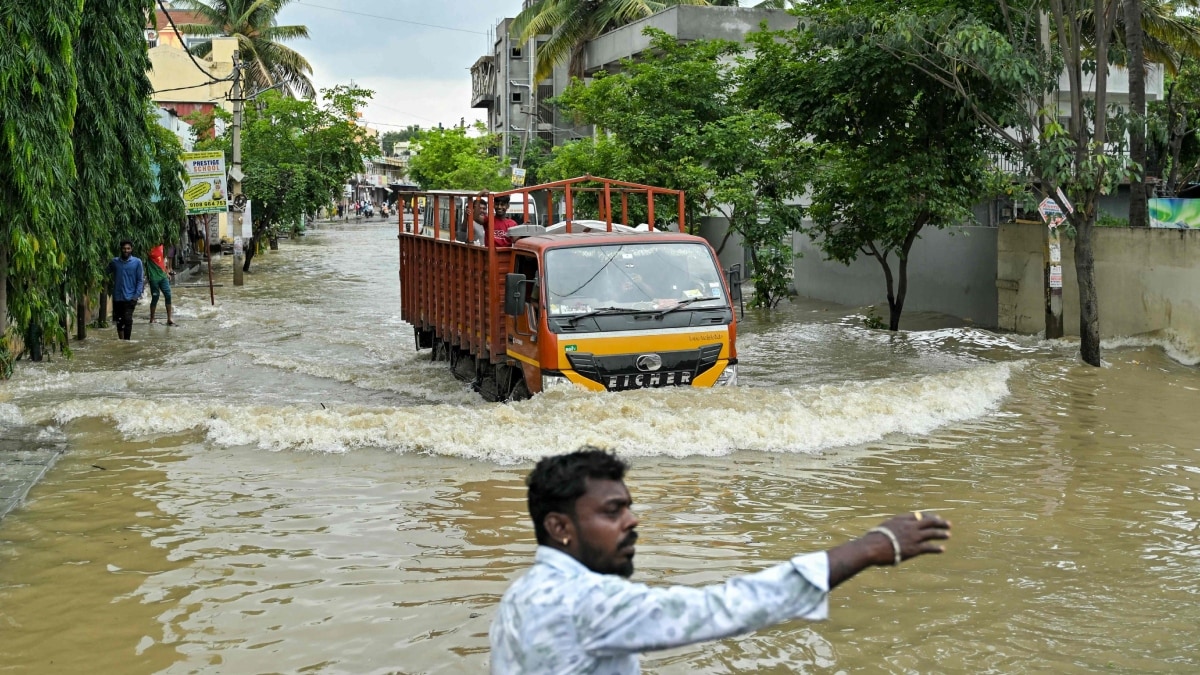
Elaborating on the worst floods in the country, Nair flagged off reasons for urban floods in India. “If the 2015 Chennai floods were caused due to wetland encroachment for urban expansion, poor maintenance of storm drains, garbage and silt blocking the channels, sudden release of excess water from Chembarambakkam reservoir and unregulated construction blocking natural drainage pathways. But the 2022 Bengaluru floods caused severe water logging in major parts of the IT corridor owing to loss of lakes and Rajakaluves due to encroachment and degradation. Haphazard urbanisation and the now defunct lake system that connected the city’s undulating terrain were responsible for flooding,” said Nair.
Stressing on the need for early flood warning system, Nair said that the IIT, Mumbai had set up India’s first urban radar network comprising four short range X -band polarimetric radars at Vile Parle, Navi Mumbai, Vasai Virar and Kalyan-Dombivli (spaced 30 km apart) to give hyper local information that helped in predictions.
Dr Stephen Appiah Takyi, senior lecturer, department of planning, KNUST, Ghana said the urban flooding was a growing challenge in Ghanaian cities, posing threat to live, livelihood and infrastructure and stated that weak enforcement of planning and regulation of land use had resulted in buildings cropping up in wetlands, waterways and floodplains, lack of qualified personnel and logistics in district planning offices had led to poor monitoring and enforcement and political interference had led to gross violation of land use.
“A flood event disrupts small and medium enterprises, damages 30% of infrastructure and an estimated $200 million is the annual economic loss in Accra alone (World Bank 2020). So protection of buffer zones, adoption of the polluter pays principle to raise funds for city management, incentives for residents to promote environmental sustainability and upgradation of existing drainage systems can go a long way in mitigation of floods,” said Takyi.
Joop Stoutjesdijk, lead irrigation engineer, World Bank advocates for nature-based solutions stating most public works and agencies only focus on grey infrastructure (stormwater drains).
“Nature-based solutions augment and complement the grey infrastructure. Every city should start with mapping to identify the vulnerable areas. Many lakes have been lost, and they will not come back. But the existing lakes should be restored and should become part of an integrated flood management program. Native trees and vegetation are important. Replace concrete surfaces with permeable pavements. You can construct recharge wells in the wetlands to augment groundwater levels,” said Stoutjesdijk.
Citing many examples, he said, “Bengaluru, has lots of green spaces. We must utilise it to retain water by creating artificial wetlands, retention ponds, and adopting rainwater harvesting. For instance, in Singapore, every large building now has a green roof, and rainwater harvesting. In Metro Manila (Philippines), we're constructing a large dam upstream of the city to keep water out of the city during typhoon events. When the floods in the urban areas have receded, you can release water out of the dam to create capacity again for the next floods. In the ‘Room-for-the-river concept, like in the Netherlands, we allow the river to flood certain areas, agricultural land, every 10-20 years to ensure that the big cities further downstream are not impacted.”
In addition to reduced flooding, benefits of nature-based solution and retention capacity are improved water quality, increased biodiversity, and even cooler urban temperatures, say experts.
