



Amid the resounding din over the Manipur issue and the no-confidence motion debate on Tuesday, the Rajya Sabha approved the key Inter-Services Organisation (Command, Control & Discipline) Bill – 2023 providing further traction to Indian military’s game-changing ‘theaterisation’ effort.
The Upper House passed the bill four days after the Lok Sabha or the Lower House had given the green signal on Friday.
After the enactment of the legislation by both the houses of parliament, the Bill will go to the President for her assent subsequent to which it will be notified as an ‘Act’ in the Gazette of India.
The Bill is among the pre-requisites that clear the deck for the operationalisation of the ‘theaterisation’ process. It empowers the commander-in-chief and officer-in-command of Inter-Services Organisations (ISOs) with all disciplinary and administrative powers in respect of the personnel serving in or attached to such organisations.
What it means is that the commanding officer—regardless of which parent service he or she belongs to—will be able to exert administrative and disciplinary control over the personnel under his command whether they be from the army, the air force or the navy.
The new law will replace the provisions contained in the specific service acts—Army Act 1950, Navy Act 1957 and Air Force Act 1950—in the ISOs.
In the theater command scheme of things, it will be the ISOs that will be the pivot of the command structure as opposed to the functional command system that is operational now.
The ‘theatrisation’ plan hinges on the principles of ‘jointness’, integration and interoperability of the war-fighting units of the Indian military.
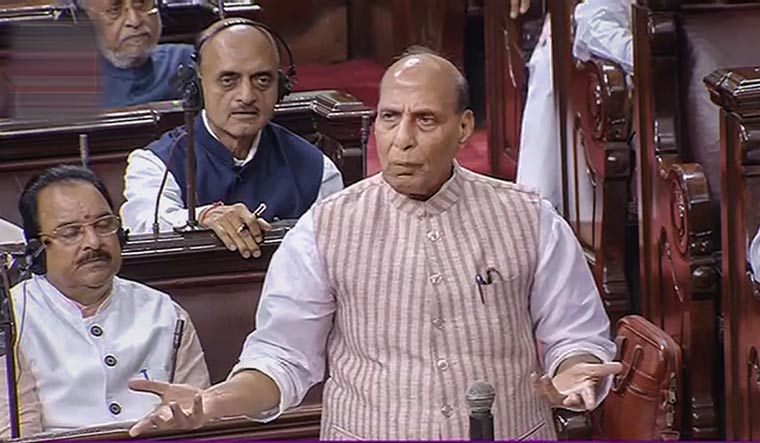
Initiating the Bill in the Upper House, defence minister Mantri Rajnath Singh said the Bill is “necessary to strengthen the armed forces in view of the global security scenario”. He said that only through better jointness and integration can the military move forward towards securing national interests.
With today’s wars being hybrid, technology and network centric, it is imperative for the three services “to work with greater coordination to face future challenges faced by the country”.
Significantly, the Bill also empowers the Centre to constitute an ISO which in the present context would refer to the various theater commands—which have not yet been announced.
