



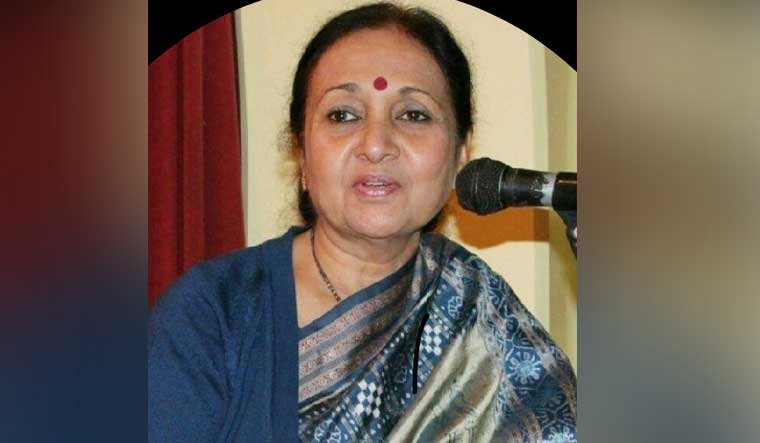
Manjari Jaruhar, a 1976 batch Indian Police Service officer, broke new ground when she became one of the first six women IPS officers in the country and the first from the state of Bihar.
Entering the civil services was her dream but the horror began when she faced discrimination in her job as a police officer. It was her unrelenting spirit and passion that helped her turn challenges into opportunities.
In a recent book, ''Madam Sir'' she describes her travails and tribulations as Bihar's first woman IPS officer. Jaruhar says disparity still exists when it comes to women in bureaucracy, especially the Indian Police Service which is more challenging than the foreign or administrative services. But, times are changing and more and more women are breaking the glass ceiling.
''My journey has been uphill not only as an IPS officer but as a woman who faced discrimination at every stage before I was accepted in the services''.
Excerpts.
Q. As the first lady IPS officer of Bihar, what challenges did you face?
My first challenge in joining the services, especially IPS, was to convince my parents who were not inclined to send me as they felt the job was physically taxing, entailed unearthly working hours and dealing with criminals. Their exposure to police was limited to the police station in our vicinity and the local policemen around there. It was after the intervention of some friends and relatives that they relented and I joined the service. When I arrived at the National Police Academy, I realised the challenges. The schedule was gruelling like waking up at 6 am to undergo exhaustive physical training and then attending classes throughout the day. When I arrived in the state, there was a lot of pushback as no one wanted a lady officer to be posted in their area. I ended up getting insignificant postings initially, which male IPS officers would resist. My bosses would refrain from sending me to tough field operations. It was frustrating. Over time, I was posted as ASP Danapur and my first challenge was to gain acceptability among my subordinates, the trust of my seniors and win over the people in my area. I handled some crucial cases of dacoity, murder and rioting and took strict action. Slowly, trust and acceptability started pouring in. Finally, I started doing the work for which I had joined the force. But, women have to work twice as hard to prove themselves first.
Q. Did you always want to become a police officer?
In those days, everyone who prepared for the Union Public Service Commission used to give the first preference as IFS, IAS and then IPS, and I also opted for the same. Interestingly, when I came to Delhi to prepare for UPSC in the 1970s, 50 per cent of those in my study circle were women which gave me a lot of hope and motivation. When I got my third preference, I readily accepted it. Today, almost all services are equally challenging but I still feel the police service is more challenging for women as there is constant field work, long hours, and direct interface with the public as well as criminals and you end up being constantly on the job.
Q. What was your most challenging assignment?
I was district Superintendent of police of Bokaro from 1983-86, when there was a massive strike at the steel plant. This was a time of turbulence in the country after the assassination of then-prime minister Indira Gandhi. At a sensitive time like that, it was a challenge to handle the crowds, control the situation and investigate cases to ensure speedy justice and keep law and order under control.
Q. Did you face death threats or political pressure during service?
It was because of the reputation I had built, that people were wary of approaching me. During my entire career, I did not get any calls or requests from politicians. They knew I will not oblige. There were petty threats from criminals and I needed to be cautious. Once I got calls threatening to kidnap my children and I took precautions for some time. It was a tactic to intimidate me.
Q. Do you feel there are more opportunities for women in states like Bihar, and Uttar Pradesh to join government services?
Women in these states have always been ready to take up challenging jobs and the civil services have been very popular here because there are fewer alternatives and opportunities around. So, both men and women would want to join the armed forces or the civil services. That trend continues. Of course, women are more aspirational today and governments are taking steps to harness their talent in every sphere.
Q. Do you think there is enough representation of women in bureaucracy today?
There is a disparity when it comes to the number of women in bureaucracy, especially in the Indian Police Service, but constant efforts are being made to increase it. After 1972 when Kiran Bedi joined the IPS, there was one woman IPS officer in the country for four years till six of us joined the IPS cadre in 1976. Now, we have a lot more women police officers coming in and the number is constantly growing. There is 33 per cent reservation in lower ranks in police service and states are making a constant effort to get women as constables, deputy superintendents of police and so on since more women are required to handle law and order duties in the police. The central paramilitary forces are also recruiting more women. It is a work in progress.
