



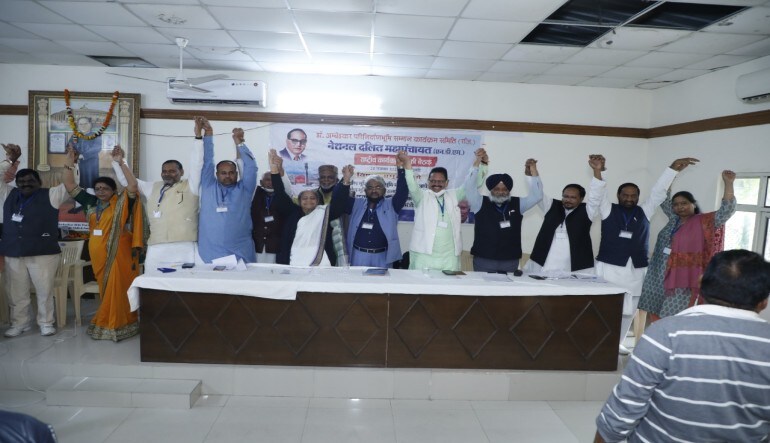
National Dalit Mahapanchayat (NDM), an organisation working for Dalit rights, demanded that the BJP appoints Dalit chief ministers in states ruled by the party in realisation of the struggles and dream of Dr B.R. Ambedkar that Dalits should share power in the country.
Based on a resolution passed at the national executive meeting and national convention of the NDM on Saturday, a memorandum of demand has been submitted to President Ram Nath Kovind and Prime Minister Narendra Modi, president of NDM Indresh Gajbhiye told THE WEEK.
The memorandum also included three other demands of the NDM on the basis of separate resolutions passed at the national executive, Gajbhiye said. Among them is the demand for a separate electorate for scheduled caste and scheduled tribe people in the country as envisaged by Dr Ambedkar.
Other demands include legal status as national memorial for Mahaparinirvan Sthal (memorial) of Dr Ambedkar in New Delhi through an Act in Parliament on the lines of Rajghat (Mahatma Gandhi's memorial), and acquisitions of bungalows around the sthal to give the memorial a larger space. Currently, it is situated in one acre of land.
The NDM said in its memorandum that the Congress had made K.R. Narayanan, a Dalit, president of the country and the BJP, Kovind. Recently, the Congress appointed Charanjit Channi as the chief minister of Punjab. Similarly, the BJP should also appoint Dalit CMs to realise the dreams of Dr Ambedkar.
The memorandum said despite reservation of seats for scheduled castes (SCs) and scheduled tribes (STs) in the country, these communities have remained largely unrepresented and their issues never taken up by the elected reserved category representatives. This is because only 40 per cent of the electorate are of reserved categories even in these reserved seats, while 60 per cent belong to general categories.
Multiple reserved category candidates vie in the polls and the reserved category votes are therefore divided and the candidate supported by general category normally wins. This elected candidate is then normally under influence of the general categories and fails to take up the issues of the category to which he/she belongs. This is the reason why SC/STs have failed to get proper representation, their issues have remained ignored and their progress has not become possible in the past 70 years, the memorandum said.
The memorandum also mentions that it was under severe pressure of Congress leaders following indefinite fast by Mahatma Gandhi in 1932 that Ambedkar was forced to agree to the Poona Pact. This led to withdrawal of the decision of the then British prime minister Ramsay MacDonald to give separate electorates to depressed (backward) classes for the election to provincial legislative assemblies. The result is that the progress of Dalits has remained impeded and to change this system, a separate electorate for SC/ST categories should be implemented, the memorandum said.
Separate electorates are usually demanded by minority communities who feel it would otherwise be difficult for them to get fair representation in government. It means that only members of a particular community will vote for a candidate of a reserved seat for that community.
