



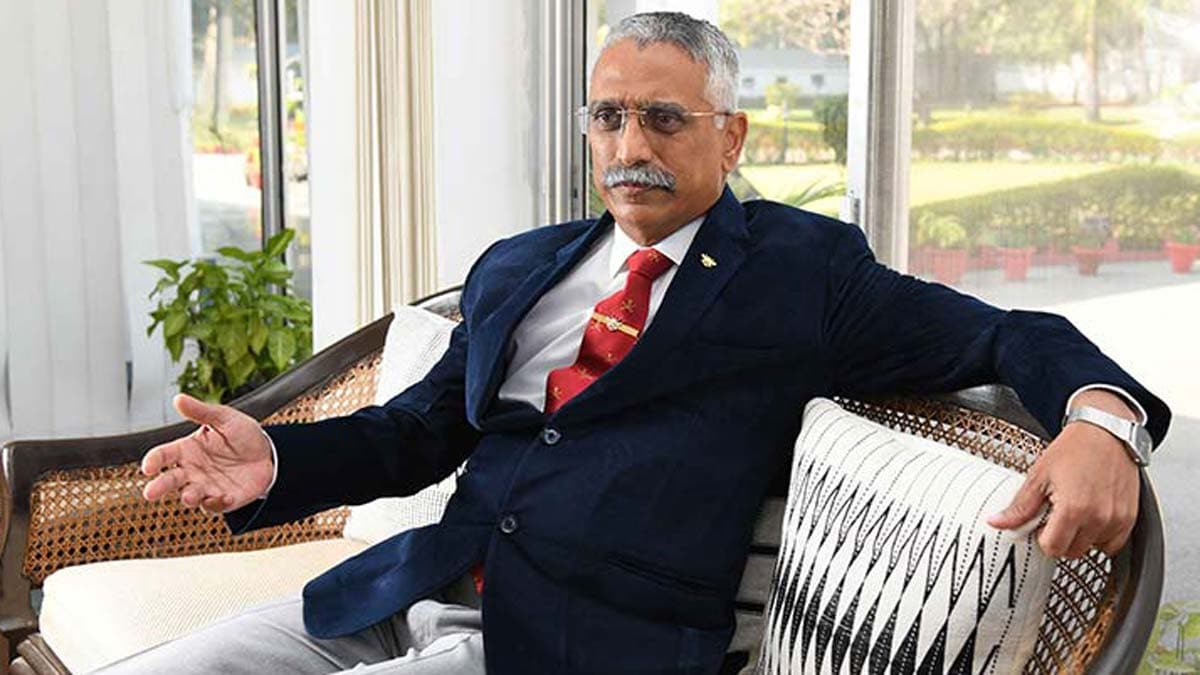
Operation Sindoor marked a "very significant shift" in India's approach towards Pakistan by expanding the scope of military action beyond terrorist hideouts near the border to those supporting them deep inside Pakistan, former Army chief General M.M. Naravane has said.
According to Naravane, India's responses to earlier terrorist attacks had largely focused on terrorist hideouts located close to the border. Operation Sindoor showed that those providing support to terrorists could also face Indian action regardless of where they were located. "Operation Sindoor, which took place after the Pahalgam attack, was a very necessary action," said Naravane, who served as the 28th Chief of the Army Staff, according to news agency PTI.
Speaking to reporters after attending a private event in Vadodara to promote the start-up ecosystem, Naravane compared Operation Sindoor with India's military responses following previous terrorist attacks.
"Previously, whenever such attacks occurred, like after Uri, and Balakot strikes after Pulwama, we were mostly targeting terrorist hideouts close to the border," he said.
However, Naravane said the approach changed with Operation Sindoor. "But this time, the strikes carried out targeted their supporters and those who provide them backing, wherever they may be, not just near the Line of Control, but deep inside Pakistan, in Muridke and Bahawalpur, from where they receive this support," he was quoted as saying, according to PTI.
The former Army chief said the operation sent a message that those supporting terrorism could not consider themselves safe because of their location. He added that India had also demonstrated that those providing support to terrorism "anywhere cannot escape".
"As our Defence Minister Rajnath Singh had said, 'we will enter their territory and eliminate them', and there will be no protection for them. So, this was a very significant shift in our modus operandi," Naravane said.
Naravane also responded to reports that Pakistan had increased its activities in the Sir Creek sector and was carrying out "Operation Ababil".
The former Army chief said such activities keep happening but added that, as a retired officer, he did not have complete information about the reported operation.
"These kinds of activities keep happening. I don't have complete information about this right now since I am retired," he said.
However, he stressed that the Indian armed forces remained vigilant and would respond if required.
"I would like to say that whatever activity takes place, our forces always keep a close watch on it. There is nothing to panic about, and whatever action needs to be taken, appropriate action will be taken at the right time," Naravane said.
Asked whether Pakistan was capable of taking on India, the former Army chief replied: "In my opinion, no."
Naravane also spoke about the proposed theatre commands, saying the debate over theatreisation of India's armed forces was not new.
He said discussions on the concept began after the Kargil War and have continued for more than 25 years.
"The discussion on theaterisation first began after the Kargil War. It has already been 25 to 26 years since then. Theaterisation is not a new concept; it is a continuous process and an evolution," he said.
According to Naravane, there is broad agreement that India should establish theatre commands, particularly as the nature of modern warfare changes and decision-making cycles become shorter.
"Considering the way the nature of modern warfare is transforming and decision cycles are becoming progressively shorter, it is essential that we move toward theaterisation as expeditiously as possible," he said.
