



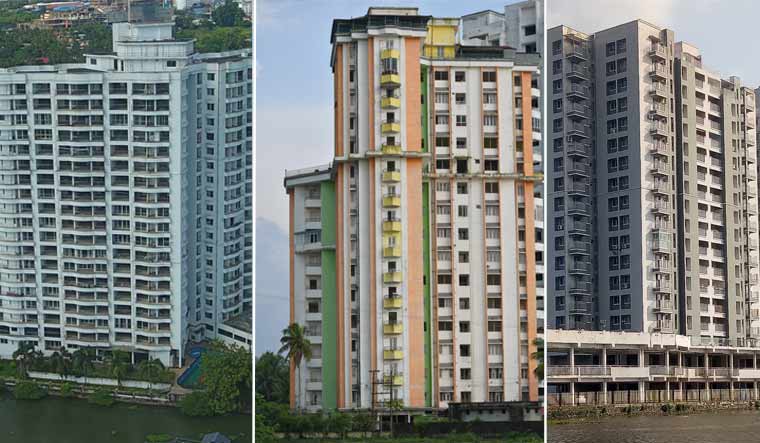
The apartments in Maradu municipality in Kochi, Kerala have been under the scanner for violating the Coastal Regulation Zone (CRZ) Act and its associated rules. As it is also situated in the wetlands, it also comes under the issues of wetlands protection. Subject to this, the Government of Kerala has enforced the immediate demolition of four buildings which have 343 apartment units in total.
The Supreme Court of India on May 8, 2019 ordered the demolition of four apartments in this municipality, namely, ‘Golden Kayaloram’, ‘H2O Holy Faith’, ‘Alfa Serene’ and ‘Jains Coral Cove’ for violating the Coastal Regulation Zone (CRZ) rules. The reason being the state is not able to withstand the danger of floods and heavy rains due to the effects of illegal constructions. No such orders of destruction of this scale has the SC decreed previously.
The apex court blamed the Maradu municipality for sanctioning the approval of these four buildings that are built on CRZ land. The most affected are the residents of these apartments who have been asked to vacate the premises in a short period of time so as to commence procedures for the building’s demolition. Each apartment is worth between Rs 50 lakh and Rs 1.5 crore. An owner would get only Rs.25 lakhs with no regards to the number of units he/she owned, be it 1 or 5, which is clearly unjustifiable and there are such owners as well.
Much is at stake and decisions have been implemented overnight, while these buildings have been standing erect for almost a decade. Furthermore, the demolition of the buildings could have adverse effects on its direct surroundings that pose a different set of serious concern on its own. The negative effects during and after the demolition, as well as the restoration phases, are beyond doubt unpredictable, in spite of any assurance from any agency. Further, the social and financial cost will be a heavy burden for the future.
The biggest conspiracy is the fact that ‘the permission to construct the buildings was granted in 2006 when Maradu was a panchayat’. Maradu was declared a municipality in 2010. In 2011, the CRZ rules were modified to say that construction activities were only prohibited up to 100 metres from the High Tide Line. Further, for Kerala, the 2011 rules said that beyond 50 metres from the HTL on the landward side of backwater islands, dwelling units of local communities might be constructed with the prior permission of the gram panchayat.
However, the SC says that these new rules cannot be applied in this case because the 2011 notification was not approved by the Union government and the apartments were built much before. The Supreme Court in November 2018 constituted a three-member panel to find out which claim was true; the committee, which included IAS officer K. Gopalakrishna Bhat; Ernakulam District Collector K. Mohammed Y. Safirulla; and Maradu Municipality Municipal Secretary Subhash P.K. concluded that this was a CRZ-III zone. On the basis of this, the SC ordered the demolition of the apartments. The SC said that the 2011 notifications were not approved by the Government of India, and therefore, the older rules from 1996 would apply―and reclassification will not be valid.
Many property buyers miss out the fact that, when purchasing a property near a coastal area or water body, permission of the panchayat or municipality is not enough if it falls under the CRZ-III or CRZ-I zone. Additional permission from the Coastal Regulation Authority (in Kerala, the Kerala Coastal Zone Management Authority) will be required.

As on November 4 2019, all residents of the four buildings has been evacuated, and both electricity and water supply has been stopped.
Furthermore, the lake near the buildings has never been an issue in spate. Bejoy Chennat, a resident of one of the flats, claims to have given shelter to over 30 families from Thripunithura and Edappally during the flood in 2018.
This leaves citizens with a lot of unanswered queries. How is destruction of a building justified? What is the immediate danger? Will its destruction solve a problem or will there be more? Are all stakeholders and users of the building who have no involvement in the decision-making process justly compensated? Why are there no laws to protect the effected who are not responsible―the residents of the buildings in this case? Why was permission granted to construct these buildings in the first place and now revoked due to change in laws?
The Apartments
H2O Holy Faith
Located near the Kundanoor-Thevara Bridge, H2O Holy Faith is at 19 floors high with 91 apartment units. The price range for an apartment ranges from Rs 97 lakh to Rs 1.25 crore. The building began functioning since June 2014.
There are a number of buildings here at stake other than the proposed building to be destructed itself. A private house is located at just 1.5m south of Holy Faith. Several other houses are also spread around the flat. The Kundanoor-Thevara bridge is just 10m apart. Gas and water pipelines also run underneath the flat. The biggest challenge would be to prevent debris from falling into the canal during destruction.
Alfa Serene
The Alfa Serene is located just opposite the canal from H2O Holy Faith apartment. It is a twin building with 16 floors height and having 80 apartment units. Adjacent to Alfa Serene, a hotel, a church and several other houses are accommodated. This is the only apartment where the director of the flat has promised new apartments for the tenants free of cost to be built elsewhere at a later time.
Jain Coral
The location of Jain Coral is at a peninsular piece of land with water on three sides. At 16 floors high (50m), it contains 122 apartment units. Price of an apartment unit starts from Rs 86 lakh. Among the four buildings under the scanner, this is the biggest apartment, and also the one with the highest infractions including an over the canal construction. The stakes due to the destruction of the apartment are also high due to the presence of the canal on three sides of the apartment. Several private houses and a KSEB electricity tower surround its vicinity.
Golden Kayaloram
Built with a setback of just 9m, this apartment stands tall at 50m with 16 floors that includes 40 apartment units. The price for a unit ranges between Rs 50-60 lakh. Next to the Golden Kayaloram is located an even taller apartment, a school and several other private houses.
The Demolition Plan
The demolition contract has been given to two private firms, namely, Edifice Engineering, a Mumbai-based firm (for Jain Coral, H2O Holy Faith, Golden Kayaloram), and Vijay Steels, a Chennai-based firm (for Alpha Serene).
The Kerala State Remote Sensing and Environment Centre have identified 9,522 buildings within a one km radius of the apartment complexes to be issued an alert. Talking about the concerns over dumping materials into the water after demolition, the sub-collector of Ernakulam district said, “There is no plan to dump any material into the water. It will be discarded in a way that won't affect the water bodies”.
Another tender will also be floated later for the removal of debris. According to the action plan, the time taken for the destruction of buildings would be 90 days and the whole process, including the removal of debris, will be completed by February 9, 2020.
Though the tender invite published by the Maradu municipality had initially stressed that the buildings would be demolished without using blasting devices, it was later changed. The firms have insisted to use blasting devices since there are no alternatives for explosives to raze down the buildings in such a short period of time.
The Coastal Area and the CRZ
The Coastal Regulation Zone was set up to safeguard the fragile ecosystem and to promote sustained utilisation of the coastal areas in India. Based on that, the Coastal Regulation Zone (CRZ) notification was issued in 1991, amended in 2011 and lastly on January 18, 2019 under the Environmental Protection Act, 1986, by the Ministry of Environment and Forest to regulate activities in coastal areas of India.
The CRZ is classified into four sub-categories, namely, CRZ-I, CRZ-II, CRZ-III and CRZ-IV. The ecologically sensitive areas and geomorphological features that lie between high and low tide line, and are very much essential for maintaining the ecosystems, are covered under CRZ-I. It is further classified into CRZ-IA which includes mangroves, coral reefs, sand dunes, biologically active mudflats, national parks, salt marshes, sea grass beds, nesting grounds, areas of archaeological importance etc. Intertidal zones between Low Tide and High Tide Line shall constitute CRZ-IB. Natural gas exploration and salt extraction are permitted in this zone. The developed areas up to the shoreline of the coast are notified under CRZ-II. It is substantially built up areas provided with drainage, roads and sewerage facilities.
The Maradu flats are within the CRZ-II area and not within CRZ-III. Rural areas that are undisturbed which fall outside CRZ-I and CRZ-II are covered under CRZ-III. It is further classified into CRZ-IIIA and B. Such densely populated areas with more than 2,161 people per square kilometre as per 2011 census shall be designated as CRZ-IIIA. However, under the coastal zone management plan, these flats are under CRZ-III. Area which is 50 meters from the HTL on the landward side shall be earmarked as “No Development Zone.” CRZ-IIIB is also with same conditions, but with an area up to 200 meters from the HTL on the landward side shall be earmarked as “No Development Zone.” Aquatic, water areas up to territorial limits are notified under CRZ-IV. Water area and the seabed area between the Low Tide Line up to 12 nautical miles on the seaward side is CRZ-IVA. CRZ-IVB areas shall include water area and the bed area between LTL at the banks of the tidal area and the banks of the opposite bank, extending from the mouth of the water body at the sea up to the influence of the tide.
It is evident that thickly populated areas similar to Maradu come under the CRZ-II area and putting it under CRZ-III of 2011 provisions will do great injustice to the occupants and a national waste when 1.77 million homeless people in India. Construction of buildings for residential purpose have allowed under CRZ-II. However, the Supreme Court found these flats in CRZ-III area under the 1991 notification. These draconian laws pose a nightmare to those who want to construct a house in Kerala, in the name of environmental protection with 580 KM of coastal length. If you travel across the countries, high-rise buildings are in the vicinity of sea beaches or in the banks of rivers like in Chicago, Paris, Manila or in any gulf countries. Protection of environment is important, but it cannot override the fundamental rights of citizens. Any kind of violations and violators must be punished rather taking antediluvian decisions by the judiciary and executives.
Environmental Hazards from destruction of structures
Every building is built with an estimated lifespan of 100 years. Three of the four buildings under scrutiny here, were built only within the last decade; making it a waste of natural resources and economy.
Controlled implosion, as suggested for this issue at hand, being spectacular, is the method that the public often thinks of when discussing demolition. However, it can be dangerous and is only used as a last resort when other methods are impractical or too costly. A perfectly controlled implosion would mean the building collapses within its own footprint without damaging surrounding structures. However, this might not always be the case. Real time factors are numerous and might take months to study all of them.
A slight error can be disastrous; one prominent danger is flying debris, when improperly prepared for, can kill onlookers.
Another dangerous scenario is the partial failure of an attempted implosion. When a building fails to collapse completely the structure may be unstable, tilting at a dangerous angle, and filled with un-detonated but still primed explosives, making it difficult for workers to approach safely.
Air over-pressure during implosion is another issue. If cloud coverage is low, the shock wave can travel outwards and destroy windows of surrounding buildings. Stephanie Kegley of CST Environmental, California described shock waves by saying, “The shock wave is like a water hose. If you put your hand in front of the water as it comes out, it fans to all sides. When cloud coverage is below 1,200 feet, it reacts like the hand in front of the hose. The wave from the shock fans out instead of up toward the sky”. This shockwave can even affect bridges.
If the land in the nearby plots were to rise, the buildings could be destroyed or develop cracks.
When 15,000 tonnes of weight bears down on the earth, it could cause the land to cave in and in the following impact, the land in the adjacent plots could rise. If it has the same impact on the nearby water bodies, it could obstruct the smooth flow of the water.
The dust created from the explosion can engulf the region, resulting in Silicosis for the people around. The effects of suspended particulate matter can be prolonged!
There are risks with debris falling into the canal due to its close proximity with the proposed buildings.
Other consequences of demolition of a building are as follows:
Injury to the human workers due to difficulty in accessing into or working inside a building, which is under demolition.
Falling of partially demolished structure.
Collapse of unstable structure due to original structure being disturbed.
Collapse of heavy demolition equipment due to inadequate support of the partially demolished structure.
Collapse of the partially demolished structure due to the accommodation of large amount of unclear debris.
Congested site environment that easily cause damages to human workers or to the third parties that are situated nearby the demo1ition site.
Heavy machinery used in demolition may have risk of collapse due to insufficient support.
Case Studies: Building demolition failures
While most buildings are destroyed due to end of life or unsafe liveable conditions, these buildings when destroyed can sometimes cause unseen collateral damages. Some such cases are mentioned below:
In 1997, the Royal Canberra Hospital implosion in Canberra, Australia experienced disaster. The main building did not fully disintegrate and had to be manually demolished. Far worse, the explosion was not contained on the site and large pieces of debris were projected towards spectators 500 metres away, in a location considered safe for viewing. A twelve-year-old girl was killed instantly, and nine others were injured. Large fragments of masonry and metal were found 650 metres from the demolition site.
In 2005, a Zip Feed Mill tower in Sioux Falls, South Dakota, just settled down into its basement and refused to go any further. It sat there with a victorious lean for two weeks while wrecking crews took it apart by more conventional smashing means.
In 2014, A botched demolition job left Crimea's disputed city of Sevastopol, Russia with its very own leaning tower. The 16-storey building was left tilting at a 70-degree angle after explosives failed to bring it down, a case of similar scale apartment building.
In 2009, the demolition of a derelict building in Turkey almost resulted in tragedy when instead of crumbling to the ground as expected, it toppled onto its side and rolled onto its roof. Astonishingly, as the building toppled over, its walls remained intact and it started to roll. The building, constructed in 1928, was still standing, albeit upside down. Contractors had intended to reduce the 25-metre high structure to rubble in order to start construction on a new shopping centre.
In April 2018, a “controlled” explosive demolition of an obsolete, 53m concrete silo in Denmark took a turn for the worse, when it toppled in the wrong direction and came crashing down on a large library building. “I will put my head on the block. We have prepared half a year for this,” Mr Wegge, contractor of the demolition work said later.
Alternate Proposals
The building has already been constructed, many discussions has been held about its legality, but will demolition of the above constructed buildings bring about a positive environment change or is it only to set a strong example for future builders. Have there been any other motives behind this sudden check in buildings and why only in Kochi, since there are numerous buildings throughout India violating such norms? Whatever be the true reason, there is always an alternative. Some of these are as follows:
A resident of the Golden Kayaloram (one of the proposed buildings to be demolished) stated, units of the apartment had been used to shelter several families during the Kerala flood in 2018. Also stated from multiple newspaper reports, the Maradu canal was never overflown even during the flood and thus shows this space has the potential to house people during times of crisis. Hence, rather than destroying the apartments, they may be used at times of need when people need to be sheltered urgently.
Conversion to Homeless Shelters―a just and fair solution the government can implement to satisfy the city’s homeless.
Use the building for vertical farming. Vertical farming is the practice of producing food and medicine in vertically stacked layers. With the city’s need for space and a green land, these buildings can be used for farming to the city’s needs. Ecologist Dickson Despommier argues that vertical farming is legitimate for environmental reasons. He claims that the cultivation of plant life within skyscrapers will require less embodied energy and produce less pollution than some methods of producing plant life on natural landscapes.
Smog Towers: Cities are dense and density brings in a lot of air pollution from traffic and factories. Converting the structures to smog towers can help reduce the sir pollution of the city to a great extent.
Spend government funds on other basic needs of the city such as improving the condition of roads and a proper drainage system. The city of Kochi was also recently flooded during the monsoon rains in 2019. Roads are seriously damaged and normal life was disrupted.
Penalise only the authorities for sanctioning the building in the first place and let residents stay as before. Many residents who have bought these apartments have done so by exhausting their life-savings; and clearly the compensation proposed is not justifiable. Construction of a building does not happen overnight. If a check on illegal structures need to be conducted, this is definitely not the right time. For the failure of the authorities not being able to take action on-time, residents of the building shouldn’t be the culprits.
The Maradu demolition case has definitely caught many stakeholders’ attention due to its complexity of issues and environmental and social concerns. While the need for stronger rules and regulations to protect the environment is obligatory, the government will need to take strict measures against the offenders. However, this has to be done justly and sudden implementation of decisions might not always aggregate to the intended solution, which means the case has to be ‘relooked into’. The life and wellbeing of many people who are not responsible for this current situation are at stake here.
The government needs to come up with a better and sensible plan than just blindly proposing the building demolition, especially when such scale of an event has never happened in the history of India. Confusing rules and regulations, and untimely management on checks of illegal construction activities are the major cause for such a situation. The citizens of the country look up to the government for better and much more sensible solutions to their woes and again approach the Supreme Court in the light of the suggestions and studies the authors have placed.
The piece is based on the paper ‘Alternate Solutions to Demolition of Buildings in Maradu under CRZ Infringements’ by Prof Abraham George, Associate Professor, Department of Architecture and Planning, IIT Kharagpur, West Bengal; Prof K.D. Raju, Professor of Law, Rajiv Gandhi School of Intellectual Property Law, IIT, Kharagpur, West Bengal; Dr Sameer Ali, Research Scholar, Department of Architecture and Planning, IIT Kharagpur.
The opinions expressed in this article are those of the authors' and do not purport to reflect the opinions or views of THE WEEK.
