



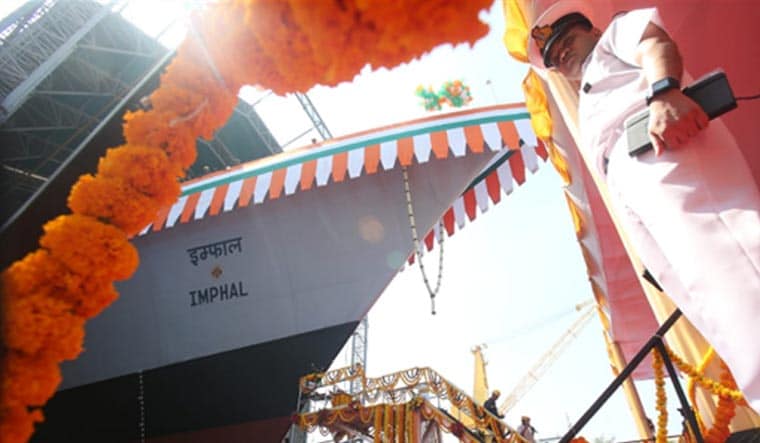
At around noon on Saturday, Reena Lanba, first lady of the Indian Navy family broke a coconut on ship's bow to launch the INS Imphal, the guided missile destroyer. Sunil Lanb, the wife of the Navy Chief Admiral, presided over the ceremony amidst chanting of slokas from the Atharva Veda, in keeping with maritime traditions.
With this, the 3,037-ton warship made its first contact with waters.
INS Imphal is the first warship to be named after a northeast city in one of the Seven Sister.
The ship was launched at the Mazadon Dock Shipbuilders limited in Mumbai was the third ship of Project 15 B, making a singlificant milestone in the annals of the India's indigenous warships design and construction programme.
In a bid to counter growing presence of Chinese warships in the Indian ocean region, last year, the government has given its nod for the Indian Navy's expansion and upgrade plan, which includes incorporating 56 new ships and submarines. Some of these will replace the existing fleet, while some will include new ships like fleet ships, submarines and mine sweepers. While the construction plan would be spread across a decade, new acquisitions would be in addition to the 32 indigenous warships and submarines under construction in multiple shipyards.
According to the navy, Project 15B ships feature cutting edge advanced technology and are comparable to the best ships of similar class anywhere in the world. These ships have been designed indigenously by the Indian Navy’s Directorate of Naval Design, headquartered at New Delhi.
According to a Navy statement, "Each ship spans 163 metres in length and 17.4 metres at beam and displaces 7,300 tonnes. These ships will be propelled by four gas turbines to achieve speed in excess of 30 knots." The Navy claims that the Project 15B destroyers incorporate new design concepts for improved survivability, sea keeping, stealth and manoeuvrability.
"Enhanced stealth features have been achieved through shaping of hull and use of radar transparent deck fittings which make these ships difficult to detect. P15B ships will be equipped to carry and operate two multiple role helicopters," according to the navy statement.
It is also told that these ships are packed with an array of state-of-the-art weapons and sensors, including multi-functional surveillance radars and vertically launched missile systems for long distance engagement of shore, sea-based and air targets. "With significant indigenous content, these ships are a true hallmark of self-reliance attained by our country in warship design and shipbuilding, and a shining example of the ‘Make in India’ philosophy," Navy spokesperson Captain DK Sharma said.
Speaking on the occasion, Admiral Sunil Lanba commended the synergistic partnership of MDL, Indian Navy, DRDO, OFB, BEL, public sector enterprises and the private industry in ensuring that force levels are made available to meet India’s National strategic maritime objectives.
He also mentioned that the Indigenous Aircraft Carrier, INS Vikrant, is undergoing outfitting at Kochi shipyard Ltd and its harbour acceptance trials are in progress , with sea acceptance trials to commence in the latter half of the year, with an expected delivery to the Navy by 2021.
The Indian navy currently operates a single aicraft carrier, INS Vikramaditya.
