



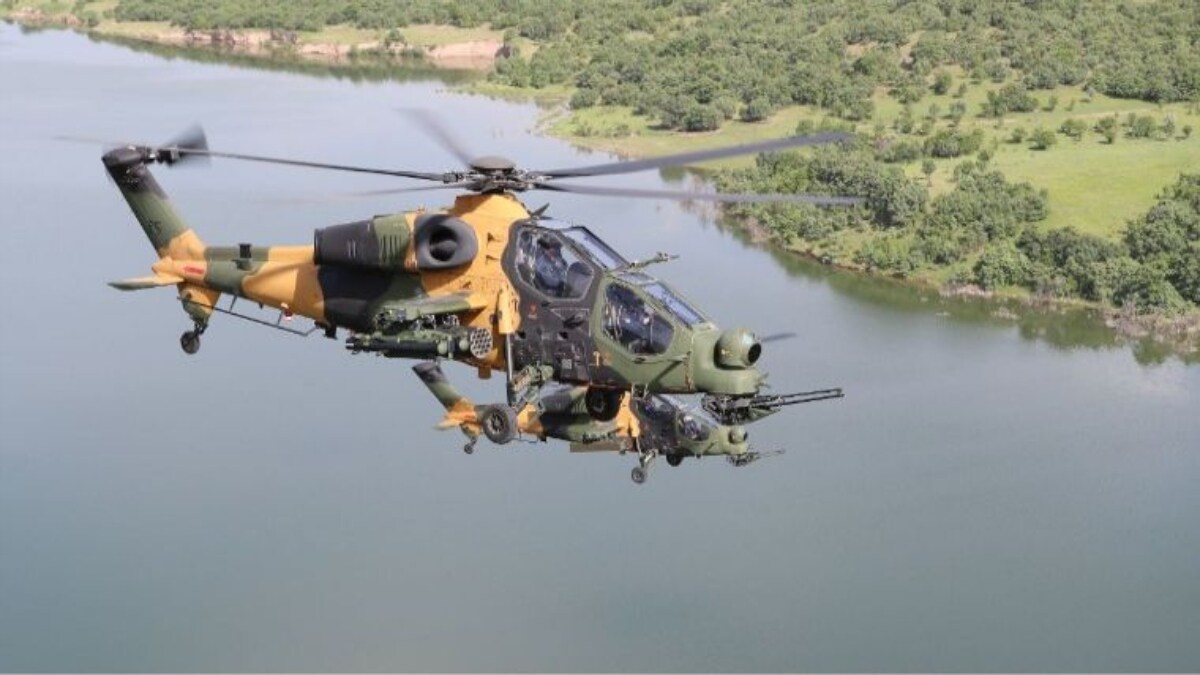
In 2022, Pakistan abandoned a $1.5 billion deal to buy 30 attack helicopters from Turkey. The news came two weeks after Islamabad had agreed to buy 30 T-129 'ATAK' helicopters made by Turkish Aerospace Industries.
The T-129 is an upgraded version of the Italian-designed A-129 helicopter, and the deal with Islamabad was the first export contract for the T-129. The helicopters use engines made by LHTEC, a joint venture between Rolls-Royce and Honeywell, a US company. The Donald Trump administration declined to grant LHTEC export clearance to sell the engines to Pakistan, resulting in the premature collapse of the deal.
Almost four years later, Türkiye is said to have managed to sell its attack chopper to another South Asian buyer. It is Pakistan's neighbour, Bangladesh, that has agreed to buy six T-129 ATAKs from Turkish Aerospace Industries. They are being procured along with Eurofighter Typhoon multi-role fighters as part of a dual-track modernisation effort to level up the Bangladesh Air Force (BAF).
Dhaka has named the mission to upgrade its military “Forces Goal 2030”, and the dual deal is a major step in the right direction for its implementation.
What are T-129 ATAK helicopters?
Turkish Aerospace Industries developed the twin-engine, tandem-seat T-129 ATAK attack helicopters in collaboration with AgustaWestland. They can be used for counter-insurgency, border security, and battlefield interdiction missions, in addition to providing close air support to ground forces. Battlefield interdiction refers to operations where the objective is to disrupt, delay, or destroy enemy forces before they can engage friendly troops. Resupply options and reinforcement channels are closed during these operations, leaving the enemy with little to no option to thwart an upcoming ground offensive.
They are equipped with UMTAS anti-tank guided missiles (with a maximum range of 20 km from helicopters) and Cirit laser-guided rockets (with a maximum effective guided range of 8 km), both of which are Turkish, as well as a chin-mounted 20mm cannon. Pilots will have access to electro-optical targeting sensors and a fully integrated digital avionics suite, enabling them to detect, track, and engage targets swiftly even while operating at low altitudes in challenging terrain, Defence Security Asia said in a report.
Currently operated by the air forces of Somalia, Nigeria, and the Philippines, in addition to Türkiye, the cost of the deal is said to be around $600 million (₹53,883,000,000 / ৳73,330,000,000), the report added.
Modernising BAF
The BAF reportedly wants to finalise the deal with Ankara within the 2025–26 fiscal year so that deliveries will align with the Eurofighter Typhoon induction timeline through 2027.
There were political reasons behind Dhaka's decision to choose the T-129s over alternatives including the US AH-1Z Vipers, reports claimed. Türkiye is open to providing maintenance support and technology transfer, despite existing integration challenges facing the BAF.
