



It is that time of the year when the state capital of Kerala belongs to women. Thousands of women—even from faraway states like MP and Gujarat—descend on Thiruvananthapuram to participate in the famed Pongala festival at Attukal Devi temple, often called the women's Sabarimala. But this year, the festival—to be held on Friday—has taken a controversial turn.
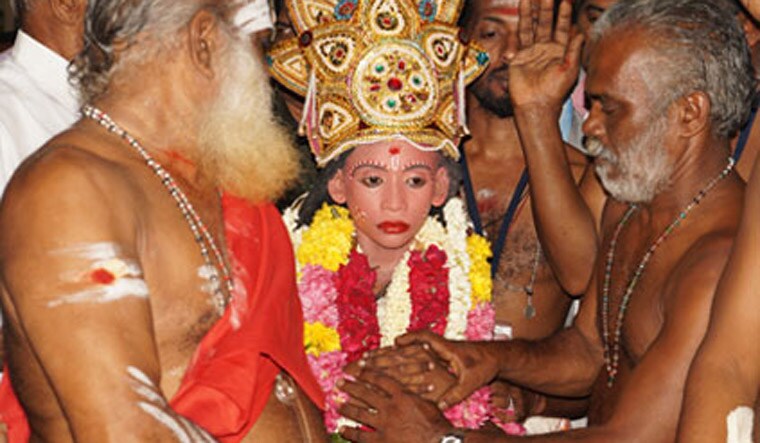
It all started when DGP R. Sreelekha called for an end to the age-old ritual called ‘Kuthiyottam’ performed during the annual Pongala festivities. Involving young boys aged between the ages of five and 12, Kuthiyottam involves undergoing rigorous rituals in the week ahead of the festival. The boys have to lead a life within the temple premises, totally cut off from parents and at the end of the ritual, an iron hook is pierced into the bodies of young boys.
Calling the ritual “regressive,” the DGP in charge of prisons wrote in her blog that the ritual involving young children should be stopped as it was a punishing practice.
“An iron hook, tiny though it is, will be pierced into their skin on their flanks. They scream. Blood comes out. A thread will be symbolically knotted through the hooks to symbolise their bond with divinity. Then the hooks are pulled out and ash roughly applied on the wounds! All this for the temple deity!” the DGP wrote.
Interestingly, the officer herself is an ardent devotee of the temple’s presiding goddess and has been offering Pongala—a mix of rice, jaggery and ghee—since she was 10.
She compared the boys to the goats to be sacrificed at Guwahati’s Kamaakhya temple. “All the boys in wet loincloths bore the same look of the sacrificial goats of Kamakhya,” said the state's first IPS officer.
Not surprisingly, the DGP's comments have stirred the proverbial hornet's nest. Kuthiyottam became a talking point in both mainstream and social media, with many voicing their opinion for and against the ritual. While some felt rituals are best untouched, a large chunk argued that everything needs to change according to time.
“Rituals are age old and we have no right to tamper with them,'' insisted Lathika G., whose son has participated in Kuthiyottam ritual. “Nobody forced us to do it. I pledged it on his behalf when my son fell ill. How can a third person decide what I should do in my personal life?'' she asked.
But those who oppose the ritual argue that parents have no right to impose these 'barbaric'' rituals on their children. “A society progresses when customs and rituals are changed as the time passes. Sati was a revered ritual at one point of time. But we no longer observe it. Like that, these type of barbaric rituals also need to be stopped,'' said Shakthidharan G, an activist.
As the controversy thickened, the Kerala State Commission for Protection of Child Rights registered a suo motu case. It has asked the state government to take an appropriate decision on the practice of Kuthiyottam ritual. In its order, the commission noted that consent of a minor child was not accepted as consent in law.
Citing sections 89, 319, 320, 349, 350 and 351 of the Indian Penal Code, an official with the Commission told THE WEEK that causing any type of pain to children was treated as an offence.
“We are certainly looking at whether there is some rights violation angle in Kuthiyottam. We have also asked for a thorough study on the mental and physical health of the children before taking the decision,'' said the official.
The commission's decision has exacerbated the controversy, with many Hindu organisations threatening the commission for the action. The myth is that young boy soldiers had accompanied Devi Kannaki when she came the area after burning down the entire Madurai as revenge for the death of her husband.
The ritual involving young boys tries to reenact those myths associated with Kannagi.
“Kuthiyottam is an integral part of the celebrations. How can anyone say what needs to be done inside the temple?'' asked Swami Dattatreya, state president of Akhila Bharatha Hindu Mahasabha. He has started a sit-in in front of the state Secretariat against the commission's move.
“Everyone thinks they have the right to tamper with Hindu rituals. And this fault finding is happening only with Hindu customs, while nobody dares to touch Islam or Christian customs. We will not allow that,” added the Swami.
