



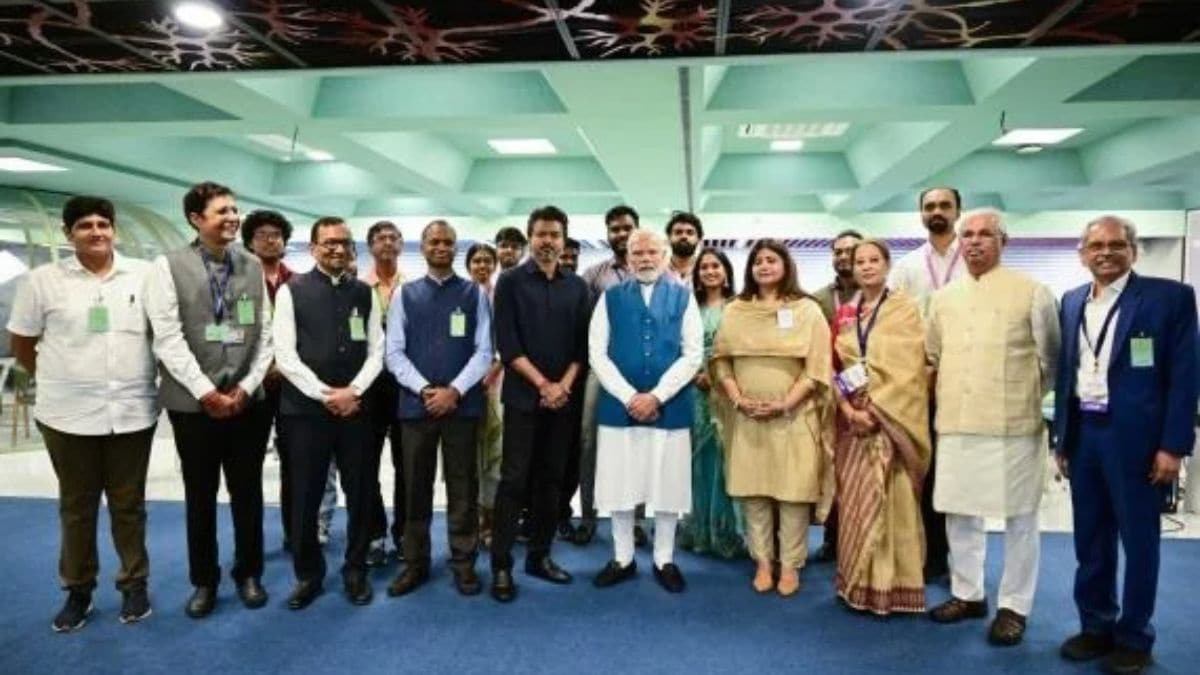
As PM Modi landed in Chennai, all roads led to the Indian Institute of Technology Madras (IIT-M), where the scientists have mapped one of the most complex structures known to humanity — the human brain.
Modi kicked off IIT-M’s Sudha Gopalakrishnan Brain Centre’s (SGBC) mission of mapping 100-plus human brains into 3D atlases at cell-resolution across the human life span from foetus to old age, including brain-related diseases. This will be the largest set of 3D maps of whole human brains at cell resolution.
The SGBC is pursuing this scientific mission through its world-class brain imaging technology platform that processes whole post-mortem human brains into cell-resolution digital 3D maps through its high-throughput brain imaging and computing platform.
These atlases are made publicly available through its multi-modal image visualisation and computing framework, so that the benefits of this cutting-edge research can reach researchers, medical professionals, and patients all over the world. This global mission led by SGBC is a large inter- and multi disciplinary effort involving 200-plus researchers, engineers and technicians at SGBC, over 10 medical institutions across the country, and more than 30 globally leading researchers from over 10 countries. The SGBC is building high-resolution, three-dimensional digital maps of the brain to help researchers understand how it develops, ages and changes in disease.
SGBC combines neuroscience, medical science, engineering, advanced imaging and computational technology to create detailed maps of human brain tissue. Its ambition is to build an open-access scientific resource that researchers worldwide can use to investigate neurological disorders and the brain’s cellular architecture.
As part of the mission, Modi released ‘C-STROKE’, the world’s first human ischemic stroke atlas developed by SGBC. C-STROKE is a landmark resource that bridges millimeter - scale pre-mortem MRI scans with micron-resolution whole-brain histology. This research is supported by Prem Watsa, Distinguished Alumnus of IIT Madras and Chairman of Fairfax Financial.
The atlas features over 1000 annotated brain sections from a stroke-affected brain. By mapping critical cellular markers including neuronal health, neuroinflammation, blood-brain barrier disruption, hypoxia, and axonal injury, the atlas reveals for the first time the details of clinical imaging signatures at a microscopic cellular level. The 3D maps were generated using Param Shakti supercomputer supported by MeitY.
Complete with an open-access data viewer and analytical suite, the platform equips global researchers and clinicians to interrogate cerebrovascular pathology across spatial scales for discovering novel therapeutic targets directly in the human brain.
“The visit ofthe Honourable Prime Minister is a great inspiration for the scientists working on this mission. I hope this will also inspire philanthropists to support this world-class research in India, which needs to be scaled up,” said Kris Gopalakrishnan, Co-founder, Infosys, who played a key role in setting up the centre, while being a major donor to the centre.
The centre’s work begins with donated human brain tissue. Researchers slice the tissue into thin sections, use specialised stains to identify cellular structures and capture the sections through high-resolution imaging. Computational tools then align the images and reconstruct them into three-dimensional models.
Beyond mapping healthy brains, SGBC is studying tissue affected by conditions including stroke, dementia, Alzheimer’s disease and rabies. By comparing affected tissue with reference maps, scientists hope to understand how diseases alter brain structures and which cell populations may be particularly vulnerable.
“It is our utmost privilege to have our PM kicking off this mission that combines brain sciences, engineering, medicine and technology. We envision that these maps and atlases will have significant implications for neuroscience and neuromedicine for decades to come,” said Prof. Mohanasankar Sivaprakasam, Head of SGBC, IIT Madras.
One of its landmark achievements is DHARANI, a three-dimensional atlas of the second-trimester human foetal brain, released in December 2024. The project digitally captured 5,132 brain sections and mapped more than 500 regions, offering researchers an unprecedented view of the developing brain. The atlas could serve as a reference for studying normal development and investigating abnormalities associated with neurodevelopmental disorders.
The challenge ahead is to expand these maps across different ages and disease conditions while ensuring that the datasets are reliable and comparable. Although the atlases are research tools rather than immediate diagnostic or therapeutic solutions, they could provide a foundation for future discoveries.
For SGBC, the goal is not simply to create striking digital images of the brain. It is to build a shared scientific resource that allows researchers across the world to explore the human brain in greater detail — and ask new questions about how it works, develops and fails.
