



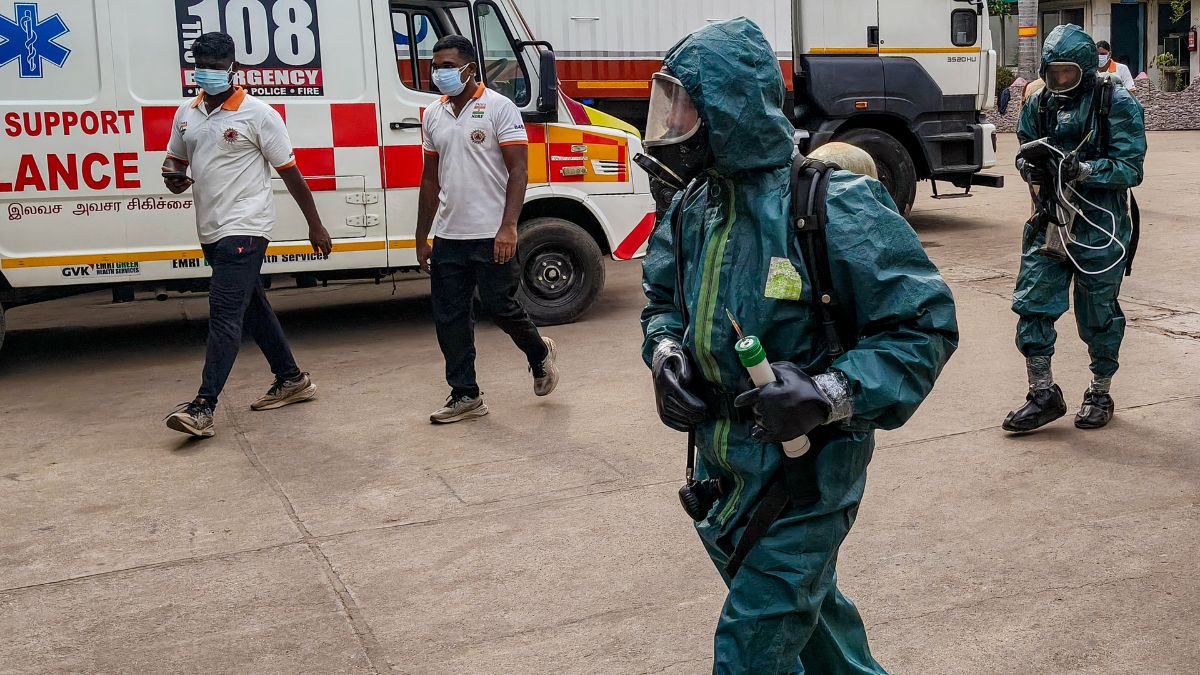
The recent ammonia gas leak incident at a seafood processing facility, Peter & Paul Seafood Export Company leak in Tiruvallur, Tamil Nadu, reveals an overlooked medical risk. In the immediate aftermath of an industrial ammonia (NH3) leak, the focus is naturally on treating overt chemical burns and acute breathing distress. However, the more serious effects of this toxic gas often hide in a deceptive "latent phase," where stabilised survivors remain at risk of severe, delayed lung damage.
Ammonia is widely used as a natural refrigerant in large-scale food and seafood preservation as it is highly efficient and has zero global warming potential. However, direct exposure to ammonia at high concentrations can be highly toxic. The degree of damage depends entirely on the combination of gas concentration, measured in parts per million (ppm), and exposure duration. Because ammonia reacts aggressively with the moisture inside the human respiratory tract to form a caustic, alkaline chemical (ammonium hydroxide), causing severe impact within seconds of exposure that can evolve over several hours.
According to the National Library of Medicine’s toxicology report on Ammonia, the Occupational Safety and Health Administration (OSHA) has set an 8-hour exposure limit of 25 ppm and a short-term (15-minute) exposure limit of 35 ppm for ammonia in the workplace.
Dr Jay Bhanushali, Pulmonologist, Zynova Shalby Hospital, points out that the seafood industry inherently carries environmental challenges. "People working in the seafood industry can be exposed to allergens, organic dust, cold environments, and processing-related irritants, which can take a toll on their respiratory health."
In the Tiruvallur case, the workers were exposed for a matter of minutes before being rescued. While official incident logs didn’t isolate an exact stopwatch duration of the exposure, the timeline based on the reports by The Wire and Times of India revealed that the leak, originating from an industrial refrigeration system, spread from the unit into adjacent residential quarters within seconds to minutes. Because the concentration of ammonia can reach dangerous thresholds almost instantly in enclosed spaces, workers reportedly experienced debilitating symptoms (burning eyes, severe coughing, and bleeding from the nose/mouth) within a few minutes of inhalation, preventing many from escaping immediately.
According to the Agency for Toxic Substances and Disease Registry (ATSDR) Medical Management Guidelines, remaining in an unventilated room with concentrations between 100 ppm and 200 ppm for roughly one hour without personal protective equipment can cause severe upper airway lining degradation, throat burning, and heavy chest tightening.
Data compiled in the Toxicological Profile for Ammonia shows that acute ammonia exposure typically follows a distinct clinical trajectory. It begins with an acute phase marked by immediate burning of the eyes, shedding of the upper airway mucosa, and the rapid onset of pulmonary edema. This is followed by a latent phase, during which the patient's condition may appear to stabilize with oxygen therapy. However, days or even weeks later, a delayed phase can develop, as a massive secondary inflammatory response causes the body to over-scar while attempting to heal. In severe cases, this excessive scarring can block the lung's smallest airways, leading to a rare but irreversible condition known as bronchiolitis obliterans (obliterative bronchiolitis).
Dr Bhanushali outlines how clinicians must differentiate between these stages, and notes that one of the most serious early complications is Acute Respiratory Distress Syndrome (ARDS). "ARDS begins within hours of ammonia exposure, and people can experience severe breathing difficulty, low oxygen levels, and widespread lung inflammation that will be seen in the scans."
The clinical challenge for medical teams lies heavily within the latent phase. Because a patient appears clinically stable, predicting who will develop chronic lung damage remains challenging. Conversely, the onset of permanent structural damage requires an entirely different diagnostic window. "Bronchiolitis obliterans can happen days to weeks later," Dr Bhanushali explains, "and lead to signs and symptoms such as constant cough, wheezing, breathlessness, and airflow obstruction, which can even be seen in the patients after recovery."
Medical experts emphasise that there is no single biomarker that can reliably predict severe fibrotic scarring after the incidence of chemical inhalation. As a result, diagnosing it often requires follow-up examinations, imaging studies, and pulmonary function testing over time.
Dr Jaspreet Singh, Consultant Pulmonary Medicine, NewEra Hospital explains, “During the latent phase, the symptoms such as cough and breathlessness will be monitored by the doctor along with oxygen levels. The doctor will also conduct pulmonary function tests, chest X-rays, or CT scans to look for lung injury and fibrosis.”
For the industrial workers who survive the initial high-concentration exposure, the recovery ahead is rarely a simple return to normal. Dr Singh emphasises, “Long-term recovery will be dependent on the severity of the exposure and the extent of lung injury in the patient and can vary from one patient to another. While many workers recover with appropriate treatment and pulmonary rehabilitation, some may still notice breathlessness, reduced lung function, chronic airway disease, or scarring that will demand constant respiratory care and monitoring for a long time until the symptoms settle down and the person’s condition improves.”
Dr Bhanushali notes that there is no broad, industry-wide surge in chronic respiratory cases being reported. However, individual health risks depend heavily on specific job roles, exposure duration, and workplace safety measures. A sudden catastrophic failure of infrastructure completely changes the clinical equation.
The Tiruvallur tragedy highlights the importance of long-term medical surveillance after industrial ammonia exposure. While emergency treatment remains the first priority, experts note that delayed respiratory complications may only become evident weeks or months later. Bronchiolitis obliterans is irreversible, making early recognition of lung injury and long-term follow-up critical for reducing the risk of permanent respiratory damage. The eight women who lost their lives cannot be a statistical blurb; they must be the catalyst that forces industrial medical protocols into the 21st century.
This story is done in collaboration with First Check, which is the health journalism vertical of DataLEADS
