



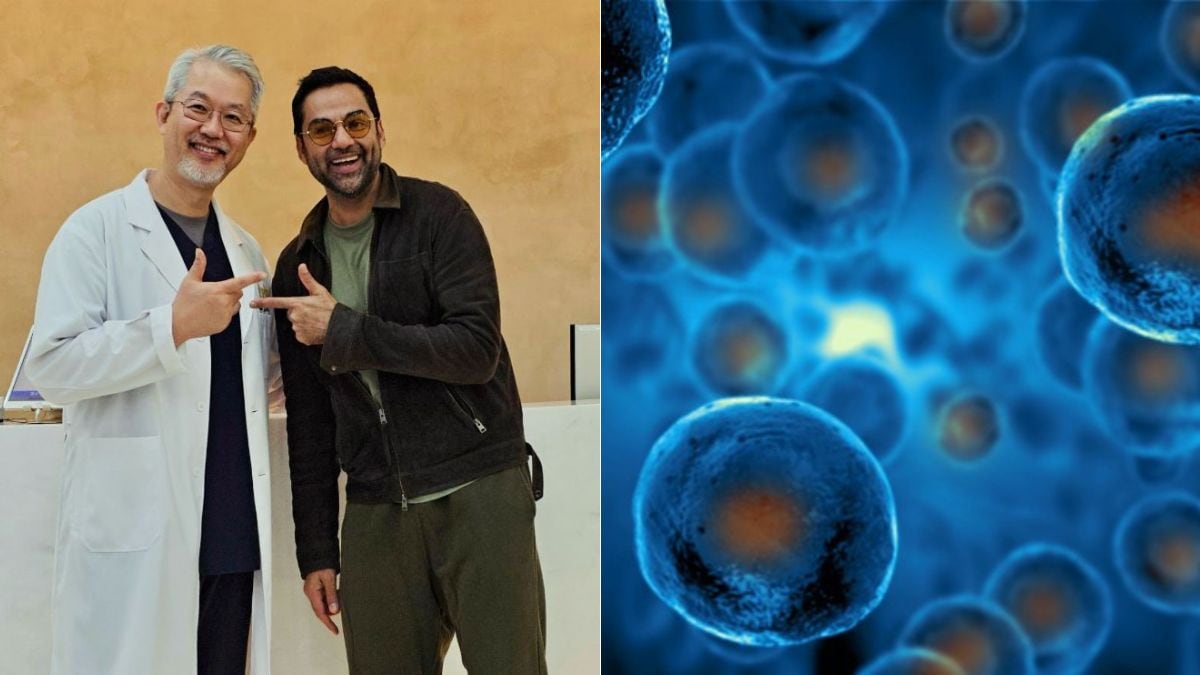
Actor Abhay Deol is not known for public disclosures about his health, which is why his recent Instagram post caught attention. The Dev D star revealed that after years of dealing with knee pain and sciatica caused by a slipped disc, he opted for stem cell therapy in South Korea, an alternative he explored after deciding against surgery.
“For a long time, I’ve had pain in my knees and sciatica in my left leg due to a slip disc. I felt quite hopeless at times,” Deol wrote, adding that he was drawn to stem cell therapy because it felt less invasive. Describing the experience, he said the procedure felt “natural and safe”, with his own cells being used to aid healing rather than synthetic materials.
Deol’s post has reignited public interest in stem cell therapy—particularly for chronic pain conditions like sciatica. But how far does the science go?
Stem cells are special cells capable of developing into different cell types and supporting tissue repair. In most clinical settings today, doctors use adult stem cells, typically harvested from a patient’s bone marrow or adipose (fat) tissue. Once processed, these cells are injected into the affected area with the aim of reducing inflammation and promoting healing.
Stem cells are unique because they support tissue repair by releasing biological signals that help the body heal itself, say doctors. Unlike painkillers that mainly suppress symptoms, stem cell therapy aims to work at the level of tissue repair.
What is sciatica?
Sciatica is not a disease in itself, but a symptom, caused when the sciatic nerve is irritated or compressed, most commonly due to a slipped disc or spinal degeneration. The hallmark symptom is pain that radiates from the lower back down the leg, sometimes accompanied by numbness or weakness.
According to experts, stem cell therapy may help by reducing inflammation around the nerve, potentially easing pressure and improving comfort over time. Some early studies suggest that stem cell injections near spinal discs or nerve roots may offer short-term relief in selected patients. However, neurologists caution against viewing it as a cure-all.
“Results so far are inconsistent, studies are small, and long-term benefits remain uncertain,” said Dr Vinaya Bhandari, Consultant Neurology & Neuromuscular Disease Specialist at Jaslok Hospital. She emphasised that outcomes depend heavily on the underlying cause of sciatica and the patient’s overall health.
Orthopaedic specialists echo this guarded optimism. While stem cell therapy is often discussed as a regenerative solution, current evidence suggests its primary benefit in musculoskeletal and nerve-related pain is pain modulation, rather than complete structural repair.
“In disc-related back pain and knee degeneration, the benefit seen so far is more about reducing inflammation and pain than true tissue regeneration,” said Dr J V Srinivas, Lead Senior Consultant, Orthopaedics & Joint Replacement, Aster RV Hospital.
Patients may experience better mobility and improved daily function, but outcomes vary widely. Factors such as age, disease stage, overall health, and the technique used all play a role.
Despite growing popularity, especially in countries like South Korea, stem cell therapy for sciatica remains experimental. It is not yet considered standard treatment, and regulatory oversight varies widely across countries.
Both neurologists and orthopaedic experts stress that surgery may still be the most predictable and effective option in many cases, especially when there is significant nerve compression or neurological deficit.
There are also concerns around unregulated clinics offering stem cell treatments without scientific backing. Patients are advised to seek care only at accredited centres, undergo thorough evaluation, and maintain realistic expectations.
Abhay Deol’s experience highlights both the hope and the hype surrounding regenerative medicine. While stem cell therapy holds promise, especially for patients who do not respond to conventional treatments, it is still evolving.
For now, experts recommend viewing it as a potential adjunct, not a guaranteed cure, best considered under strict medical guidance and evidence-based counselling.
As regenerative medicine advances, stem cells may well play a larger role in managing chronic pain. Until then, cautious optimism, not blind faith, remains the most sensible approach.
