



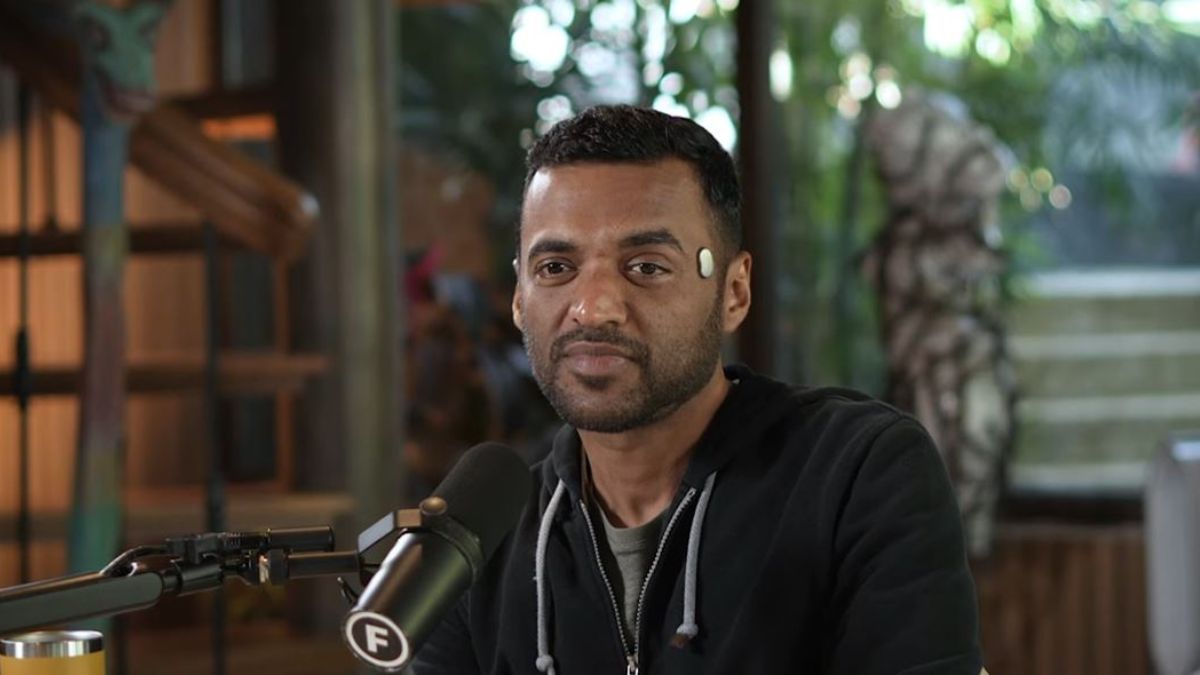
Most of us were left wondering about one particular detail while listening to Zomato founder Deepinder Goyal speak about gig workers, entrepreneurship and building scale on Raj Shamani’s YouTube podcast - what was that tiny metallic-looking device stuck to his temple?
As the podcast clips spread across social media, the device became a distraction of its own. Viewers paused, zoomed in and speculated, trying to decode what looked like a small golden patch placed on Goyal’s temple. The curiosity soon spilt over to Reddit, where users began sharing theories. Funny assumptions followed.
“Chewing gum,” one user said, while another commented, “External SSD.” One user joked, “Pimple patch.” Another wrote, “After chewing bubblegum, he didn't know where to stick it. Then he did this.” “It’s his brain,” quipped another. Other tongue-in-cheek guesses ranged from “Mind Jewels” and “Brainwashing” to “Charging pads."
But it wasn’t all jokes— critics like Dr Suvrankar Datta, who works with AI in healthcare, stated that “the device currently has 0 (zero) scientific standing as a useful device.” He cautioned the public, saying, “Do not waste your hard-earned money to buy fancy toys billionaires can afford to waste money on. If you are one, then go ahead.”
Beneath all this noise was a serious question many were asking: What exactly is this device? When did the idea behind it emerge? Is ‘Temple’ already available in the market? And what do medical experts actually think about the claims surrounding it?
What is the device name? How did it all start?
In November 2025, Deepinder Goyal, founder and CEO of Zomato, shared what he described as the “Gravity Ageing Hypothesis.” In the post, he suggested that gravity may slowly reduce blood flow to the brain over a lifetime, and that this gradual decline in cerebral blood flow could contribute to ageing.
Around the same time, photographs began circulating of Goyal wearing a small, golden-coloured device attached near his right temple, prompting widespread curiosity.
Goyal later confirmed that the device he was wearing is an experimental research tool designed to measure blood flow in the brain with accuracy. He said he had been using the device himself for nearly a year as part of his ongoing research.
In December 2025, Goyal hinted at the device’s future availability. Posting an image of it on Instagram, the text on the picture read “Temple coming soon,” while the caption simply said, “Getting there.” He also revealed that the device is named ‘Temple’.
In simple terms, the device seen on Deepinder Goyal’s temple is called ‘Temple’. It is an experimental tool designed to continuously measure brain blood flow in real time and is part of Goyal’s broader research project, ‘Continue,’ aimed at exploring whether long-term changes in cerebral blood flow could act as a driver or accelerator of ageing. He has committed $25 million (Rs 225 crore) of his personal funds to expand the initiative.
‘Temple’ is not a Zomato product, is being developed privately, and is not yet available for public or commercial use.
His post on ‘Gravity Ageing Hypothesis’
In November 2025, Deepinder Goyal shared a long thread on X outlining his opinion on gravity and ageing. “I’m not sharing this as the CEO of Eternal, but as a fellow human, curious enough to follow a strange thread. A thread I can’t keep with myself any longer,” he wrote.
“It’s open-source, backed by science, and shared with you as part of our common quest for scientific progress on human longevity,” he further wrote. “Newton gave us a word for it. Einstein said it bends spacetime. I am saying gravity shortens lifespan. Read on, and tell me what you think,” he added while sharing slides on the research.
The hypothesis proposes that gravity gradually reduces blood flow to the brain, contributing to brain ageing over time. Because the brain is positioned above the heart and humans spend most of their lives upright, gravity constantly pulls blood downward. Over several decades, this persistent reduction in circulation may damage the brain, according to the idea.
An ageing brain, the hypothesis argues, can then accelerate ageing across the rest of the body. Key brain regions such as the hypothalamus and brainstem, among the oldest parts of the brain in evolutionary terms, regulate essential functions including breathing, heart rate, hormone balance, immunity and body temperature. When blood flow to these regions is compromised, these systems may weaken, creating imbalances throughout the body.
To support the theory, the research draws attention to examples involving bats, yoga and height, all linked, in different ways, to the effects of gravity. One example cited in Goyal’s post states, “Bats are the longest-living mammals relative to their size, often living 10x longer than expected. They spend long durations, inverted, with head below the heart.”
Yoga is presented as another reference point. “Over 50 per cent of poses in yoga practice involve ‘head below heart’ postures. Several yogis have linked the practice of inversion (head below heart) to a longer lifespan,” the post notes.
Height is also discussed as a possible factor. “Science already knows that shorter people live longer than taller people, but doesn't know why. Maybe it's because the heart needs to pump blood for a shorter distance against gravity, to their brains,” it says.
It is important ot note that Goyal has repeatedly clarified that gravity is not being presented as the sole cause of ageing, nor is the hypothesis being positioned as settled science. He has stated that the work builds on more than 100 existing scientific papers, along with two years of literature review and discussions with scientists around the world.
According to him, ‘Temple’ is a tool designed to explore whether long-term changes in cerebral blood flow could act as a driver or accelerator of ageing. He clarified that the device itself is separate from the Gravity Ageing Hypothesis. “Temple has nothing to do with the hypothesis,” he said, explaining that ‘Continue’ is the broader research project, with the hypothesis being just one working model.
Goyal shared that the device was initially developed as an experimental, continuous brain-flow monitor used on himself and a small cohort, benchmarked against hundreds of MRIs and Doppler scans. “We needed a gold-standard-anchored proxy of cerebral blood flow in daily life to even start testing the hypothesis,” he said.
He emphasised that the device was originally a measurement project, not a product. “Productising it (and naming it Temple) came later,” Goyal added, noting that while sceptics may have opinions, the sequence of events is transparent. “We have nothing to hide here.”
“None of this is our work. It is mainstream literature,” Goyal has stated on X.
What do experts say about this?
Dr Suvrankar Datta, a former senior resident at AIIMS and now the group lead at CRASH Lab that looks at responsible AI for healthcare, was one of the first ones to criticise the device in his X post, stating that “the device currently has 0 (zero) scientific standing as a useful device,” and had said that people should not “waste” their hard-earned money on “fancy toys.”
Dr Datta, who is an AI researcher and was a radiologist at AIIMS Delhi, noted that his team had experimented with similar approaches in 2018, including using AI for interpretation, and even reached the finals of the Indian Innovation Growth Programme. He stressed that “only cfPWV (Carotid-Femoral Pulse Wave Velocity, which is used to assess central arterial stiffness) is a marker that can truly predict cardiovascular mortality and is accepted by the scientific community.”
He further explained that using the temporal artery as a surrogate for brain blood flow is unreliable, “because they aren’t reflective and has many confounding factors.” On the current claims around the device, he added, “What it is being repurposed for now is something you have to prove by doing year-long studies.”
Dr Vinit Suri, Senior Consultant Neurologist at Indraprastha Apollo Hospitals, New Delhi, also expressed scepticism about the claims surrounding the ‘Temple’ device. He noted that while the device is worn on the temple, “it can only measure the superficial temporal artery, which is a branch of the external carotid artery,” and not the major vessels supplying the brain. He explained that “the brain is predominantly supplied by the internal carotid artery, so anything placed on the temporal area won’t directly reflect cerebral circulation.”
Adding to this, Dr Viswanathan Iyer, Neurosurgeon at Zynova Shalby Hospital, Mumbai, noted that the device “looks like a wearable sensor placed on the side of the head” and explained that such devices are designed to pick up surface-level signals rather than directly measure brain blood flow.
He clarified, “MRI scans are complex medical tests done in hospitals and cannot be replaced by small wearable gadgets,” adding that there is limited scientific evidence that wearables like this can accurately measure blood flow inside the brain. “While they may track indirect signs such as pulse or skin changes, this is not the same as measuring real brain activity or circulation,” Dr Iyer said.
Dr Iyer emphasised that maintaining brain health is best achieved through proven habits- regular exercise, proper sleep, stress control, and a healthy diet. “These methods have strong medical backing,” he said. He concluded that “at present, such wearables should be seen as general wellness products, not medical devices,” and cautioned people against relying on them for brain health decisions or treatment until proper clinical studies are conducted.
This story is done in collaboration with First Check, which is the health journalism vertical of DataLEADS.
