



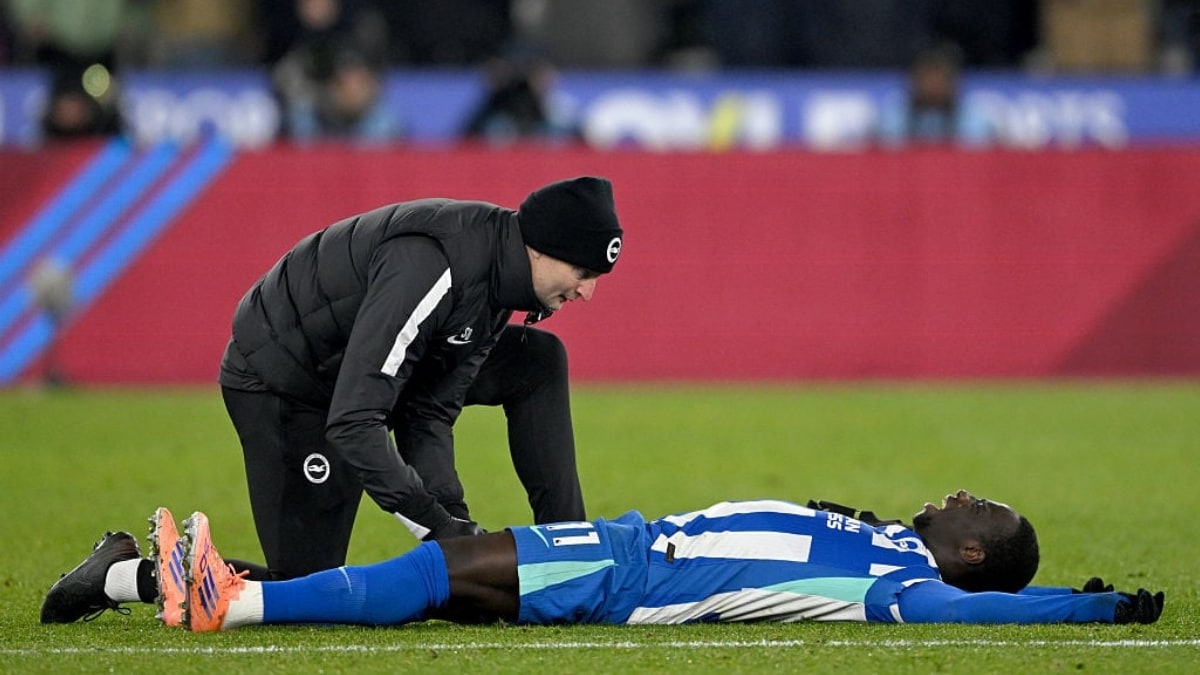
Yankuba Minteh of Brighton and Hove Albion is unlikely to feature against Manchester City at the Etihad. “We need to have a look at Minteh. It’s still not perfect, but there’s a small chance that he will be available tomorrow,” manager Fabian Hürzeler said.
Gambian Minteh was forced off in the second half of Brighton’s 2-2 draw against West Ham with a suspected thigh injury during the final fixture of 2025. However, scans later confirmed that the 21-year-old had only suffered a dead leg. Missing the City clash would mean Minteh being unavailable for two weeks in a row after having missed the 2-0 win over Burnley last week.
What is a ‘Dead Leg’ injury?
In case you are wondering what a dead leg is, here is everything you need to know about a “dead leg” injury.
A “dead leg”, medically known as a quadriceps contusion, is a common injury affecting professional sports stars. It is caused by a direct blow with great force to the thigh. In football, it can be caused by an opponent’s knee or boots during a sliding tackle or other types of challenge.
Usually, the force of the impact compresses the player’s muscle against the thigh bone (femur), causing internal bleeding and swelling. Following an initial period of stiffness and numbness mixed with pain, a dead leg can make running and kicking uncomfortable, if not difficult. Since the affected thigh muscle “shuts down” or goes numb temporarily, the area may feel heavy or unresponsive, giving the sensation of dragging “dead” weight. Hence the name “dead leg”.
'Dead Leg' Treatment
It is not a serious or long-term injury in most cases, with players recovering within minutes to a few days, depending on the severity of the blow.
If a player is forced out of action following a quadriceps contusion, it is likely to mean that he or she is yet to fully recover from the temporary issues caused by the injury. While it should not be confused with a ligament tear or muscle strain, medical teams usually monitor the condition to prevent complications.
Severe cases can force a player to remain rested for over three weeks, with major swelling and bruising remaining unresolved. In such rare instances, the patient may require crutches and intensive physiotherapy.
The R.I.C.E. method is followed for the treatment of a quadriceps contusion. This involves:
- 'R'est: Keeping weight off the leg.
- 'I'ce: Reducing blood flow and swelling.
- 'C'ompression: Wrapping the thigh to limit internal bleeding.
- 'E'levation: Keeping the leg raised.
