



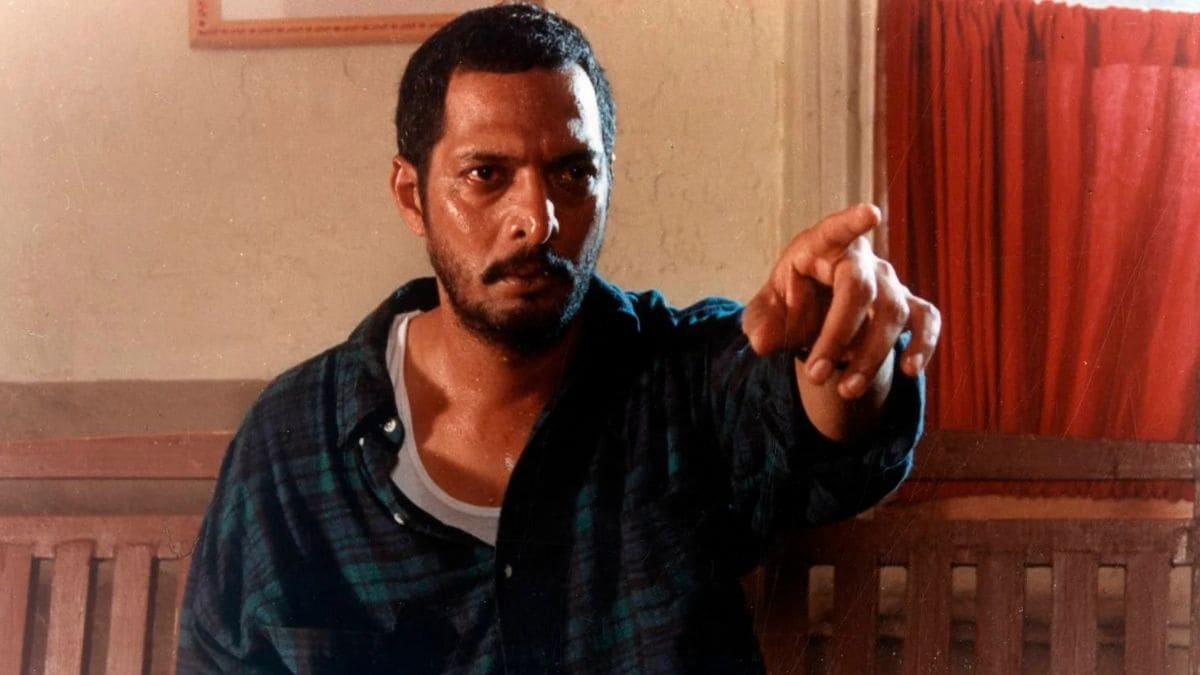
Some actors deliver lines. Nana Patekar made them sound like confrontations, confessions and truths we weren’t always prepared to hear.
There are actors whose dialogues are remembered because they were written to be memorable. And then there is Nana Patekar, who could take a handful of ordinary words and make them sound as if they had been pulled from a lifetime of anger, disappointment, courage and conviction.
With him, a dialogue was never merely a line in a screenplay. It was an event.
His voice could turn a question into an accusation, a pause into a warning and a seemingly casual remark into something that followed you out of the cinema. He did not need to shout all the time. Sometimes, the slightest tightening of his jaw, a sudden change in pitch or a fraction of a second of silence did more than an entire speech could have in another actor’s hands.
That was the peculiar power of Nana Patekar: he did not simply speak his dialogues. He inhabited them.
In Parinda, which I saw over and over again with my father through the years, his portrayal of Anna demonstrated the most controlled dialogue delivery. He made the character frightening not merely through what he said, but through the unsettling certainty with which he said it. The words seemed to emerge from a mind that had already considered every possible consequence.
In Krantiveer, his dialogue delivery became an instrument of rage and moral confrontation. Patekar brought a combustible intensity to Pratap, a man whose anger was inseparable from his disillusionment with society. The film gave him the space to turn words into public indictments, but it was his performance that made those words feel personal. He was not delivering a lecture from a safe distance. He seemed to be demanding an answer from everyone in the room.
A powerful dialogue can be remembered for its writing; a truly powerful performance makes the audience remember the person who spoke it.
Patekar understood the difference between volume and force. His delivery could be explosive, but it was rarely just noise. There was rhythm in his anger, precision in his pauses, and an almost uncomfortable intimacy in the way he addressed the person before him. Even when his characters occupied the extremes of human behaviour, they never sounded like people reciting lines.
In Ab Tak Chhappan, the same intensity acquired a different texture. As Sadhu Agashe, Patekar brought a terse, unsentimental quality to the language of a policeman accustomed to violence. The performance relied on restraint as much as aggression. Here was an actor who knew a character did not have to explain himself at length to establish authority. Sometimes, the absence of an explanation was the most revealing thing about him.
And that is what makes Patekar’s dialogue delivery so difficult to imitate convincingly. His characters appeared to believe every word they uttered, even when their beliefs were uncomfortable, contradictory or deeply flawed.
He also possessed a rare instinct for making silence audible. He could hold a beat just long enough to make the audience anticipate an outburst, then change the emotional direction of a scene with a single line. He understood that dialogue is not only about what is spoken; it is also about what precedes it, what remains unsaid.
This is why his performances continue to invite recollection. The dialogues survive not simply as quotations circulated across generations, but as complete cinematic moments, inseparable from the voice that gave them their unmistakable weight.
Cinema changes. Its audiences change, and the rhythms of screen dialogue change. What sounds electrifying in one decade can occasionally seem dated in another. But a performance grounded in human emotion has a different lifespan. Patekar's dialogue delivery is not confined to a particular era; rather, his dialogues will continue to be repeated, debated and rediscovered.
