



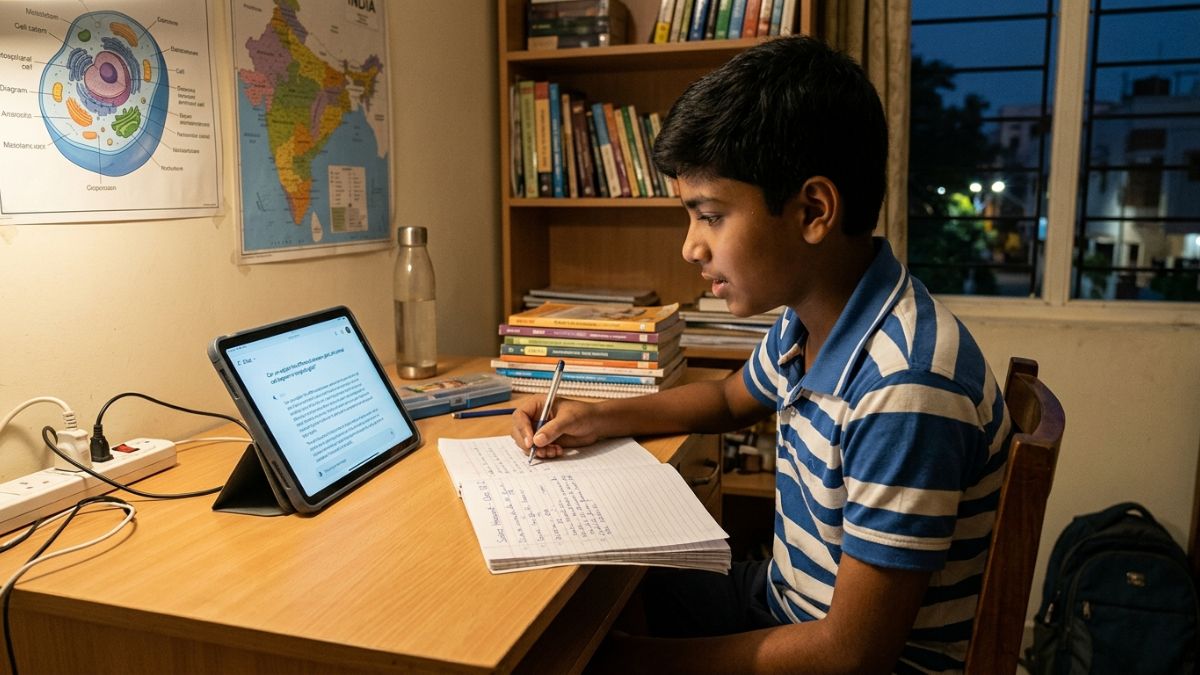
Karnataka is setting a definitive policy direction for public digital education following a recent directive to explore introducing Artificial Intelligence (AI) training in government schools from Class 6.
Supported by the state’s IT department and private partners, the proposal seeks to extend a vocational AI pilot already running for Class 9. The framework builds directly upon the AI Akshara Abhiyana and Coding Gurukula initiatives first announced during the state’s Independence Day address this year.
To bridge immediate resource and infrastructure gaps, the state is moving to establish an AI University framework and recruit 956 outsourced IT teachers. State officials have also been tasked with studying active educational initiatives in Telangana to model their infrastructure after existing programmes run in collaboration with Google.
Karnataka’s proposal, however, is not happening in isolation. The foundational question of what an 11-year-old should be taught about machine intelligence has already been established at the national level through structured educational policy frameworks.
What children are being taught
According to the official Central Board of Secondary Education (CBSE) framework, the AI education mapped out for children depends strictly on the stage of schooling they are currently in.
The preparatory stage (classes 3–5):
Schools allocate 50 hours annually, focusing purely on Computational Thinking (CT) integrated into core subjects like Mathematics and The World Around Us (TWAU). Students learn foundational concepts like decomposition, pattern recognition, abstraction, and algorithmic thinking through unplugged, activity-based workbooks without requiring a computer.
The middle stage (classes 6–8):
Schools expand the curriculum to 100 hours annually. This comprises 40 hours of advanced CT, 20 hours of introductory AI concepts, and 40 hours of interdisciplinary projects. Children are introduced to basic AI domains, including Computer Vision, Natural Language Processing, and Statistical Data, alongside the AI Project Cycle, which covers Problem Scoping using the 4Ws method, Data Acquisition, Exploration, Modelling and Evaluation, as well as foundational AI Ethics.
The secondary/senior secondary level (classes 9–12):
AI transitions into a formal elective and skill subject, such as Subject Code 417. The curriculum covers machine learning lifecycles, data science methodology, introductory Python programming, and a practical overview of Generative AI tools.
But knowing how an AI system works is only one part of becoming AI literate. The larger question is whether children can use these systems without surrendering their own ability to think, question, and make decisions.
The new literacy: Three practical habits
AI literacy is rapidly emerging as a fourth pillar alongside reading, writing, and arithmetic on the classroom blackboard.
With apps and algorithms now capable of writing essays and generating realistic pictures, India’s National Education Policy (NEP) 2020 has triggered a massive pedagogical shift. The structural goal is not to turn every child into a computer scientist, but rather to teach them how to navigate a world run by smart machines safely.
True AI literacy for an Indian schoolchild comes down to mastering three practical habits.
1. Knowing the machine is just a calculator
According to CBSE guidelines, students are taught that AI does not actually “think” or understand human emotions. It simply looks at massive piles of data, identifies mathematical patterns, and guesses what should come next.
When a child learns that AI is only as smart as the data humans feed into it, the machine loses its omniscient mystery.
“I think AI literacy for a schoolchild should be understanding how AI models work,” Krishna Gangwal, a final-year student, machine learning researcher, and AI content creator, tells THE WEEK.
“It is also to understand what kind of particular use cases AI is for, and that using AI in the correct way is as important as studying these days. So, we must make sure that schoolchildren understand the importance of AI and get comfortable with its usage.”
This approach matches global standards like the UNESCO AI Competency Framework for Students, which maps AI competence across core areas such as a human-centred mindset, the ethics of AI, and AI system design, layered above three progressive levels: understand, apply and create.
At Seth Anandram Jaipuria Schools, AI education similarly begins with awareness and age-appropriate use cases. Harish Sanduja, Director of Schools and IT, Jaipuria Group of Educational Institutions, tells THE WEEK that the focus is on making children aware of both the potential of the technology and the caution needed to use it safely.
“Children are being taught about AI use cases to make them aware of the power and potential of this technology and the cautionary measures one must adopt to safely leverage this potential.”
2. Practising “healthy doubt”
Because AI tools communicate with absolute confidence, a core focus of the curriculum is the cultivation of healthy scepticism.
An AI-literate child knows that computers can “hallucinate”, a tech term for generating inaccurate or fabricated information. They understand that if a chatbot does not have access to verified data, it can present an incorrect answer convincingly.
Consequently, a literate student does not accept AI answers blindly; they automatically double-check important facts against trusted books or official websites. They also realise that because AI learns from human history, it can repeat human prejudices and biases.
The curriculum’s emphasis on ethics and critical judgement becomes particularly relevant here. Students are expected to confront concepts such as bias, privacy, fairness, and responsible use.
These are not merely technical concerns. Because an AI system can produce an authoritative answer without it being accurate, verification becomes a cornerstone of literacy.
A child who knows how to generate an answer but does not know how to question it has learned only half the skill.
Harish says students at his schools are taught to apply their own critical thinking when assessing AI-generated responses.
“We have adopted a definitive strategy to educate children in applying their own critical thinking to the responses generated by AI and not believe blindly in the technology.”
3. Guarding personal boundaries
The final piece of literacy centres on personal safety and self-reliance.
Children are growing up in an era where personal data is highly valuable, and AI tools are hungry for it. An AI-literate child treats an AI search bar like a public street, knowing never to type in private details, family secrets, or personal photos.
Just as importantly, they know where to draw the line between using AI as a helpful assistant and using it as a cognitive crutch.
They use it to brainstorm ideas, but they rely on their own intellect to solve the final problem.
The danger of letting AI do the thinking
The primary challenge identified by educators regarding Artificial Intelligence is the risk of cognitive offloading—the habit of letting machines do the heavy lifting for the human brain.
By wiping out the natural friction of researching, writing, and problem-solving, AI can rob the brain of the mental struggle needed to truly learn and remember things.
This creates a psychological trap where users mistake a computer’s polished answer for their own actual knowledge.
Because AI works by predicting the most common, average response based on historical data, relying on it to think risks flattening human creativity and making distinct ideas sound identical.
Even worse, because these tools state facts and fabrications with the exact same confidence, a passive user easily lowers their guard, choosing a quick answer over the effort of fact-checking.
Gangwal argues that the concern extends beyond children.
“Regular reliance on AI will 100% affect children’s critical thinking.”
He says this is not limited to children or classrooms, arguing that regular AI use for every small task can lead to a deterioration in critical-thinking skills.
“It is very, very important for parents, teachers, and mentors to make sure that children are making use of their minds for the things that they do not need AI for, and it is also a recommendation that they should only resort to AI for things that require AI usage.”
The teacher’s evolving role
Under India’s National Curriculum Framework (NCF) 2023 and NEP 2020, teachers are also being hardcoded directly into the curriculum as active co-creators and managers of learning.
To support the massive rollout of mandatory Computational Thinking and AI courses, boards like the CBSE have launched nationwide Capacity Building Programmes (CBPs) and online training series.
Instead of relying on a rigid, unchangeable syllabus, teachers are being trained to use Teacher Observation Journals to continuously assess student mindsets.
They are given the institutional freedom to design custom classroom puzzles, direct unplugged logic games, and build interdisciplinary projects, transforming the traditional educator from a routine textbook pipeline into the primary engine of classroom innovation.
But teachers themselves need to understand how AI works and how students are using it. Harish says teachers need training in both the practical and ethical dimensions of the technology. “They have to be competent in prompt engineering, identification of work if AI was used in it, and the ethical use of AI.”
