



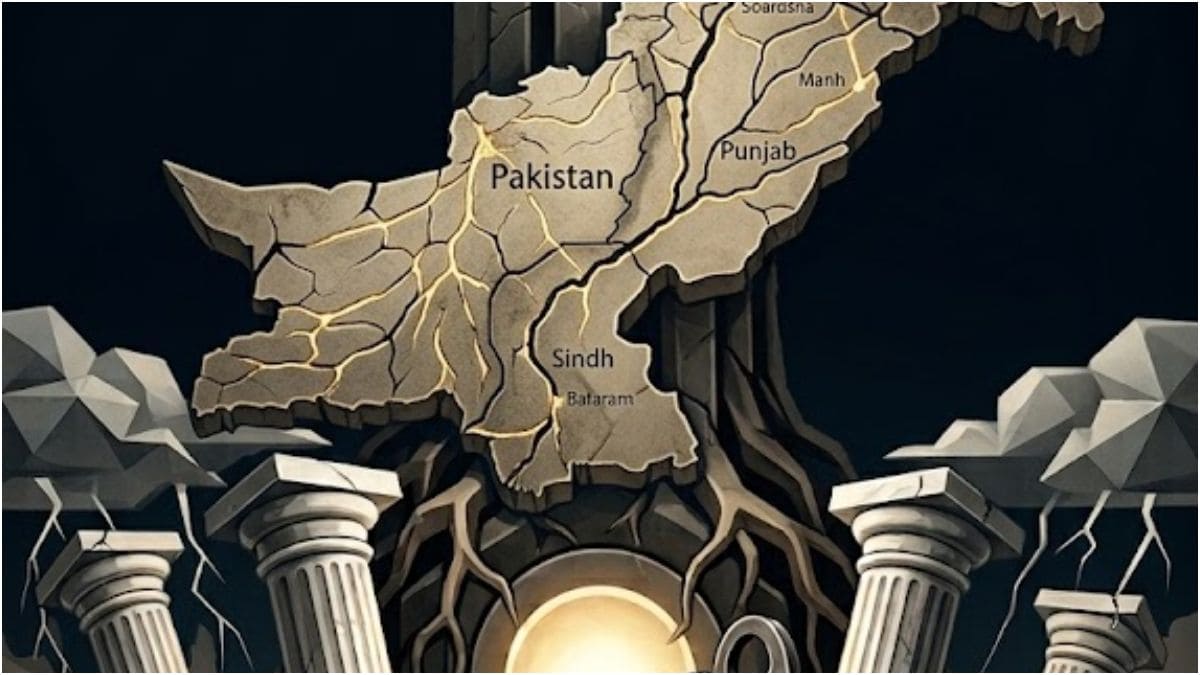
On Sunday evening, the federal government in Islamabad imposed emergency and governor's rule in Khyber Pakhtunkhwa. The two provisions, Articles 232 and 234 of the Constitution, took effect after the president approved the cabinet's recommendation. The PTI (Pakistan Tehreek-e-Insaf) runs the province and holds 93 of 145 seats in the assembly. Within hours, the opposition alliance Tehreek-e-Tahaffuz-e-Ayeen-e-Pakistan, of which the PTI is a part, called the move unconstitutional and promised to fight it in the courts, in the assemblies and on the street. The provincial information minister claimed that the chief minister had been taken into custody.
Eighteen days earlier, the federal information minister had stood in Peshawar and said that Islamabad had no plan to remove the provincial government. The province, he said, needs people's rule, not the governor's rule.
Any other country with a jailed party founder, a rebellious province, an insurgency on its western border, and a lender on speed dial would have been written off by now. Pakistan has been written off since 1971, when its eastern wing became Bangladesh. It is still here. Foreign commentators call that a miracle, and Pakistanis sometimes do too, usually in a tired voice. It is no miracle. It is a mechanism, and anyone who has to plan against it should understand how it runs, because mistaking luck for design, or design for health, is how analysts get surprised.
The spine that does not bend
Civil institutions in Pakistan bend with every storm. Governments fall, courts reverse themselves, and assemblies are dissolved. The army does not. It owns the only chain of command that reaches every district, a budget that survives every crisis, and a settled habit of acting as the final referee. When Islamabad moved in Khyber Pakhtunkhwa, it did so in the language of security. An opposition alliance speaker asked the obvious question: if terrorism exists in 12 districts, why impose governor's rule on the whole province? The question answers itself. In Pakistan, security is the master key, opening political doors as easily as military ones.
A rented geography
Pakistan sits where the Gulf, Central Asia, China and South Asia meet, and every major power has needed something from it at some point. Washington wanted a partner against the Soviets, and again after 2001. Beijing wants a road to the Arabian Sea. The Gulf has long valued Pakistan's soldiers and goodwill. Each has paid in aid, loans, rollovers or silence, and the International Monetary Fund has been a regular visitor for decades. Creditors have put up with this because a Pakistan that defaults and fragments is a bigger problem than one that limps. A state considered too dangerous to fail is under little pressure to fix itself. That is its great temptation.
The bomb in the background
Nuclear weapons changed the arithmetic of collapse. The world will pay to keep a poorly governed nuclear state afloat and thinks twice before pushing one. That has cushioned Pakistan from the full cost of its choices. It has also encouraged a habit of using militancy as an instrument of policy, on the assumption that the nuclear shadow will cap any escalation. India has never had the luxury of forgetting that habit. The irony is that militancy has come home. The Tehreek-e-Taliban Pakistan has turned parts of Khyber Pakhtunkhwa into contested ground, and the state now fights abroad what it once tolerated closer to home.
A society that improvises
The state is weak, but society is resourceful. Families abroad send money home. Informal trade moves goods the formal economy cannot. Clans, landlords, mosques and neighbourhood committees settle disputes and feed the poor where the district administration is absent. This elasticity absorbs shocks. It also lets the state off the hook, because citizens learn to expect little. A population that has stopped asking for services rarely topples a government over their absence, at least not quickly.
The invoice
Survival has a bill, and Khyber Pakhtunkhwa is where it lands. Governor's rule is no stranger to Pakistan's provinces. What matters is whether this spell does better than those before it. Dismantling an elected government with a large majority in the middle of a security crisis carries its own danger. Even a Pakistani editorial that did not spare the provincial chief minister's rhetoric warned that the step risks worsening the situation. Militants need very little to work with. A grievance served up by the centre is a gift.
A quieter cost exists as well. Every year spent managing instability is a year not spent on schools, courts, tax collection or power grids, the dull work that makes states sturdy. Pakistan's governing class has grown skilled at the first and out of practice at the second.
The deeper problem is that a state that survives by managing crises never gets around to resolving them. Each emergency strengthens the arbiter and weakens the politics that should be arbitrating. A province that feels overruled will not feel like a stakeholder in the federation. Pakistan's own history, from Dhaka onward, ought to be a sobering thought in Rawalpindi.
What India should take from this
Neither triumph nor complacency. Pakistan will likely keep surviving. A neighbour that cannot collapse and cannot consolidate is a permanent variable, not a passing problem. Our planning should assume a state whose military shapes its decisions, whose internal fractures can push it towards adventure abroad, and whose friends will keep it afloat. Deterrence has to remain credible. The intelligence picture on the western front has to remain continuous. And our own national cohesion, which is the real advantage we hold, needs as much care as our borders. None of this calls for alarm. It calls for patience and a clear head.
Pakistan's endurance is real. So is its fragility. The mistake is to see a miracle where there is only a mechanism, one that keeps the country alive and keeps it from getting well.
(The opinions expressed in this article are those of the author and do not purport to reflect the opinions or views of THE WEEK.)
