



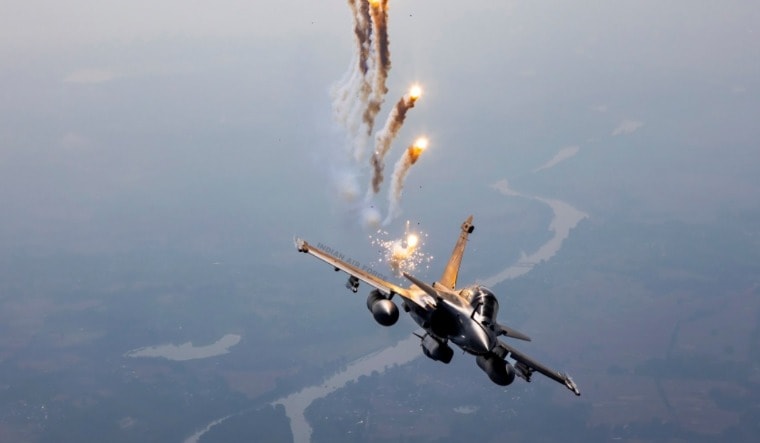
Amidst a fake social media propaganda push to establish that the Chinese Air Force's (PLAAF) J-16 "Flanker-N" fighter jets proved superior to French Rafales during an air exercise in Egypt, international media have reported that these claims stand in sharp contrast to the facts.
When the prized Chinese J-16 was pitted against the Egyptian Air Force's Rafale jets during the second edition of the air exercise "The Eagles of Civilization 2026", the Western platform showed it was far from a pushover. The exercise took place from August 22 to early September 2026 across multiple air bases in the African nation, and the Chinese fighter pilots who flew at least six J-16 jets reportedly learnt that there are areas in which the French jets can outperform them with ease.
According to reports, the PLAAF crew in Egypt were convinced that the Rafale’s close-combat agility is superior. A Rafale jet needs less time to pose a threat to enemy planes when they get close to each other and engage in visual combat.
In aerial warfare, this is the situation when rival pilots can see each other and are engaging at close range, rather than relying solely on long-range radar or missile engagements. Since the distance between the aircraft and the time available to act are reduced, they have to react fast and make split-second decisions—making the engagement more immediate.
"The reported Rafale advantage concerns close-range manoeuvring, particularly instantaneous turning, rapid rolling, high-angle-of-attack control, and nose pointing—characteristics that can shorten the time required to threaten an opponent when aircraft converge and visual combat compresses the space available," Defence Security Asia said in a report.
"Operationally, a Rafale pilot benefiting from rapid nose pointing could seek an early firing opportunity, while a J-16 crew might attempt to preserve speed and prolong the engagement, although no published results disclose whether those approaches succeeded repeatedly," the Malaysian defence news website further said.
Here is a closer look at these concepts that the PLAAF pilots believe make the Rafale fighter jets a threat:
Rapid rolling: The capability to rotate quickly around its lengthwise axis, tilting its wings from one side to the other. This helps the jet quickly change the direction of a turn or reposition itself during combat.
Nose pointing: This feature indicates how quickly an aircraft can point its nose towards an enemy aircraft. It is important because the jet that gets to point its nose quickly may get an opportunity to aim at the opponent first, which could effectively settle the contest. "Pointing the nose at an enemy is not the same as turning the entire aircraft towards the enemy.

The nose may swing towards the target while the aircraft's overall direction of travel changes more slowly," AI-based research showed.
High-angle-of-attack control: High-AoA refers to how well the jet remains controllable when its nose points far away from its direction of travel. In other words, it indicates how effectively controllable the jet is when operating at extreme angles between its longitudinal axis (where the nose points) and the relative airflow.
Manoeuvrability at extreme angles: Better high-AoA control means the jets can execute tough manoeuvres—pointing the nose and firing weapons without needing the aircraft's flight path to change immediately. These are extreme angles at which airflow can pose a challenge—which could result in the pilot losing control of the aircraft.
IAF Rafale: Ensuring aerial superiority
The Rafale has also recently demonstrated a new electronic warfare capability through collaborative operations with an unmanned aerial system. Dassault Aviation and Harmattan AI announced the successful in-flight demonstration involving a Rafale F4 and a drone equipped with NAMIB, a newly developed electronic warfare payload.
During the trial, the unmanned system detected, identified, and precisely geolocated electromagnetic emissions from an air defence radar located several dozen kilometres away. The target's location was transmitted to the Rafale, which then simulated a strike on the radar. The demonstration showcased the Rafale's ability to operate alongside unmanned systems, further expanding its multi-domain combat capabilities while integrating autonomous technologies into future air combat operations.
