



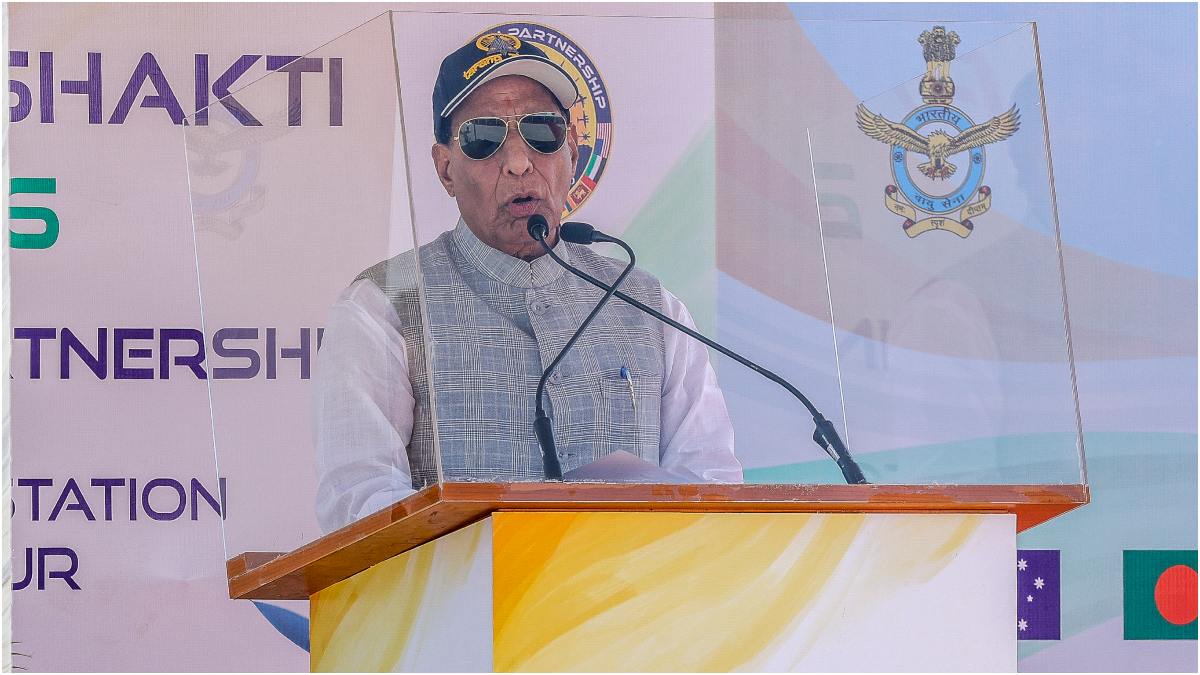
Defence Minister Rajnath Singh said the military strength of the future will be determined less by the number of aircraft, weapons and other platforms a country possesses and more by how quickly its armed forces can gather information, understand threats, make decisions and act.
Singh stressed that speed, precision, information and integration are emerging as the defining characteristics of military power as warfare undergoes a fundamental transformation driven by new technologies.
“Future military power will be defined less by the number of platforms we possess. It will be determined by the speed of sensing, understanding, deciding, and acting,” he said.
The defence minister made the remarks while addressing participants of the second edition of Exercise Tarang Shakti-2026 at Air Force Station Jodhpur on Saturday.
Singh said modern warfare was no longer confined to the traditional domains of land, sea and air. Military operations increasingly extend into space, cyberspace, the electromagnetic spectrum and the information domain.
He highlighted the growing role of unmanned systems, drones, artificial intelligence, electronic warfare and long-range precision weapons in shaping contemporary conflicts.
His remarks underscored the importance of armed forces being able to sense developments on the battlefield, process information, make decisions and respond rapidly.
According to Singh, the ability to integrate information and capabilities across different domains will become increasingly important as the nature of warfare continues to evolve.
He also called for continuous vigilance amid rapid geopolitical changes and uncertainties arising from technological advancements in the defence sector.
The defence minister said the Indian Air Force had undergone a significant transformation since Independence, evolving from a force operating on limited resources into a modern aerospace power.
He pointed to the IAF's advanced aircraft, precision weapons, sophisticated sensors, integrated networks and increasingly advanced indigenous technologies as evidence of this transformation.
Singh also emphasised that India's pursuit of self-reliance in defence was not intended to isolate the country from international cooperation. According to him, Atmanirbhar Bharat meant developing the domestic ability to design, develop, manufacture, maintain and upgrade critical defence technologies.
He highlighted several indigenous programmes and systems, including the Light Combat Aircraft Tejas, Dhruv, Rudra and Prachand helicopters, the Light Utility Helicopter, Akash air defence system, AESA radars and electronic systems.
He also referred to emerging unmanned and aerospace technologies as part of India's expanding indigenous defence capabilities.
Singh described the Advanced Medium Combat Aircraft (AMCA) programme as an important step towards mastering fifth-generation stealth fighter technology.
He underscored the importance of developing advanced aero-engines and pursuing co-production arrangements to strengthen India's aerospace capabilities.
The defence minister said India was keen to explore cooperation among like-minded countries in research, co-development, co-production, maintenance, training and innovation.
He stressed that trusted partnerships and resilient supply chains would become increasingly important as countries seek to develop and sustain advanced military capabilities.
“The defence relationships of the future will be about technology and trust, not just about platforms,” Singh said.
