



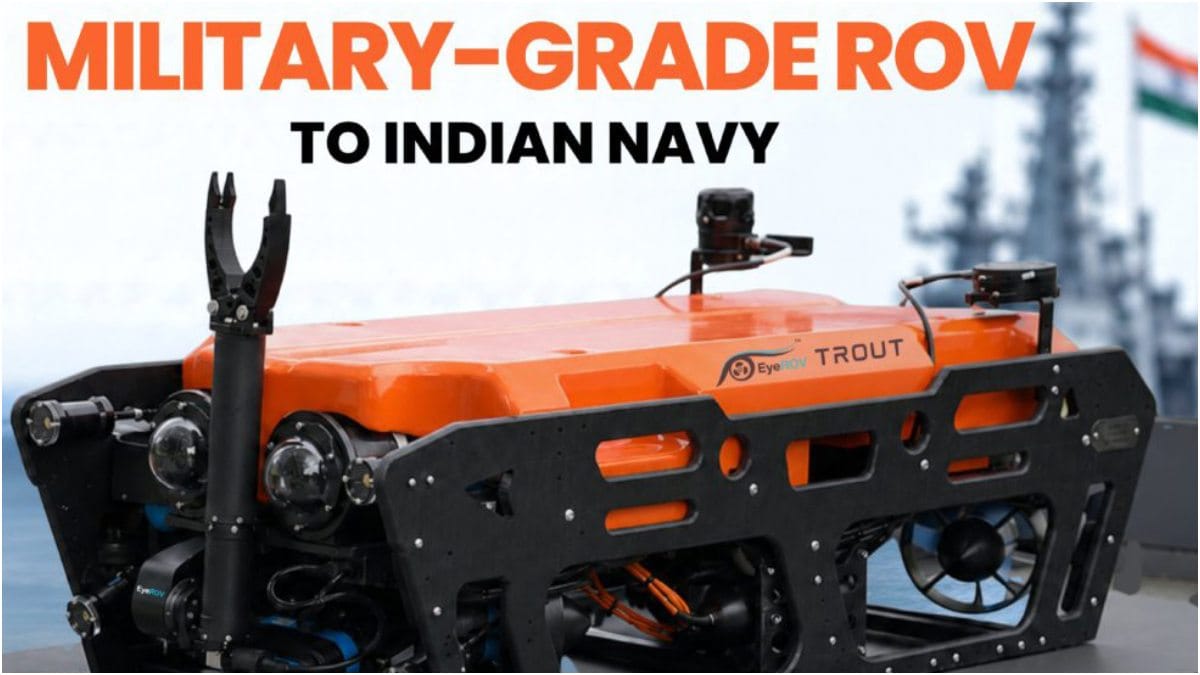
The Indian Navy is set to strengthen its underwater surveillance, reconnaissance and inspection capabilities as it took delivery of two EyeROV TROUT military-grade Remotely Operated Vehicles (ROVs) developed by Kerala-based marine robotics and AI company EyeROV.
The indigenous underwater robotic systems are designed to operate in challenging subsea environments, including deep waters, areas where there is poor visibility and locations affected by strong underwater currents. They can undertake missions that would otherwise be difficult or hazardous using conventional methods.
The two systems delivered to the Navy are part of an order for five EyeROV TROUT platforms. According to the company, TROUT is the first military-grade underwater ROV designed, developed, manufactured and qualified to military standards in India.
TROUT is a rugged, mission-ready underwater robotic platform capable of carrying out a range of naval and subsea operations.
Its primary applications include underwater inspection, surveillance, reconnaissance, search and recovery, detection and robotic intervention—capabilities particularly relevant to maritime security, underwater infrastructure protection, port and harbour security, and maritime domain awareness.
The system is designed to operate in underwater environments where poor visibility, strong currents, deep-dive conditions and limited accessibility can complicate conventional operations, according to a statement from the company.
Its ability to perform inspection and detection tasks in such conditions could provide the Navy greater flexibility in conducting underwater missions while reducing the need to expose personnel to hazardous environments.
Before its delivery, TROUT underwent extensive field trials and system-level validation to assess its suitability for demanding naval operations. The trials focused on manoeuvrability, deep-dive capability, performance in strong underwater currents, detection, navigation, endurance and operator control.
The platform also underwent the quality assurance framework of the Directorate of Quality Assurance (Naval), or DQA(N).
According to EyeROV, TROUT has been engineered to comply with Environmental Stress Screening (ESS) requirements under DGQAN policies and applicable military standards covering environmental and operational resilience.
The system has also completed type testing to verify that its design performs according to specifications under defined test conditions.
The company said these qualification processes distinguish a military-grade underwater robotic platform from a commercial underwater vehicle and support its readiness for sustained naval service.
Johns T. Mathai, CEO and Co-Founder of EyeROV, described the delivery as an important milestone for the company.
“What started as an ambitious indigenous engineering programme has now matured into a mission-ready underwater robotic platform for the Indian Navy,” he said.
Mathai added that the development validated India's ability to produce advanced marine robotic technologies domestically.
Kannappa Palaniappan P, CTO and Co-Founder of EyeROV, said developing a military-grade underwater robotic system required the integration of multiple technologies.
“Developing a military-grade underwater robotic system requires mechanical engineering, electronics, embedded systems, software, navigation, sensing, communication and robotic control to perform reliably as one integrated platform,” he said.
He described TROUT's deployment in the Indian Navy as an important validation of the company's technology and indigenous engineering capabilities.
Kochi-based EyeROV, formally known as IROV Technologies Private Limited, develops remotely operated underwater vehicles, unmanned surface vehicles, autonomous underwater vehicles and AI-powered analytics.
Its technologies are used across defence, maritime security, offshore energy, infrastructure inspection, environmental monitoring, scientific research and search-and-recovery applications.
