



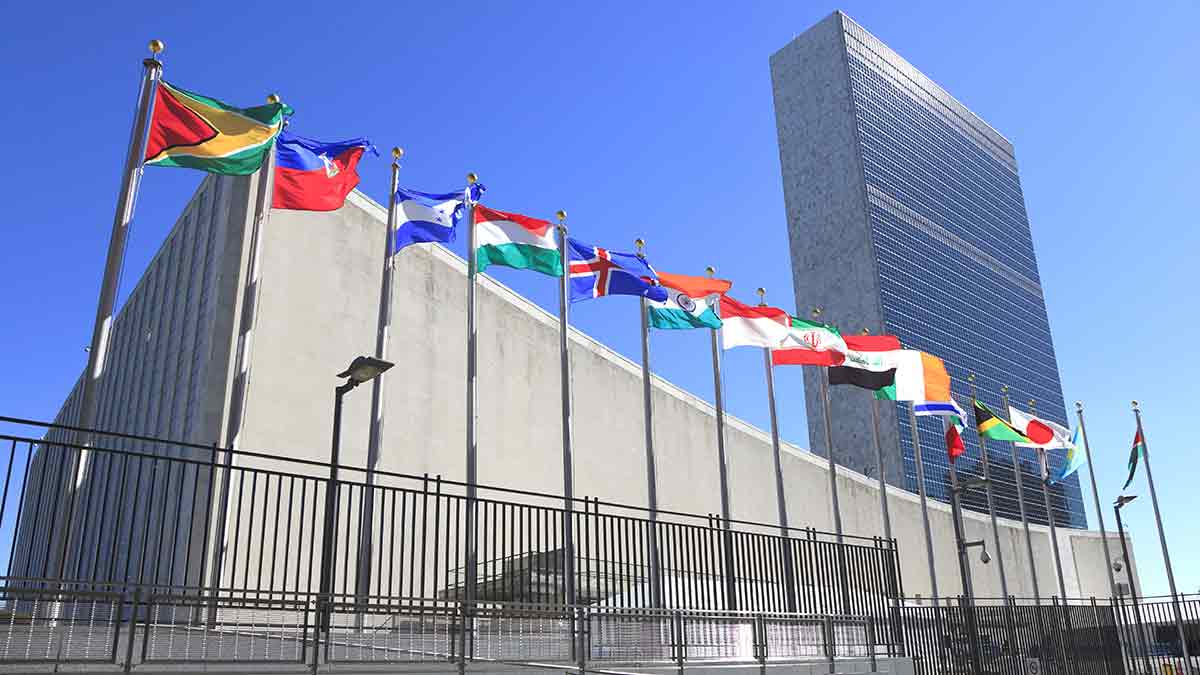
The 81st session of the United Nations General Assembly in New York ended much as it began: with world leaders talking loudly while wars raged unchecked across the globe.
There were impassioned speeches, bitter exchanges, and dramatic walkouts. Israeli Prime Minister Benjamin Netanyahu’s address was preceded by a mass departure of delegates protesting military operations in the Palestinian territories, to which Netanyahu responded with characteristic defiance.
The spectacle was more than diplomatic theatre; it served as a stark metaphor for the state of the United Nations itself.
Created in 1945 from the ashes of the Second World War to prevent another global conflagration, the UN remains humanity’s indispensable diplomatic forum. Yet, when confronted with today’s most dangerous conflicts, from Russia and Ukraine to Israel and Palestine, along with escalating confrontations between the United States and Iran, it appears increasingly incapable of fulfilling its core mandate: stopping wars before they consume nations.
The central question facing the international community is no longer whether the UN remains relevant. It is whether the UN, in its present form, is fit for purpose.
The achievements we forget
It is easy and fashionable to dismiss the UN as a talk shop. That assessment is historically inaccurate.
When 50 countries met in San Francisco to draft the Charter in 1945, humanity was recovering from total war. Today, the organisation has grown to 193 member states. That expansion reflects a monumental transformation.
The UN provided the principal framework through which newly independent nations across Asia, Africa, and Latin America entered the international system. Its decolonisation machinery helped more than 80 former colonies achieve self-determination. In 1945, roughly 750 million people lived under colonial rule; today, fewer than two million remain in non-self-governing territories.
Its peacekeeping record is similarly significant. Since 1948, the UN has deployed more than 70 operations involving hundreds of thousands of personnel. Over 4,400 peacekeepers have lost their lives in service. From the Congo and Cambodia to Mozambique, El Salvador, and Timor-Leste, UN missions have repeatedly created the space required for combatants to lay down arms and initiate political dialogue.
Beyond security, the UN’s specialised agencies form the backbone of global governance. They manage refugee crises, combat hunger, coordinate public health, protect children, and establish standards for aviation, telecommunications, and human rights.
The paradox of the UN is that its greatest victories are invisible: the epidemics prevented, the famines averted, and the border disputes that never escalated into headlines.
Built to fail: The veto problem
Despite these contributions, the UN’s central flaw was embedded in its founding structure.
The Security Council was designed around the power realities of 1945. Five victors of World War II—the US, the Soviet Union, the United Kingdom, France, and China—
were granted permanent seats in the Security Council (SC) and individual veto power.
This was a pragmatic bargain. The major powers agreed to participate in a collective security framework only because they held the power to block action against their core national interests.
That bargain, however, introduced a structural weakness. A single permanent member can paralyse the entire Council, even when the broader international community demands action.
During the Cold War, ideological rivalry frequently stymied the Council while proxy wars multiplied. Decades later, the structural problem remains unchanged:
- Ukraine: Russia’s position as a permanent member limits the Council’s capacity to address the war decisively.
- Gaza: Strategic use of the US veto continuously constrains collective action regarding ceasefires and humanitarian access.
- US-Iran dynamics: The UN struggles to intervene effectively when permanent powers themselves are active parties to a dispute.
The issue is not that the Security Council occasionally struggles to find consensus. The issue is that paralysis is an intentional feature of its architectural design.
When major powers choose to wage war, the UN discovers the limits of its power. The General Assembly can pass non-binding resolutions, the Secretary-General can issue moral appeals, and humanitarian agencies can attempt relief delivery. But without political will among the Permanent Five (P5), moral authority lacks enforcement capability.
Permanent diagnosis without treatment
Nowhere is this dynamic clearer than in the Middle East. For decades, the UN has affirmed the principle of Palestinian self-determination and supported a two-state solution based on pre-1967 borders.
Yet, the political process remains stalled. At a 2026 high-level meeting on the two-state framework, Secretary-General Antonio Guterres cautioned that conditions for a viable Palestinian state continue to erode under settlement expansion and systemic instability.
While broad international consensus exists regarding the ultimate objective, the institutional machinery to realize it is absent.
"A world organisation that repeatedly declares that a political solution is necessary but cannot help deliver it risks becoming an institution of permanent diagnosis without treatment."
The decline of the rules-based order
The broader challenge facing the UN is an erosion of the principles that defined the post-1945 era. The Charter was designed to replace the doctrine of ‘might is right’ with an international framework where territorial conquest and arbitrary force were prohibited.
That framework is coming under increasing strain:
- Power dynamics: Great-power competition is rising alongside global military expenditures.
- Coercive tools: Economic sanctions and trade restrictions are increasingly weaponised.
- Modern warfare: Drones, cyber capabilities, autonomous systems, and information warfare are evolving faster than international legal frameworks can address them.
If states conclude that international law applies only when enforced by superior military power, the world risks reverting to the dynamics that led to two world wars: defined spheres of influence, rigid military alliances, and territorial revisionism.
The modern geopolitical disconnect
To remain relevant, reform must begin with the Security Council.
The UN’s membership has nearly quadrupled since 1945, yet the composition of its highest decision-making body remains frozen in time. Africa holds zero permanent seats despite representing 1.4 billion people and a large share of the Council's agenda. Latin America has no permanent representation. India, home to over 1.4 billion people and one of the world's largest economies, remains excluded from permanent UN SC status.
This layout is increasingly viewed not just as an imbalance, but as a crisis of institutional legitimacy. The UN’s 2024 Pact for the Future acknowledged the need for a more representative and accountable Security Council, specifically noting historical underrepresentation across Africa, Asia-Pacific, and Latin America.
India and other emerging powers have repeatedly noted that an institution engineered eight decades ago cannot reflect contemporary geopolitical realities.
A pragmatic framework for Security Council reform
Expanding the Council cannot simply mean extending historical privileges to a new group of nations. Reform requires structural modification:
- Expansion of permanent seats: The Council should expand to include permanent representation for India, alongside designated permanent seats for Africa, Latin America, and underrepresented regions in the Asia-Pacific.
- Veto restrictions: Abolishing the veto entirely is unlikely, as the P5 will not vote to strip themselves of power. However, its application can be restricted. Permanent members should be barred from using the veto in cases involving genocide, mass atrocities, or major humanitarian crises.
- General Assembly accountability: Any exercise of a veto should automatically require a public debate and formal explanation before the General Assembly.
Permanent membership must carry greater international responsibility, rather than diplomatic immunity.
India’s role in global governance
For India, the pursuit of UN reform goes beyond securing a permanent seat; it involves shaping the rules of global governance.
India occupies a distinct position in modern diplomacy: it bridges the Global South with major global powers, maintains a history as a leading contributor to UN peacekeeping, and possesses significant economic weight.
Rather than focusing solely on Council membership, New Delhi can lead a broader reform agenda:
- Enhancing the authority of the General Assembly.
- Standardising predictable financing for global peacekeeping operations.
- Giving troop-contributing nations a greater voice in framing peacekeeping mandates.
- Strengthening conflict prevention and diplomatic mediation mechanisms.
Conclusion: The need for a second founding moment
Abandoning the United Nations is neither realistic nor desirable. There is no alternative global forum capable of convening 193 nations under one roof. Without the UN, smaller and developing nations would lose a critical platform to challenge larger powers, and global humanitarian coordination would collapse.
Preserving the UN, however, does not mean preserving its structural flaws. The organisation requires a foundational renewal.
Collective security is not an act of charity by powerful nations to weaker ones; it is an insurance policy for global stability. The world faces a clear choice: either the United Nations adapts to reflect twenty-first-century realities, or international diplomacy will bypass it entirely.
And if that happens, the institution created to prevent the return of ‘might is right’ may itself become one of its casualties.
(Lt Gen Philip Campose (Retired) is a former Vice Chief of the Indian Army. He has authored a book titled ‘A National Security Strategy for India: The Way Forward’)
(The opinions expressed in this article are those of the author and do not purport to reflect the opinions or views of THE WEEK.)
